
AMD Ryzen 7 9700X Review: Performance Gains, Power Consumption, and Overclocking Insights
Benchmark analysis demonstrates how the Ryzen 7 9700X balances lower power consumption with substantial gains in productivity and gaming performance.
Hardware by Nahe Yan on Nov 21, 2025
The CPU releases slated for 2024 didn't exactly set the world on fire. Initial assessments didn't set the world on fire, and AMD is willing to take its time with the 9000 series. The Zen 5's key advantage was its lower power consumption, which enabled the prospect of unlocked performance improvements.
The CPU releases slated for 2024 didn't exactly set the world on fire. Curiosity about whether tuning would yield notable performance benefits through lower power consumption increased as the price difference narrowed over time.
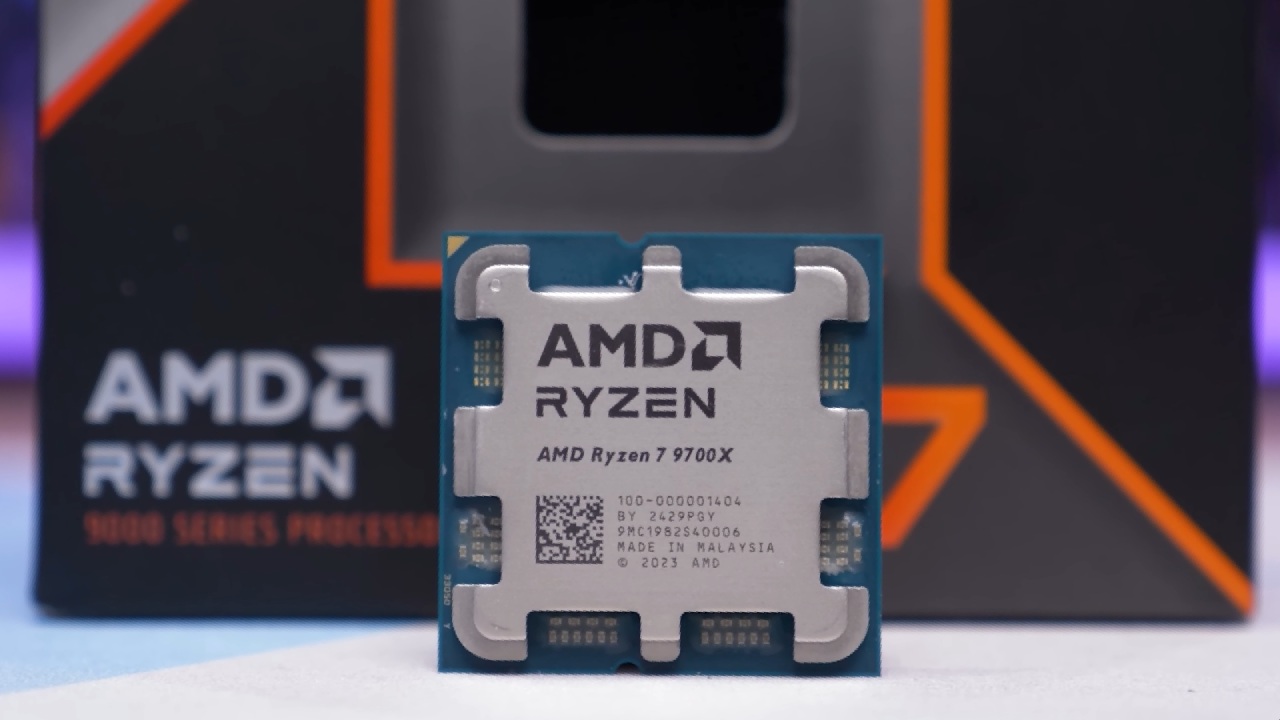
Test System and Tuning Methodology
We used a Strix B650E motherboard with an RTX 5090, a 280mm AIO, and 32GB DDR5-56000CL30 to test the CPU. We concentrated on precise boost overdrive rather than implementing a direct overclock. Performance behavior was shaped by reducing the curve optimizer by 20, setting the core boost to 200, and adjusting the power limitations.
Results of Cinebench 2024
Three sets of Cinebench numbers were collected: PBO enabled, RAM optimized using Buildzoid's sluggish Hynix timings, and stock with only XMP enabled.
The multi-core score rose from a level comparable to the 7700 to over 2200 points with memory adjustment. PBO enabled resulted in about 200 additional points. The stock, memory-tuned, and PBO outcomes differed noticeably as a result of these modifications.
AI Benchmarks with Geekbench Performance
Geekbench displayed an alternative pattern. Even in stock, the 9700X outperformed the 7700 by 10% in single-core and 5% in multi-core. PBO increased the score by several thousand points, and memory tweaking contributed an additional 6%.
While OpenVINO showed a slight improvement, ONNX's AI results showed no benefit from RAM tweaks or PBO. With an approximately two-thirds improvement over the previous generation, the larger lesson was the significant generational leap.
Notes on the 3DMark CPU Profiles
Smaller benefits from memory tweaking and larger gains through PBO were reflected in the 3DMark CPU Profile. The performance improvement over the 7000 series, which held across all load levels, was even more significant.
Benchmarks for Productivity: Blender and Resolve by DaVinci
At stock settings, productivity tests in Blender and DaVinci Resolve revealed only slight variations. The results changed significantly with PBO. A DaVinci Resolve H.264 output finished 37 seconds faster than the Blender classroom render, which finished 40 seconds faster. Higher power limitations and continuous clocks were directly linked to the gains.

Gaming Performance
In CS2 multiplayer testing, there was barely a 5% difference between stock, memory-tuned, and PBO configurations. The 9700X achieved some of the best CS2 results even when it was in stock, matching the 7800X3D and slightly outperforming it under PBO.
The 9700X was marginally slower than the 7700 in Cyberpunk 2077. However, it caught up with RAM tweaks and PBO, boosting performance by about 10% while still lagging behind the 7800X3D.
The 9700X matched or surpassed the earlier X3D model in certain RT settings thanks to Spider-Man 2's impressive performance, including a base performance marginally better than the 7700 and a 20% uplift after tuning.
Similar behavior was seen in The Last of Us Part II, where the PBO configuration matched or outperformed CPUs such as the Intel 285K and 7800X3D.
Baldur's Gate 3 was still reliant on V-Cache functionality. At stock, the 9700X lagged behind the 7700, but with tuning and PBO, it gained 14% and outperformed the 285K, falling short of the 7800X3D by almost 20%.
The stock 9700X underperformed the 7700 by roughly 5% in the Warhammer 40,000 Space Marine 2, and tuning only partially made up the difference. The X3D model continued to lead by a wide margin.
Hitman World of Assassination demonstrated an 8% improvement in the RT test with tuning and a 17% improvement in the regular benchmark. Due to GPU variations, older comparative data were not directly applicable.
Efficiency Trends at Different Power Limits
Although PBO tuning eliminated any efficiency benefit, it produced noticeable performance gains. As power constraints rose, Cinebench's performance per watt gradually declined. Efficiency at stock was less than 14 points per watt. It dropped to 12.6 at 105W, 10.6 at 130W, and below nine at 160W.
Although multi-core performance decreased to 962 points when the power restriction was lowered to 65W, efficiency increased to more than 16 points per watt, with actual consumption falling below 60W.

Final Thoughts
The comparison between AMD's current situation and Intel's trajectory more than 10 years ago is becoming increasingly popular. Beyond minor generational improvements, the 9000 lineup has little appeal because the 7000 series supports PCIe 5.0 and DDR5.
In some workloads, particularly with PBO tuning, we discovered that the 9700X can outperform previous models. In other situations, it can even come close to, or even match, an older X3D processor. In other contexts, the improvement seems insignificant.
Also, check our other AMD articles:
- AMD Ryzen 9 9950X3D Review: Setting The Standard For 2025 Gaming CPU
- AMD Ryzen 7 9800X3D Review: 3D V-Cache Goes God Mode with Stunning Gaming Performance
- AMD RX 9070 Performance Review: Thermals, Clocks, and Real-World FPS
- AMD Ryzen 5 7600 Review: Best Budget Gaming CPU of 2025?
- AMD Radeon RX 7800 XT Review: RDNA 3 Power For Midrange Gaming
- Sapphire NITRO+ AMD Radeon RX 9070 XT Review: The Ultimate 4K Gaming GPU
- AMD Ryzen 7 7800X3D: Delivers Gaming Performance Far Beyond Expectations
- AMD Ryzen 9 7900X Review: Powering the AM5 Era with DDR5 & PCIe 5.0
- ASRock Radeon RX 7800 XT Challenger OC Review: Best Price-to-Performance GPU of 2025
- Intel Core i9‑14900K vs. AMD Ryzen 7 7800X3D: Power Profiles & Gaming Benchmarks
Editor, NoobFeed
Gaming Hardware Updates
No Data.