
MSI GeForce RTX 5090 SUPRIM LIQUID SOC Review: All‑in‑One Liquid‑Cooled Gaming GPU
Explore the Suprim Liquid SOC’s compact three‑slot design and factory‑assembled AIO cooler for easy installation
Hardware by Masaru Hoshino on Jul 27, 2025
MSI Suprim Liquid SOC RTX 5090 is an all‑in‑one, liquid‑cooled graphics card that arrives ready to install right out of the box. Inside the box, you’ll find the water block, pump, tubing, and radiator—all connected and tested at the factory—so you don’t have to wrestle with separate parts or complicated fittings.
This card is shorter and slimmer than air‑cooled models, letting you fit it into more cases while still enjoying top‑tier performance. Because the heat generated by the GPU is moved away through the liquid loop, the Suprim Liquid SOC stays whisper‑quiet even during long gaming sessions or when you’re running demanding creative applications.
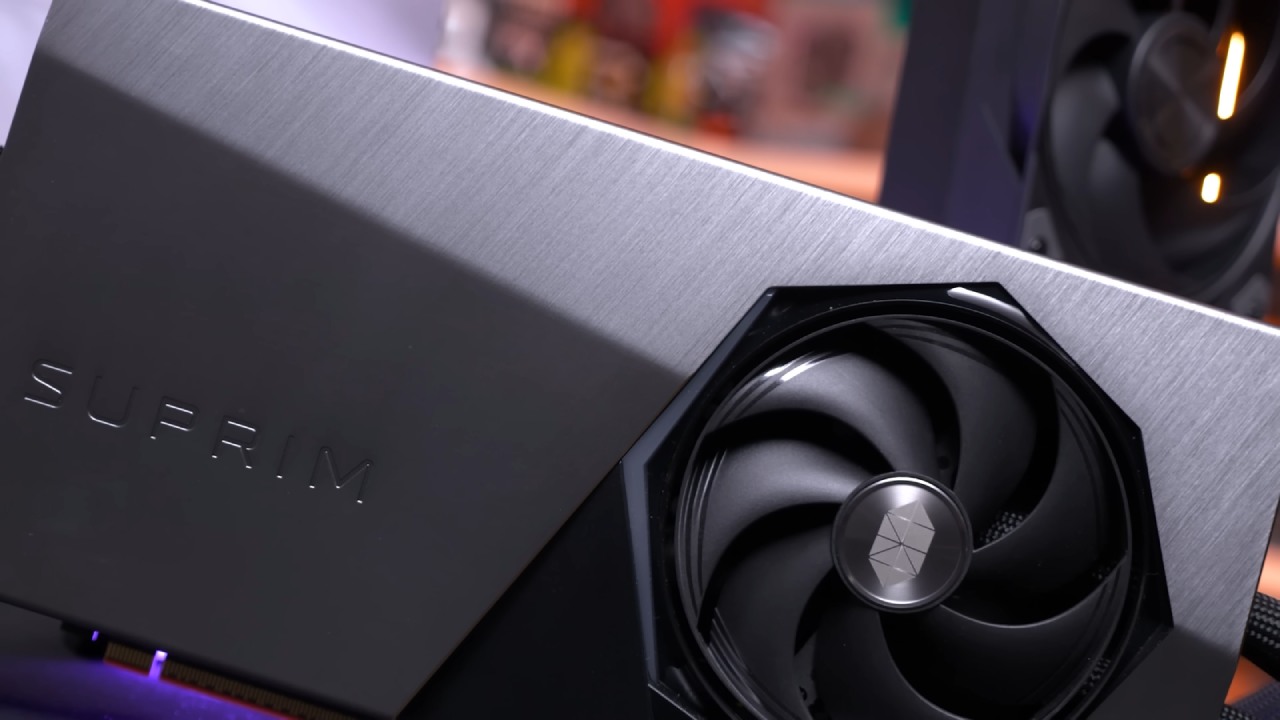
In short, it brings together ease of setup, compact design, and excellent cooling in one neat package.
Compact, Clean Design
As the name suggests, Suprim Liquid SOC is much more compact than its air‑cooled counterpart. The card itself measures just 280mm in length—22% shorter than the air‑cooled Supreme S—and occupies three slots at a height of 51mm, making it 33% thinner.
Weighing 44% less than Supreme S at only 1160g (the radiator and fans add 1604g for a total of 2764g), it greatly reduces stress on the PCIe slot. A single 95mm fan on the I/O end provides airflow over board components, resulting in a cleaner appearance and minimal visual clutter.
Premium Materials and Subtle Lighting
The front fascia features a large, brushed‑aluminium panel with aggressive angles and integrated LED accents. GeForce RTX branding is rendered in matte black to blend seamlessly into the design, and the dual‑bios switch lets you toggle between Quiet and Gaming modes in seconds.
On the backplate, a silver Suprim logo and more blacked‑out branding complete the refined aesthetic. Sleeved tubing to the radiator and recessed 12‑pin power connector maintain the card’s sleek profile.
360mm Radiator and Fans
The included 360mm radiator supports three 120mm StormForce fans that clip together via custom‑length sleeved cables, eliminating the need for cable management. While the radiator measures 27mm thick by itself, the fans bring the assembly to 55mm in depth and 394mm in length—standard dimensions for easy installation in any modern ATX case with dual‑rad support.
GPU Teardown and Build Quality
Disassembly involves 23 screws to remove the backplate and cooler from the PCB, with an additional seven screws to separate the copper water block from the heat spreader. The PCB (220mm×145mm) is identical to the air‑cooled Supreme S, featuring 22 power stages for the GPU and seven for GDDR 7 memory—all using 50A power stages.
The hybrid heatsink (388g) supports power‑delivery cooling and prevents PCB flex. The 5 mm copper block—un‑nickel‑plated but precision‑machined—minimizes thermal‑pad thickness for the memory chips, though screw cutouts leave small sections without direct contact.
.jpg)
Thermal Performance
In a 21°C room, one hour of The Last of Us Part One at 4K max settings saw the GPU peak at just 55°C with only 1000 rpm radiator fans, and GDDR 7 memory at 72°C. Switching to the Gaming BIOS raised fan speed to 1200 rpm, dropping peak GPU temperature to 53°C and memory to 70°C—an outstanding showing given the >500 W load.
Overclocking Results
Out of the box, Suprim Liquid SOC boosts to 2565 MHz with 28 Gigabit memory. We pushed the core to 2815 MHz and memory to 30 Gbits, achieving a stable 3300 MHz under load at an average power draw of 540 W.
Temperatures remained remarkably low at 54°C for the GPU and 72°C for the memory, with fans spinning at just 1300 rpm.
Comparative Thermal Analysis
Against NVIDIA’s Founders Edition, Suprim Liquid SOC ran 22°C cooler at stock settings and 14°C cooler in Gaming BIOS mode. When noise‑normalized to 40 dB, it remained 16°C cooler than Supreme S and 24°C cooler than the FE model. Memory temperatures also improved by up to 24°C under noise‑normalized conditions.
Gaming Benchmarks
In Dying Light 2, Suprim Liquid SOC was 2% faster than FE stock and 7% faster once overclocked, and 3% ahead of the overclocked air‑cooled Supreme S. The Last of Us Part One saw a 5% gain stock and 10% gain when overclocked.
In Deathloop, we recorded 177 fps—6% faster than FE stock and 4% faster when overclocked. Marvel’s Midnight Suns yielded typical gains of 2% stock and 8% overclocked.
.jpg)
Power Consumption
Power draw was roughly 10% higher than Founders Edition but about 4% lower than air‑cooled Supreme S. Considering the significant thermal advantages, the slight increase is a fair trade‑off.
Final Thoughts
MSI’s Suprim Liquid SOC RTX 5090 delivers the best thermal performance we’ve seen from any RTX 5090 variant. Its compact, dual‑slot card and quiet pump make it ideal for high‑end builds, provided you have space for a 360mm radiator.
Concerns remain over long‑term durability—pump lifespan and potential corrosion—but early results are impressive. Availability and pricing are currently prohibitive: base‑model RTX 5090 MSRP is $2000 US, while Suprim Liquid SOC lists at $2800 US (40% above MSRP).
Other brands, like ASUS and Gigabyte, are charging even more. At today’s inflated prices and scarce stock, we can’t recommend buying right now, but if availability and affordability improve, liquid cooling a high‑end GPU like this makes perfect sense.
Check Our Other NVIDIA Articles:
- GeForce RTX 5090 Unleashed: Is NVIDIA's New Flagship the Ultimate 4K Gaming GPU?
- NVIDIA GeForce RTX 5080 Review (2025): Still A 4K Gaming Powerhouse?
- RTX 5090 Performance Testing In GTA 5 – 1080p, 1440p, and 4K Max Settings Benchmark
- RTX 5090 Laptop Vs. M4 Max MacBook Pro: Ultimate Raw Performance Vs. Battery Endurance
- NVIDIA RTX 5070 Review: Mid-Range Muscle or Marketing Hype?
- RTX 5070 Ti Review: Performance, Thermals & Power Efficiency Tested
- Asus ROG RTX 5090 Astral OC Vs. Founders Edition: The 4K Gaming Benchmark
- ASUS ROG Astral RTX 5090 OC Edition Review: 32GB GDDR7 & 4K Gaming Benchmark
- ASUS GeForce RTX 5090 LC Liquid Cooled GPU Review: Unmatched Silence & Speed
- MSI GeForce RTX 5090 32GB SUPRIM SOC Review: Power Efficiency, Cooling, and Gaming Performance
- NVIDIA GeForce RTX 5050 Review: Specs, Gaming, and Pricing Versus Rivals
- Colorful iGame GeForce RTX 5050 Review: Price, Specs, Power Efficiency, Gaming
- INNO3D RTX 5060 Ti 16 GB X2 Review: Gaming Benchmarks, Temps, and Power Efficiency
- HP Omen 45L Review: RTX 5090 Performance, Thermals, and Value Analysis
- ASUS TUF Gaming GeForce RTX 5060 Ti Review: DLSS 4, Power Efficiency, and Gaming
- ASUS Prime RTX 5060 Ti OC 16GB Review: DLSS 4, Ray Tracing, & Thermals Tested
- NVIDIA GeForce RTX 5060 Review: Specs, Gaming, and Cost per Frame
- MSI GeForce RTX 5090 GAMING TRIO OC Review: A Monster Power GPU
Editor, NoobFeed
Gaming Hardware Updates
No Data.