
Forza Horizon 5 4K Performance Test Featuring RX 9070 XT and 32GB RAM
1080p maximum settings consume over 10GB VRAM highlighting memory requirements in modern titles.
Hardware by Shinji Okazaki on Feb 14, 2026
Forza Horizon 5 highlights how well current GPUs work at their highest settings and at different resolutions. This RX 9070 XT has the newest drivers, a factory overclock, a Ryzen 7 98H00X3D processor, and 32GB of RAM.
We test 4K, 1440p, and 1080p using TAA and MSAA anti-aliasing. We don't use resolution-scaling options like FSR2.2 and XSS because they don't improve visuals or frame rate much.
.jpg)
Setting Up the Test and Graphics
There is a big fan on the XFX Pro Gaming Mercury-class GPU that works in a room that is 13°C. All of the graphics settings are made by hand to their highest possible levels instead of using presets. Since TAA anti-aliasing keeps things clear without getting too fuzzy, it's the first one we use.
This is better than many Unreal Engine games. MSAA testing is done separately to see how well the system works. Resolution scaling is disabled, so the original rendering results remain the same.
Results of 4K Performance
At 4K resolution, Performance stays over 100 fps most of the time. Still, it can drop to approximately 90 fps in heavy areas like tunnels. The average frame rate is about 116 fps, and the lowest is roughly 96 fps. The game runs well, with consistent frame times and no obvious stuttering.
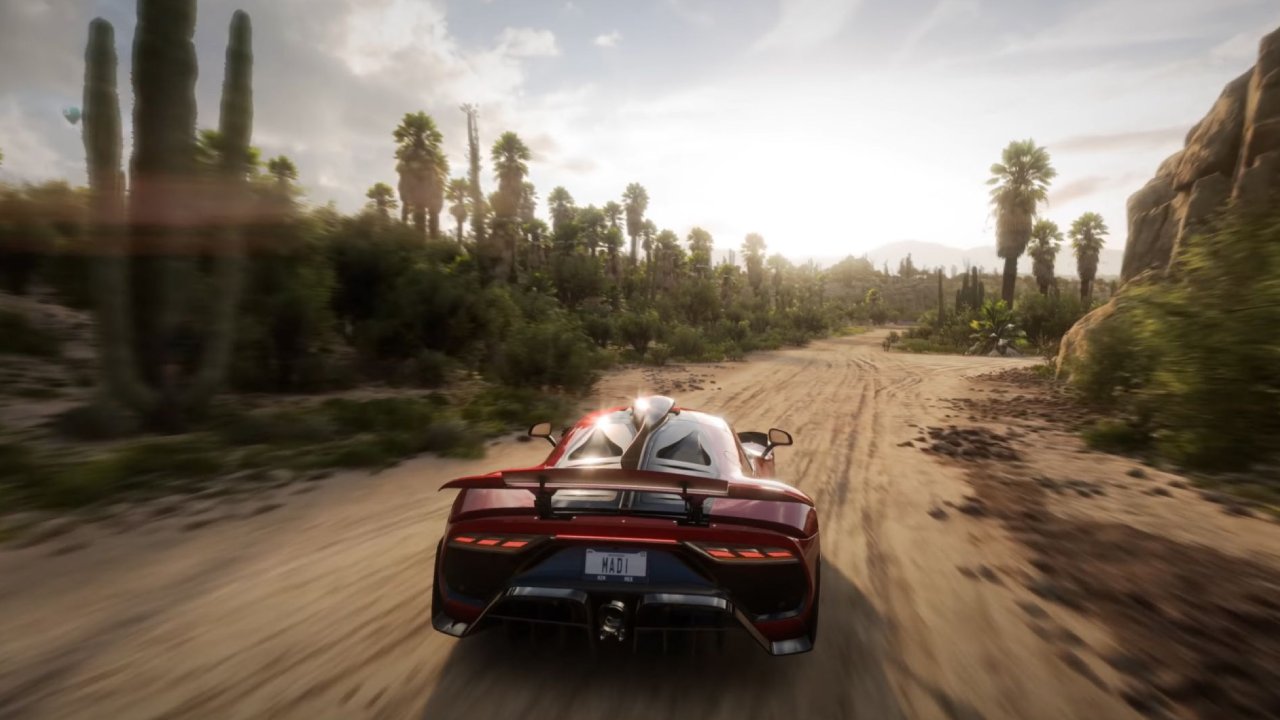
Without ray tracing, reflections remain accurate and reveal environmental features, such as checkpoints, even when they're not on-screen. Using screen-space and cube-mapping approaches, the game engine handles reflections well. Ray tracing is only possible in photo mode, which helps keep the game running smoothly.
A Comparison of TAA and MSAA for Anti-Aliasing
When you switch to 4xMSAA, the frame time becomes unstable and stutters in ways you didn't expect. Even though VRAM utilization is about the same, 1% lows drop a lot. The image sharpness increases a little, but the plants flicker and shimmer more often. Going back to TAA eliminates stuttering and stabilizes the frames again.
Turning off anti-aliasing increases the frame rateslightly but also makes surfaces and plants shimmer more. TAA is still the best setting for balancing Performance and clarity.
Observations about Frame Generation and Upscaling
You can only make frames in this game on Nvidia hardware. Even if they are available, artifacts like ghosting and mirror shadow duplication make the picture look worse. At native resolution, frame creation isn't needed because the fps performance is already very high.
Results for 1440p Performance
At 1440p, the frame rate is usually close to 200fps during typical gameplay and stays around 150fps in busy city sections. When you go through a tunnel, your fps may drop to 120–130. 1% lows stay steady at 125fps, while frame time graphs stay flat.
Using Ultra settings instead of Maximum settings can boost Performance to over 200 fps while maintaining the same visual output with only minor variations.
Performance at 1080p and VRAM Usage
At 1080p, VRAM utilization reaches roughly 11GB. If a GPU has only 8GB of VRAM, it may stutter and slow down due to memory limits, even if its raw computational capability is sufficient.
This shows why modern games at their highest settings are hard for GPUs with less than 12GB of VRAM to handle, even at reduced resolutions.
Performance in Race Scenarios
When racing at 4K resolution, the frame rate stays the same as it does in normal gameplay. At 1440p race scenarios, the average frame rate is about 172 fps, while the lowest frame rate is about 141 fps Even with a lot of automobiles and reflections on at the same time, Performance stays the same.
Quality of Reflection and Rendering Without Ray Tracing
The game shows that tuned screen-space reflections can provide high-quality visuals without ray tracing. Environmental reflections are still visible on car surfaces with little effect on Performance. In many cases, this shows that optimization can compensate for the lack of ray tracing.
Limitations of 8K Testing and Resolution Scaling
When you use virtual super-resolution scaling on Radeon hardware, the fps are higher than when rendering natively. This means that comparing with genuine native 8K is not valid. So, to be sure, testing is only done at the native resolution.
Comparing Optimization to Modern Games
To achieve similar frame rates, many modern games need to render at 1440p, even though the visual quality isn't much better. Optimization quality is more important for consistent Performance than ray tracing or heavy graphical effects.
Final Thoughts
At the highest settings for 4K, 1440p, and 1080p, the RX 9070 XT keeps a steady, high frame rate. Your graphics will stay stable and the game will run well with TAA. When MSAA is used, this GPU may have trouble keeping the frames stable. If you want to play current games at their best settings, your VRAM needs to be at least 10GB. Performance stays the same because of strong engine tuning, not fancy rendering technology.
Also, check our other AMD articles below:
- AMD Ryzen 9 9950X3D Review: Setting The Standard For 2025 Gaming CPU
- AMD Ryzen 7 9800X3D Review: 3D V-Cache Goes God Mode with Stunning Gaming Performance
- AMD RX 9070 Performance Review: Thermals, Clocks, and Real-World FPS
- AMD Ryzen 5 7600 Review: Best Budget Gaming CPU of 2025?
- AMD Radeon RX 7800 XT Review: RDNA 3 Power For Midrange Gaming
- Sapphire NITRO+ AMD Radeon RX 9070 XT Review: The Ultimate 4K Gaming GPU
- AMD Ryzen 7 7800X3D: Delivers Gaming Performance Far Beyond Expectations
- AMD Ryzen 9 7900X Review: Powering the AM5 Era with DDR5 & PCIe 5.0
- Intel Core i9‑14900K vs. AMD Ryzen 7 7800X3D: Power Profiles & Gaming Benchmarks
Editor, NoobFeed
Gaming Hardware Updates
No Data.