
Stellaris: Shadows of the Shroud Review
PC
Harness the unknown, bend reality, and shape your empire through the mysteries of Shadows of the Shroud DLC.
Reviewed by Mezbah Turzo on Sep 22, 2025
Few strategy games capture the sheer scope of galactic ambition quite like Stellaris. Part 4X, part grand strategy, puts you at the helm of an interstellar empire. It challenges you to guide it through exploration, diplomacy, warfare, and all the messy politics in between.
What makes it stand out isn't just the scale, but the way each playthrough feels like its own sprawling space opera; one galaxy might see you leading benevolent explorers spreading knowledge, while the next has you ruling with an iron fist as a cybernetic hive.
It's this endless blend of storytelling and strategy that's kept players coming back since its launch, and why each new expansion promises not just new mechanics, but new stories waiting to unfold among the stars.
Stellaris has been around for quite a while now, and over the years, Paradox has shaped it into a very different game from the one that launched back in 2016. In Paradox DLCs fashion, A huge part of that evolution has come through its long line of DLCs, which have steadily layered on new systems, civics, origins, and story events.
Some of these expansions have been transformative, reworking how planets, warfare, or diplomacy function, while others lean more toward roleplaying flavor, giving players fresh ways to shape the identity of their empires. At this point, if you want to play Stellaris, you nearly always have to deal with part of this DLC ecosystem. Every new release raises the issue of whether it's a must-have for long-time fans or just a "nice-to-have."
The most recent expansion keeps that tradition alive by trying to make the galaxy seem like it's always changing, even after over ten years of updates. The newest expansion, Shadows of the Shroud, follows in the footsteps of previous Stellaris DLCs by carving out a fresh thematic niche while tinkering with the core galactic sandbox.
Where older releases like Utopia reshaped empire-building through ascension paths, or Nemesis injected tension with espionage and galactic threats, Shadows of the Shroud positions itself somewhere in between. It offers both mechanical tweaks and new narrative flavor, while also topping up the final DLC of the main ascension paths through Psionics.
At its heart, it's about Psionics, the fancy space wizard stuff, that was the only remaining area of the game's ascension mechanic that was left untouched by DLCs and updates. It is designed to give players yet another layer of identity and challenge as they guide their civilizations among the stars. It may not be as sweeping a rework as some of Stellaris' landmark expansions, but it aims to stand alongside them by broadening the types of stories you can tell in your galaxy.
At its core, Stellaris follows a loop that's as elegant as it is expansive. You begin at the dawn of your empire's spacefaring age, sending science ships into the unknown to explore star systems and catalog their secrets with research ships. Expansion comes next: surveying planets, establishing colonies, and staking claims on chokepoints before rival empires close in.
As your borders grow, so do the challenges; balancing resources like energy, minerals, and alloys, managing the happiness of diverse populations, and building up fleets to deter (or invite) conflict. Diplomacy and warfare are constant companions in this loop. You'll find yourself brokering trade deals, forming federations, or simply subjugating weaker neighbors, all while keeping an eye on galactic politics and looming crises.
Layered on top of this is the RPG-like depth Paradox is known for; ethics, civics, and ascension paths shape not just your strategy but your empire's story, ensuring no two campaigns unfold the same way. What makes Stellaris shine is how it threads storytelling into mechanics: every anomaly, every first contact, every unexpected war becomes part of your empire's evolving saga.
The real meat of Shadows of the Shroud comes from its new origins, civics, and a full rework of Psionics. The new origins especially push you into radically different playstyles. The Endbringers' origin is the wildest of the bunch, and easily the hardest.
Instead of being a standard empire, you're effectively playing as a proto-crisis, with your ultimate goal being nothing less than the annihilation of reality itself. It flips the normal loop of growing, allying, and surviving into one where you deliberately set the galaxy on fire, watching as everyone scrambles to resist your doom.
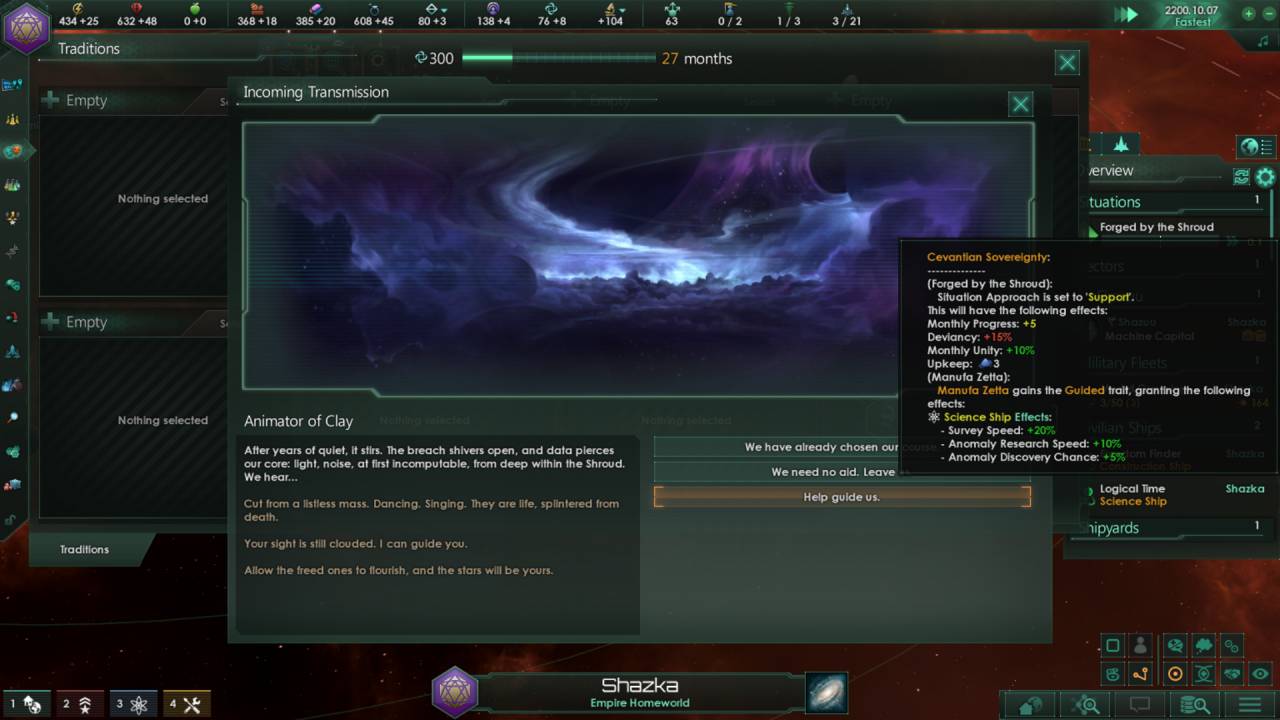
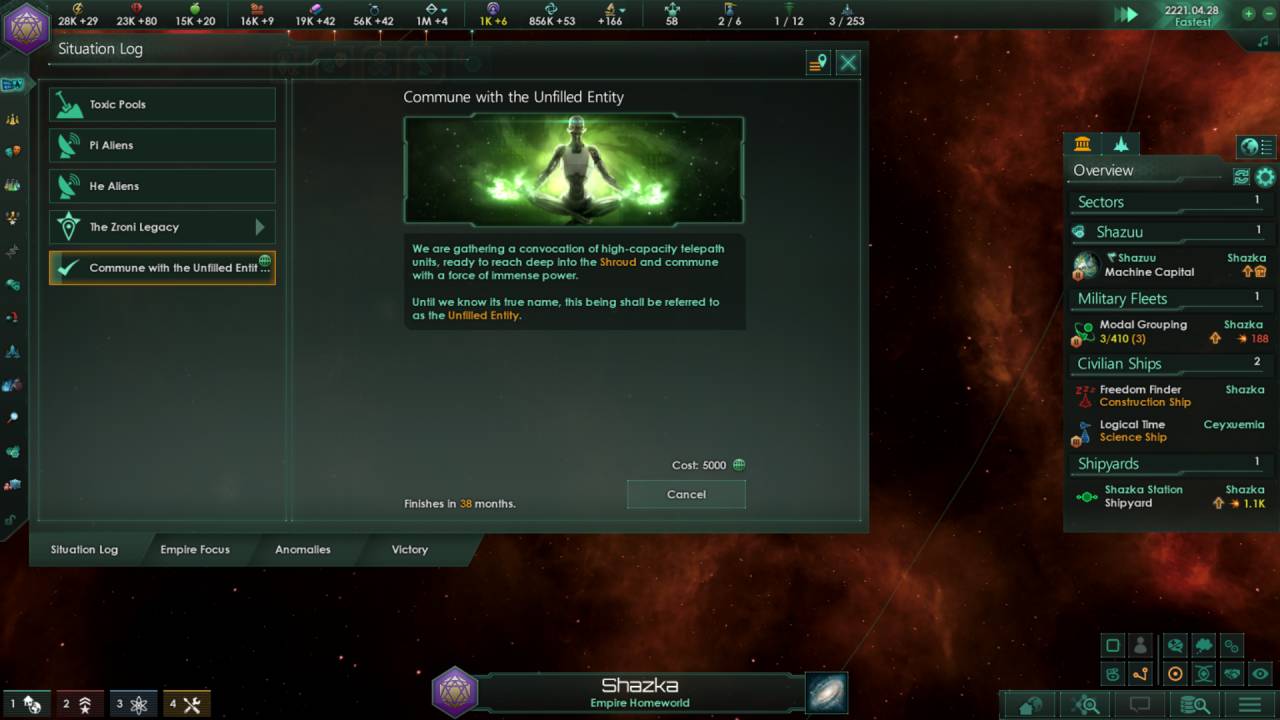
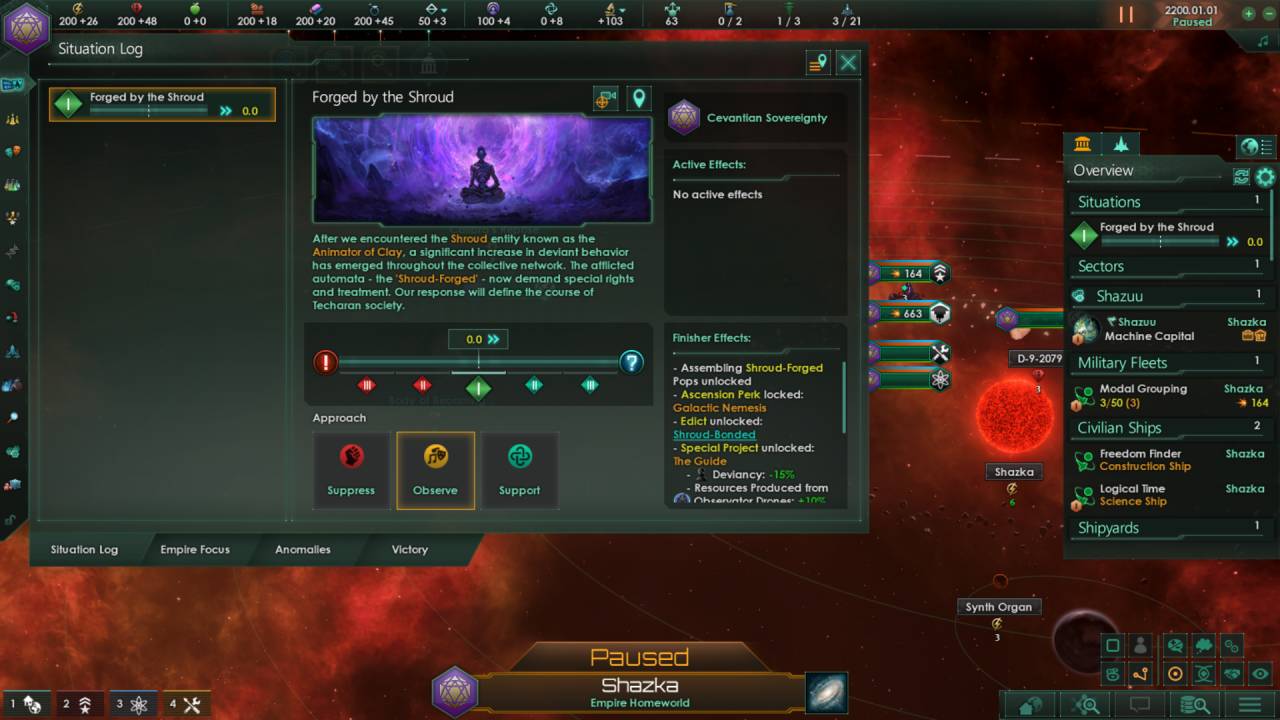
For a more narrative-driven start, the Shroud-Forged origin (for machine empires!) is fascinating. Machines have long been locked out of Psionics, but this origin finally lets them reach beyond their logic circuits into the unknowable. You can choose to pursue Psionics or not, but the journey is loaded with storytelling potential as your empire wrestles with being both machine and mystic.
Then there's the Mindwarden; arguably the strongest and most interesting origin. Instead of embracing the Shroud, you resist it. You form the first Mindwarden enclave, essentially a psionic counterweight to the galaxy's growing mysticism.
These enclaves act like mercenary contractors, but with a thematic twist: you're leading an anti-psionic crusade, gaining special buffs and tools to dismantle psionically ascended rivals. It's a refreshing inversion of the usual "all must ascend" path, and a blast to play.
The DLC also introduces six new civics (four general, two bio-exclusive). The standouts are Chosen and Entropy Drinkers, both of which lock you into psionic ascension from the start. Chosen is particularly bold, tying your empire directly to a Shroud entity from day one; it's powerful, but forces you to play by that entity's rules.
Entropy Drinkers, meanwhile, are all about feeding on unraveling reality, eventually pushing you into Psionics whether you like it or not. The others, like Secret Societies and Experimental Sentencing, offer a more general flavor, but Secret Societies is worth highlighting because it introduces Proxy Wars, letting you spark conflicts between rivals from the shadows and swoop in afterward to reap the benefits.
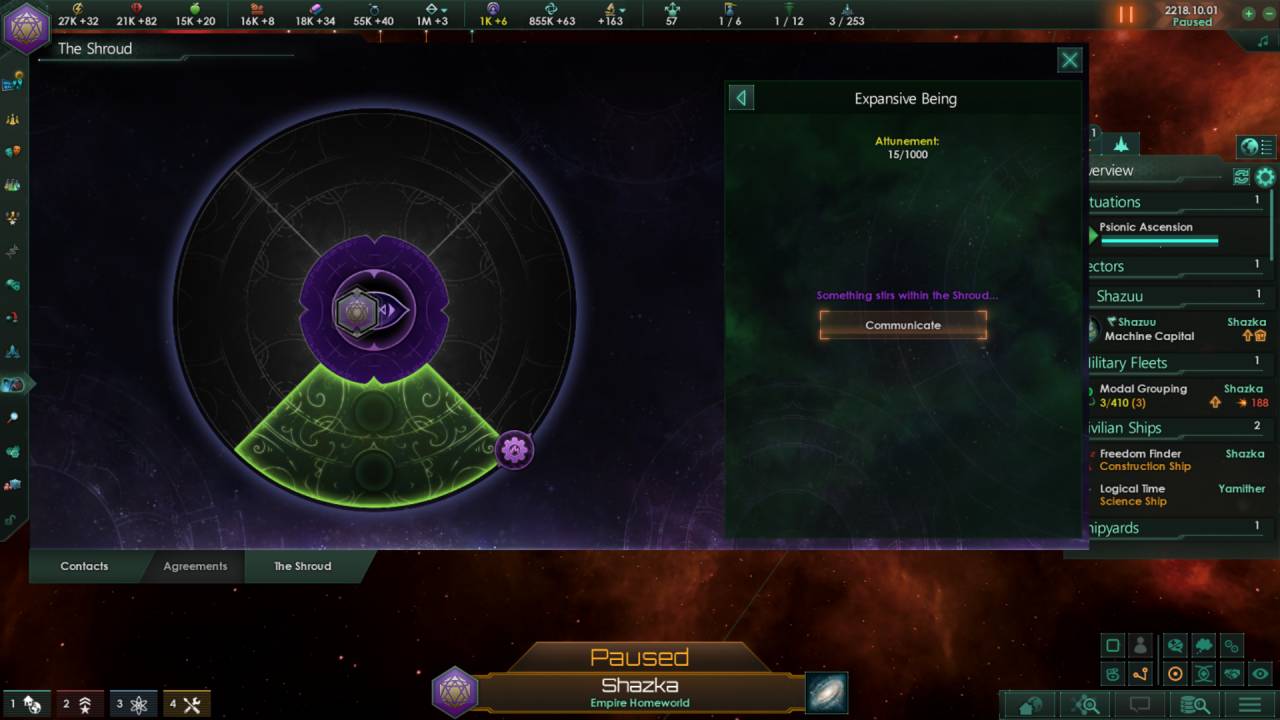
Traits round out the customization, with new psionic-only options letting you craft some truly bizarre "space wizard" species builds. But the biggest overhaul is, of course, the psionic ascension path itself. It still begins with the familiar Mind Over Matter perk and psionic traditions, but now grows into something much deeper. Your people gain psionic traits, your leaders develop psychic talents, and a sprawling new "Shroud map" opens up.
Instead of the Shroud being a random event generator, it's now a political space filled with major and minor entities, each with its own agenda. You can court them, align with them, or even strike formal covenants; deals that grant immense powers but often carry devastating long-term costs.
This expansion also brings a cascade of new events, situations, buildings, and ship weapons, all dripping with psionic flavor. The ability to dive into the Shroud repeatedly gives the path a sense of progression and danger it always lacked. The new weapons, in particular, are some of the strongest in the game, rewarding those willing to walk the razor's edge of eldritch bargains.
Overall, the reworked Psionic Ascension path is still very much a late-game powerhouse. In most runs, you won't truly unlock its full potential until dozens of in-game years have passed, but once you do, it's transformative.
The crown jewel here is the addition of psionic auras. These auras, tied to the patron you've aligned with in the Shroud, radiate outward across your empire. They grant you significant buffs while weakening your enemies in the surrounding space, giving you the feeling of bending reality itself to your will. The catch is patience: it takes a long time for these effects to mature, but when they do, you become a near-unstoppable galactic force.
On the flip side, there's the Mindwarden path, designed to counter this kind of power creep. If you'd prefer to fight against Psionics than join them, their enclaves and special benefits enable you to hold the line against Shroud-corrupted civilizations, which makes those scary psionic auras less powerful. It's a nice check-and-balance system that makes conflicts in the late game a lot more interesting.
As with nearly every Stellaris expansion, Shadows of the Shroud also brings a suite of new cosmetic options to flesh out your empire. New portraits showcase how psionic transformation visibly alters your species over three distinct stages, while additional backgrounds, advisor voices, shipsets, and cityscapes add flavor to your playthrough. It's a small touch, but these visual and auditory upgrades help reinforce the sense that psionic empires really are walking a stranger, more dangerous path.
All in all, Shadows of the Shroud is a fantastic addition to Stellaris, delivering exceptional value for fans of the Psionic Ascension path. It's by far the most thematic and mechanically rich of the recent ascension-focused expansions, adding entirely new origins, civics, events, and systems that feel both fresh and surprising.
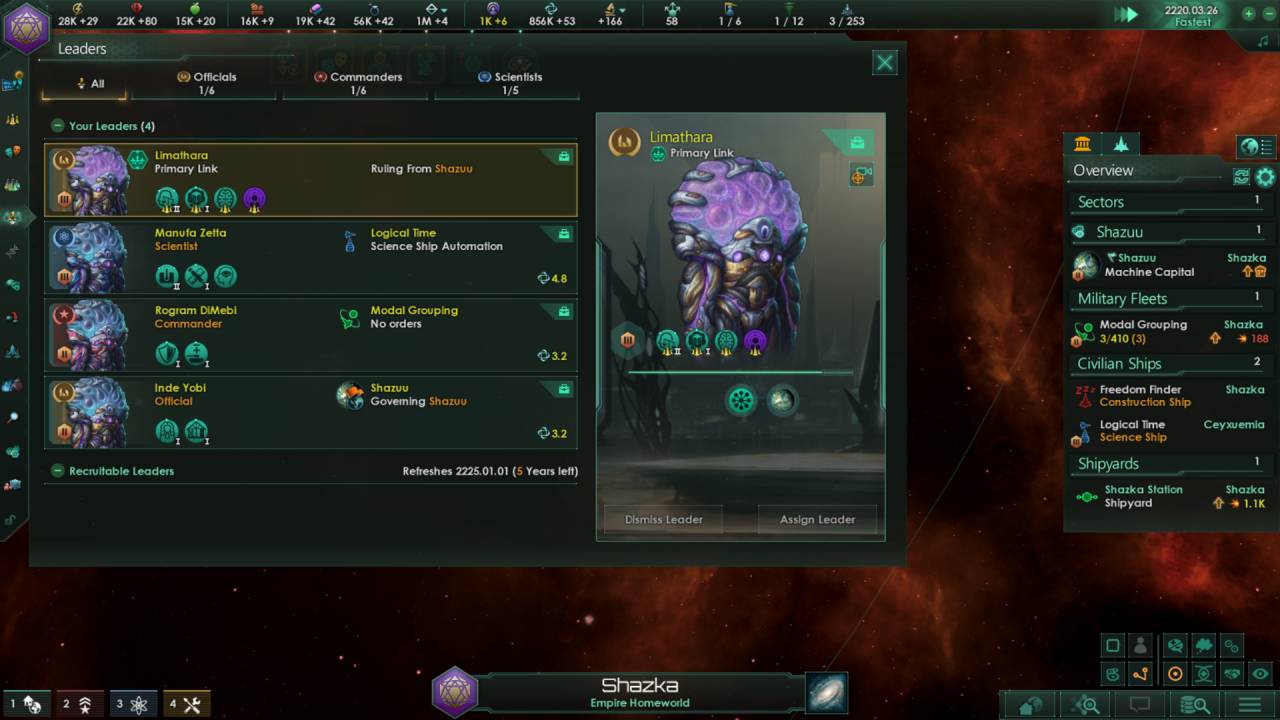
Whether you're forging pacts with mysterious Shroud entities, unleashing psionic auras across your empire, or experimenting with the Mindwarden counterplay, there's a lot here to explore and enjoy. For anyone who loves the narrative and strategic possibilities of Psionics in their 4X, Grand Strategy game, this DLC is a must-have.
That said, it's not without its caveats. The full power of the expansion is decidedly late-game, and it can take a good while before you truly feel its impact. Also, those who want bigger improvements to the game or more diverse material outside of Psionics may find this expansion a little limited compared to older ones like Biogenesis. Still, for anyone who is interested in the story and mystical aspect of Stellaris, it's a fun, well-made, and satisfying game.
Contributor, NoobFeed
Verdict
Shadows of the Shroud is a must-play for psionic enthusiasts: thematic, deep, and surprisingly fresh, even if its full power unfolds only in the late game.
85
Related News
No Data.