

MSI Claw 8 EX First Look: Intel Arc G3 Extreme Dominates the Handheld Gaming Market
Intel Arc G3 Extreme delivers substantial graphics gains while pushing handheld gaming performance to new competitive levels.
Hardware by Nakiro on Jun 24, 2026
Handheld gaming PCs are evolving rapidly, with manufacturers pushing for higher performance, improved efficiency, and console-like gaming experiences in small form factors.
Intel's latest handheld-focused CPU, the Arc G3 Extreme, is a big step forward for this segment. Designed specifically for handheld gaming devices, the new chip debuts inside MSI's latest Claw 8 EX AI Plus, promising substantial gains in both CPU and GPU performance while maintaining competitive battery life.
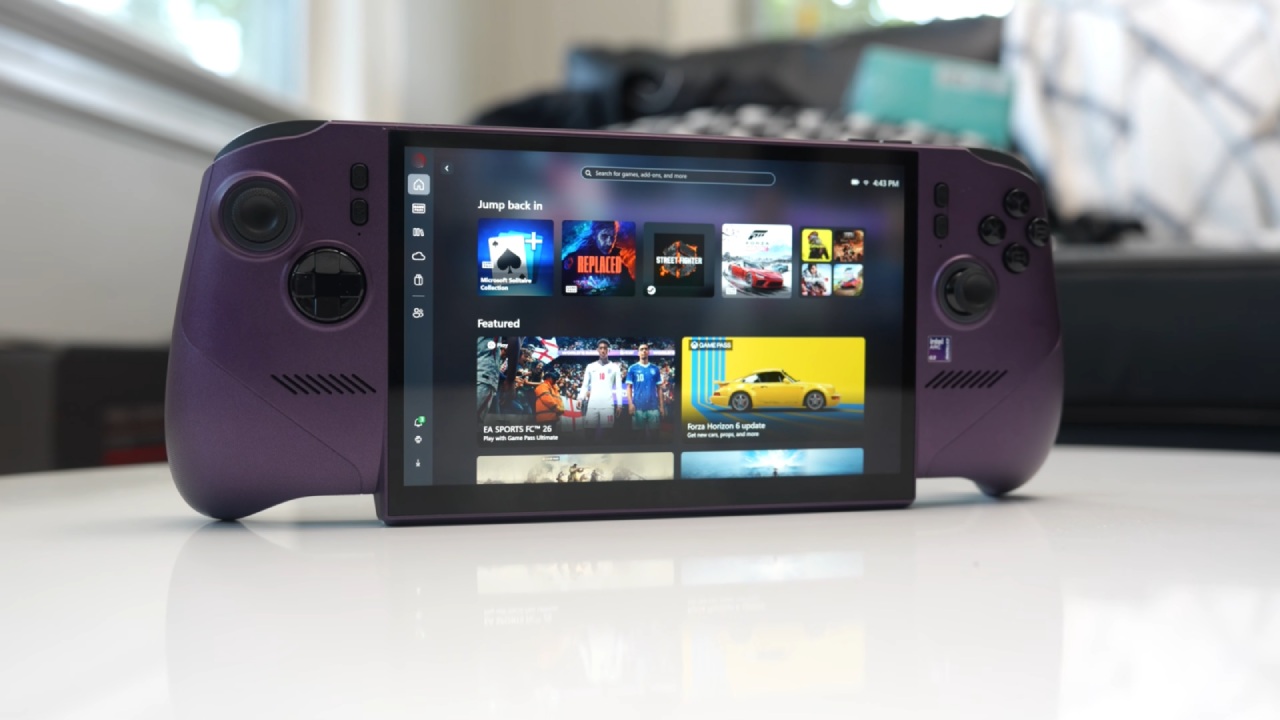
MSI Claw 8 EX AI Plus Overview
The MSI Claw 8 EX AI Plus arrives with several upgrades over previous Claw models. Although the review unit included additional accessories such as a Thunderbolt dock and low-latency Bluetooth earbuds, the retail package includes a 65W charger that quickly tops up the device.
The handheld features a large 8-inch 120Hz VRR display, essentially the same panel seen in the Claw 8 AI, but many other aspects have changed. MSI has introduced a new metal-dome D-pad, upgraded LRA vibration motors, and a redesigned chassis featuring a laser-etched dot texture on both the front and rear for improved grip.
On the rear, larger cooling fans measuring 5mm more than the previous design help manage temperatures. The increased cooling capacity is particularly important because the Arc G3 Extreme can operate at up to a 35W sustained TDP, compared to the previous Claw 8 AI's 30W limit.
The top-mounted I/O includes a power button with an integrated fingerprint sensor, two USB4 ports operating at 40Gbps, a microSD card slot, a 3.5mm audio jack, and a volume rocker. Shoulder buttons and triggers complete the control layout.
At launch, MSI is offering the device exclusively in a Void Purple colorway. While the large lower bezel beneath the display may initially seem unusual, the ergonomic design significantly enhances comfort. The device feels remarkably similar to holding an Xbox controller, with grips that fit naturally into the palms and allow easy access to every button.
New Controls and Improved Ergonomics
The D-pad has received a notable redesign with metal dome switches underneath. This results in a clickier sensation with better articulation. The form is still a bit pointy and looks like an eight-way D-pad, but the responsiveness is much better.
Throughout the control configuration, hall-effect analog sticks and triggers are used. They offer greater accuracy and longevity and are especially useful for racing titles and other games that require precise input. Dead zones and controller behavior can be adjusted through MSI's software suite.
Intel Arc G3 Extreme Specifications
The primary attraction of the new Claw 8 EX is Intel's Arc G3 Extreme processor. Unlike previous mobile chips adapted for handheld use, this processor was built specifically for handheld gaming PCs.
The chip features 14 cores and 14 threads, configured with two performance cores, eight efficiency cores, and four low-power efficiency cores. Graphics duties are handled by the integrated Intel Arc B390 GPU, featuring 12 Xe3 cores clocked up to 2300 MHz. The GPU also includes 96 XMX engines and 12 ray-tracing cores.
Additional specifications include:
- 32GB LPDDR5X memory running at 8533MT/s
- 8in 120Hz IPS display with VRR support from 48Hz to 120Hz
- 100% sRGB color coverage
- Intel Wi-Fi 7
- Bluetooth 6.0 with low-latency support
- 1TB NVMe SSD
- 80Wh battery
- 65W fast charging
- Weight of 785g (1.73lbs)
- Windows 11
.jpg)
MSI Center and Power Management
MSI's updated M Center software is integrated directly into the Windows Game Bar. Users can configure multiple performance profiles, including AI-managed modes that automatically adjust power consumption.
The Arc G3 Extreme supports a sustained 35W PL1 setting with a 45W PL2 boost. Intel recommends maintaining at least a 2W difference between PL1 and PL2, a requirement already built into MSI's software implementation. The power modes can be dialed down to 8W to accommodate battery-conscious gaming, making the device well-suited for independent titles and emulation workloads.
CPU Performance Benchmark
Intel’s architecture for handhelds proves powerful in CPU performance benchmarks. In Geekbench 6 at 35W TDP, the Arc G3 Extreme achieved 2,586 points in single-core, whilst the Ryzen Z2 Extreme scored 2,716, giving AMD a 4.8% lead.
But when the dust settled on the multicore tests, Intel was the winner. The Arc G3 Extreme hit 13,449, and the Ryzen Z2 Extreme scored 11,583, which means that Intel is up by 16.1%.
Cinebench R24 produced comparable findings. In single-core testing, Intel achieved 118 points while AMD got 113, giving Intel a 4.4% lead. The advantage was even more pronounced in the multi-core tests, where Intel scored 864 points to AMD’s 793, an 8.9% margin.
Arc B390 Gaming Performance
Graphics performance is where the Arc G3 Extreme really shines. The Arc G3 Extreme scored 6,945 points in 3DMark Time Spy at 35W TDP. The Ryzen Z2 Extreme had a score of 4,127. That's a really impressive 68.3 percent lead for Intel in this synthetic graphics benchmark, showing the power of the Arc B390 integrated GPU.
Gaming Performance
Forza Horizon 6
The game averaged approximately 70 fps at 25W TDP, running at 1200p with high settings and no upscaling. Power consumption at 800p was reduced to 17W, and performance remained above 70 fps, demonstrating exceptional efficiency at lower power levels.
Street Fighter 6
The redesigned D-pad worked nicely during gameplay at 17W TDP and 1080p quality with regular settings. The metal dome switches improved responsiveness, though the shape still feels slightly sharper than a traditional D-pad.
.jpg)
Cyberpunk 2077
Using the Steam Deck preset at 800p and a 15W TDP, performance exceeded Steam Deck levels by approximately 10fps to 12fps. With the same 15W power limit and 1200p resolution, the performance was on par with what the Steam Deck can produce at 800p. The average frame rate was about 41 fps; thus, achieving a locked 30 fps experience was easy.
Raising the wattage to 25W achieved performance around 60fps at 1200p. With graphics settings cranked up to Ultra and Intel’s XeSS Multi-Frame Generation enabled, frame rates topped 100fps. Frame rates topped 140 fps at the highest power level of 35W, making docked gaming particularly tempting.
Spider-Man 2
Spider-Man 2 still needs a lot from integrated graphics solutions. With Medium settings and XeSS Balanced enabled at 30W TDP, frame rates tended to hover around the 60fps mark; there were still times when things dipped due to the game's optimization woes.
Red Dead Redemption 2
The game was still fully playable at 25W TDP, running a mix of High-Ultra settings at 1200p with no scaling. The picture quality was good, and even in the most demanding settings, I found the performance very fluid.
Battery Life & Low-Power Gaming
The Arc G3 Extreme turns out to be very good for lower-power gaming. For example, Mina the Hollower and Silksong played at the minimum 8W TDP setting easily. Paired with the Claw 8 EX’s 80Wh battery, these lower-power use cases gave outstanding endurance.
With screen brightness set to 50%, RGB lighting enabled, and refresh rate reduced to 60Hz, estimated battery life reached:
- 8W TDP: approximately 7 hours 15 minutes
- 17W TDP: approximately 3 hours 10 minutes
- 25W TDP: approximately 2 hours 15 minutes
- 35W TDP: approximately 1 hour 40 minutes
Further software and BIOS optimizations could potentially improve these figures over time.
The Intel Arc G3 Extreme is a compelling mix of CPU economy, great integrated graphics performance, and powerful low-wattage gaming performance.
Combined with MSI’s updated Claw 8 EX AI Plus, it provides one of the most powerful portable gaming experiences on the market today.
The gadget is especially appealing to enthusiasts who want desktop-class gaming on the go, thanks to its better ergonomics, Hall-effect controls, high-refresh-rate display, and powerful Arc B390 GPU.
Competition will continue to intensify, but Intel’s new chip, targeted at handhelds, puts it in a good position in the fast-developing portable gaming sector.
Editor, NoobFeed
Latest Articles
No Data.