
OBAKEIDORO 2: Chase & Seek Review
Nintendo Switch 2
A charming hide-and-seek game where spooky fun meets chaotic multiplayer.
Reviewed by Elme Dhee on Aug 07, 2026
OBAKEIDORO 2: Chase and Seek takes the simple idea of childhood hide-and-seek and builds it into an asymmetric multiplayer game with a charming horror twist. Three players control humans trying to survive for three minutes while one player becomes a monster. Its chibi character designs and spooky presentation create a family-friendly atmosphere that feels more playful than frightening, making the concept instantly approachable.
The premise is deliberately simple, and that's to the game's credit. Humans have to hide, stay out of sight, and help each other if needed, while the monster has to find all three players before time runs out. The short matches make OBAKEIDORO 2 perfect for a quick play session, especially on Nintendo Switch 2, where its simple rules and bite-sized rounds fit portable gaming naturally.
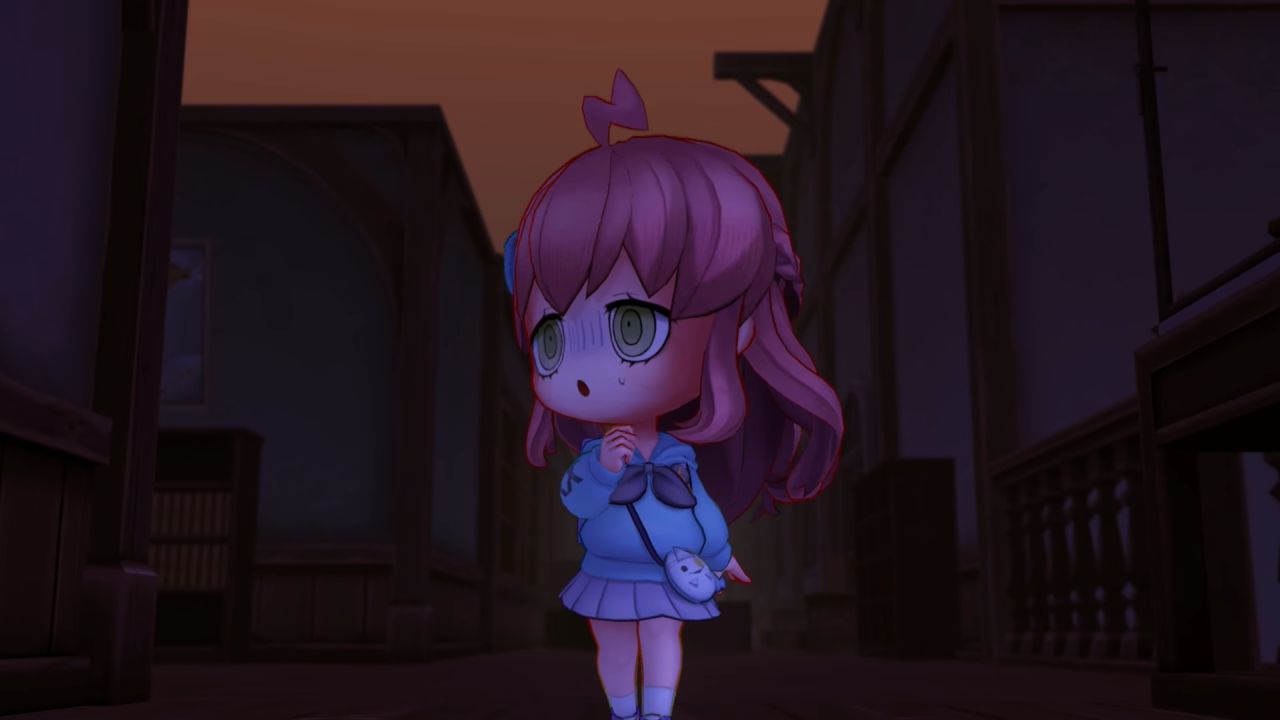
The human side focuses on concealment, teamwork, and timing.
Humans have a few ways to avoid the monster, such as hiding behind objects or disappearing into tall grass and shrubs, as long as they stay out of the monster's view. Each character also has an individual ability that can affect a chase. Hajime, for instance, can move faster near a ghost, while Kuro can determine the location of the monster when a guard is at the jail.
Spotting flips the situation on its head. Humans can use a short burst of lantern to stun the monster, giving them a brief window to escape instead of simply accepting capture. That creates a simple but effective risk-and-reward loop: staying hidden is safest, but helping teammates or using abilities at the right moment can flip a losing situation on its head. The mechanics remain accessible without becoming completely mindless.
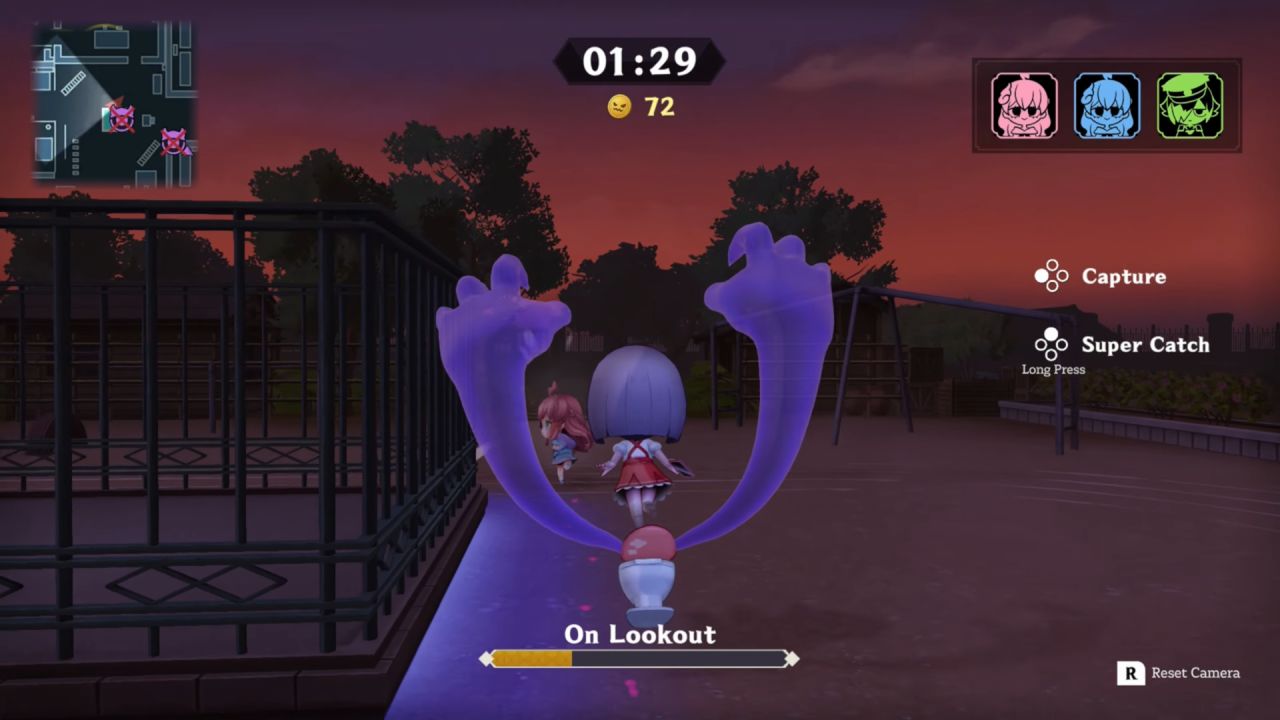
Monsters have their own tools for turning a quiet hunt into a frantic chase.
Playing as the monster completely reverses the experience. Rather than simply trying to remain unseen, you are always on the lookout for movement, listening for musical cues, and looking for signs of humans nearby. Each monster also has its own abilities and special attacks, giving the role more personality than simply walking around a map and hitting a button when another player is found.
The asymmetrical structure works especially well because neither side is operating in quite the same environment. Humans think about concealment, survival, and sometimes rescuing teammates, while monsters focus on detection and controlling the limited time available. That contrast creates the game's central tension without requiring an elaborate ruleset. Matches remain easy to understand, yet every round can unfold differently depending on who is playing.
Short matches and unlockable rewards give the multiplayer loop a reason to continue.
OBAKEIDORO 2 doesn't rely entirely on its basic matches for progression. Players can complete smaller objectives and earn stamps, which provide modest bonuses while also unlocking additional lanterns for humans and new characters for both sides. The system is relatively simple, but it gives repeated matches more purpose and encourages players to keep playing with the expanding roster.
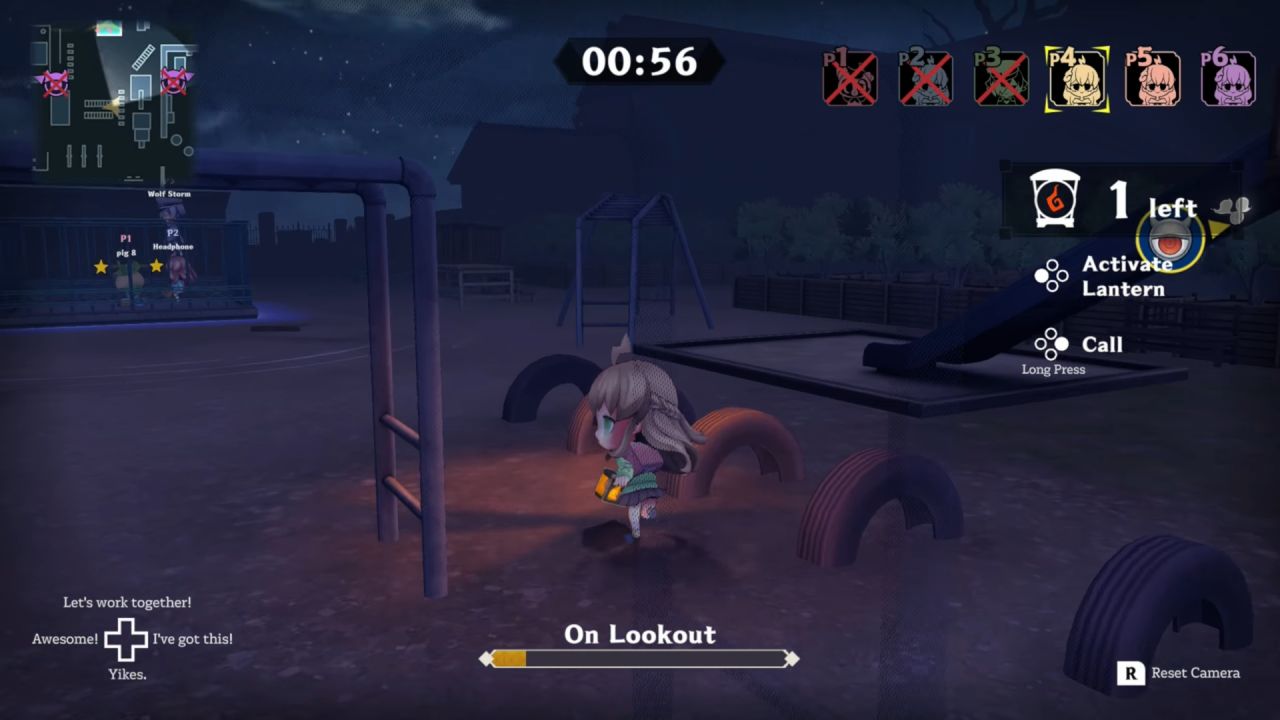
That progression is especially useful because the core game is intentionally uncomplicated. Rather than introducing a huge collection of complicated systems, the game uses small rewards to encourage continued play. New characters and lanterns are available, but the experience stays accessible. For a multiplayer game built around short bursts of hide-and-seek, that restrained approach comes across as appropriate rather than underdeveloped.
The offline options add flexibility, but they also expose where the game works best.
Although OBAKEIDORO 2: Chase and Seek is clearly designed around multiplayer, the Nintendo Switch 2 version benefits from several offline options. You can play without an online group or bring the game into a local setting, which gives the simple format more flexibility. That makes it easier to enjoy casually, although the experience reveals some weaknesses when AI replaces human opponents.
The biggest problem is that the opposing AI can feel strangely inconsistent. As a human, hiding from an AI monster can be almost comically easy because staying outside its sight for three minutes is often enough to survive. Once it actually spots you, however, escaping becomes extremely difficult because its tracking is so effective. The result is an odd situation: avoiding detection is far more reliable than attempting a genuine chase.
The monster AI creates the same imbalance from the opposite side. Playing as the monster against AI humans reveals another side of the problem. Special abilities can make certain captures extremely easy, yet ordinary catches are less dependable, while the AI-controlled humans seem unusually capable of locating their hiding allies.
Whenever a human is captured, the remaining players tend to rush to the relevant switch, making them predictable rather than genuinely strategic. The result feels more functional than intelligent. That is unfortunate because the game's mechanics could support more interesting AI behavior.
Humans have hiding spots, lantern stuns, character abilities, and opportunities to rescue one another, while monsters have tracking tools and unique attacks. In multiplayer, those options can create genuine mind games because human opponents can adapt. Against AI, however, the lack of meaningful coordination limits the strategic nuance that the underlying systems potentially provide.
Split-screen multiplayer is wonderfully chaotic, even if it's almost impossible to play fairly.
Split-screen multiplayer is one of those features that sounds brilliant until you remember what the game actually asks players to do. Hide-and-seek depends on unevenly distributed information, so letting opponents share the same screen requires everyone to follow an honor system. Nothing stops someone from simply looking across the screen and discovering exactly where their opponent is hiding.
Despite that obvious flaw, having local multiplayer available is still welcome. It gives groups another way to experience the game without relying entirely on online matchmaking, and the inherently silly nature of cheating can even become part of the fun with the right group. It is not the fairest competitive format, but OBAKEIDORO 2 is laid-back enough that local chaos fits its fun character.
Its presentation makes the horror feel more like Halloween mischief than genuine terror.
Visually, OBAKEIDORO 2 has a surprisingly distinctive personality. Its chibi characters pair a Burtonesque design of sunken eyes, thin facial details, and exaggerated expressions, creating an aesthetic that feels spooky without being disturbing. The result feels like a playful interpretation of a classic horror story rather than something meant to frighten its audience, which fits the game's family-friendly approach especially well.
The presentation also takes into account its theatrical side. Menus are framed like a literal stage performance, while captures and rescues are presented with an overstated flair that makes each match feel like a small production. Combined with the game's playful horror atmosphere, the result appears less like survival horror and more like children playing a supernatural game of hide-and-seek during Halloween. That tone gives OBAKEIDORO 2 much of its charm.
Its soundtrack completes the weird mix of spooky atmosphere and playful charm.
The music also adds to OBAKEIDORO 2's personality, with a European feel that will remind you of classic mystery games. Tracks shift between slower, moodier pieces and livelier compositions depending on the situation, while accordion-heavy arrangements give the soundtrack an unusual character. It is not the sort of score that tells you when to feel scared; instead, it reinforces the game's theatrical and mischievous tone.
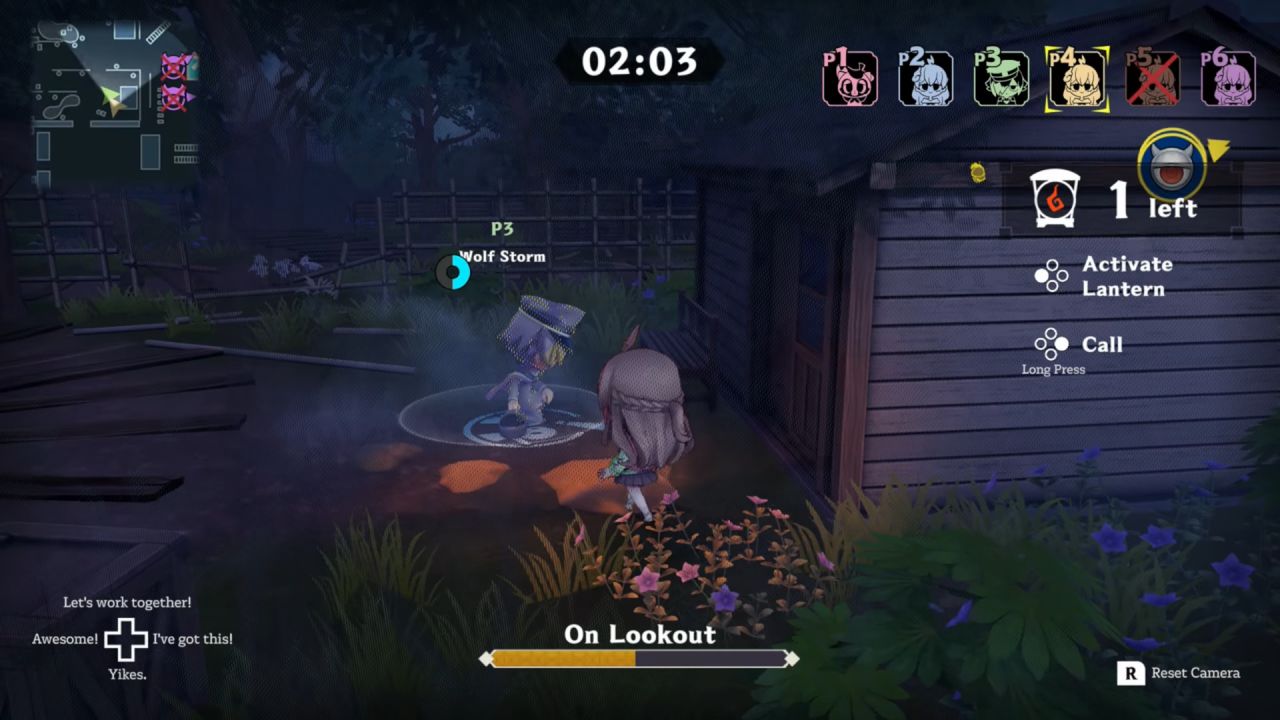
That approach works because the game never takes its horror completely seriously. The music, character designs, environments, and exaggerated presentation all point toward the same idea: this is a spooky game of make-believe rather than a genuinely frightening experience. The result feels especially appropriate for younger players or families looking for a Halloween aesthetic without the intensity normally associated with horror games.
The multiplayer design is strongest when everyone understands that the game is meant to be chaotic.
OBAKEIDORO 2 isn't a dedicated asymmetrical multiplayer game, so expecting the depth and complexity of one would be unfair. Its appeal comes from the simplicity of each match and the interactions that emerge when real players start making unpredictable decisions. A monster can panic when several humans scatter, while a human can risk a rescue attempt that completely changes the final seconds of a round.
That simplicity also makes it easy for people who may not normally play PvP or asymmetrical multiplayer games. The rules are straightforward enough to explain quickly, while the short matches mean nobody has to commit to a lengthy session. On Nintendo Switch 2, that format feels particularly comfortable for casual multiplayer, whether you are playing online or gathering people together for a few quick rounds.
The biggest limitation is that its simplicity can become repetitive without a regular group.
The same straightforward design that makes OBAKEIDORO 2 accessible can also limit its longevity. Once players figure out the best hiding spots, escape tactics, and monster powers, there's only so much depth beneath the core chase-and-catch loop. The unlockable characters and lanterns add some motivation, but they don't change how matches are played.
That means the game suits occasional returns better than becoming the centerpiece of a long-term multiplayer rotation. It works particularly well as a short-session game that you can revisit with friends, especially during Halloween season, rather than something designed to demand hundreds of hours. The charm lies in the sudden bursts of lighthearted competition, and stretching the experience much further may reveal its relatively limited depth.
Obakeidoro 2 is a charming multiplayer game that understands exactly how much complexity it needs.
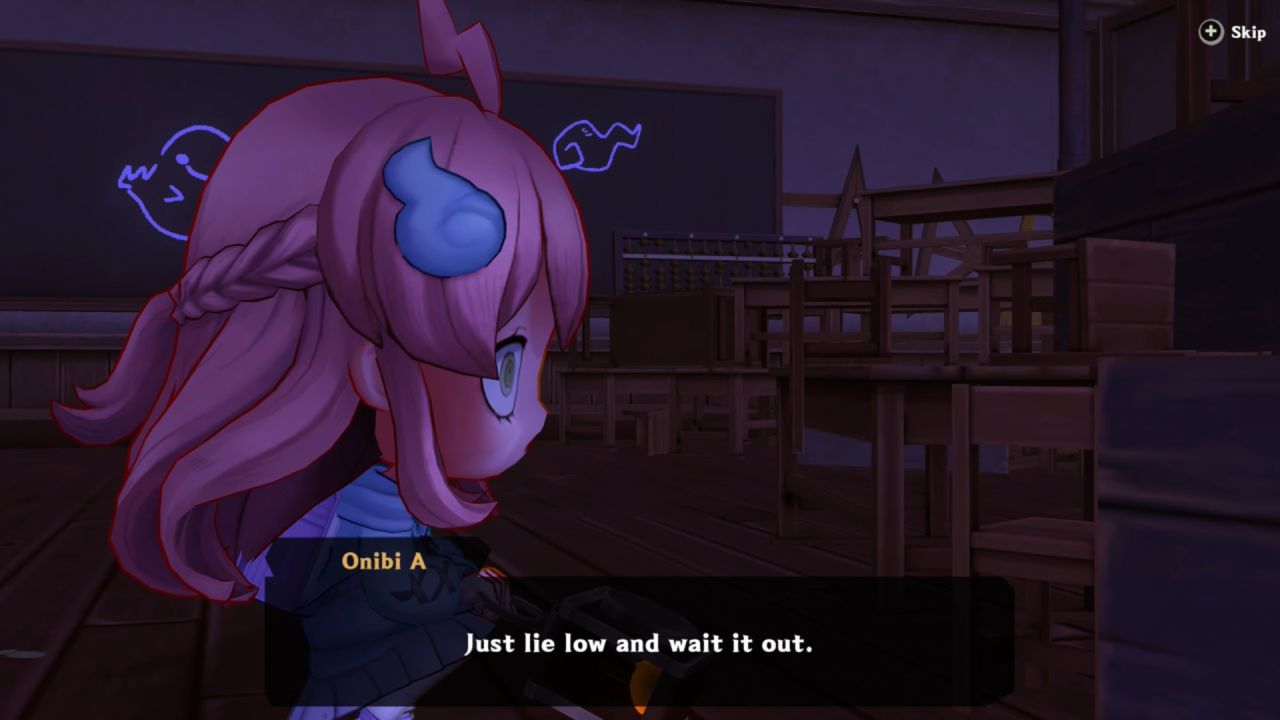
OBAKEIDORO 2: Chase and Seek succeeds because it does not overcomplicate its central idea. Humans hide, monsters hunt, abilities create opportunities, and three minutes later the match is over. That simplicity is supported by a distinctive visual style, a playful horror atmosphere, unlockable content, and enough character-specific mechanics to keep individual rounds from feeling identical.
It is not without weaknesses. The AI can be frustratingly inconsistent, split-screen requires an honor system that some players will immediately ignore, and the limited depth may eventually make the experience feel repetitive. Still, those issues do little to undermine what the game is actually trying to achieve. This is a family-friendly asymmetrical multiplayer experience designed for short, chaotic sessions rather than an endlessly competitive grind.
For Nintendo Switch 2 players looking for something lighthearted to play with friends, OBAKEIDORO 2 is easy to recommend. Its spooky presentation gives it plenty of personality, while the straightforward multiplayer makes it easy even for newcomers. It may not become a permanent fixture in your library, but it does not need to. Sometimes a game only needs to deliver a few genuinely fun rounds before everyone starts laughing and asking for one more match.
Editor, NoobFeed
Verdict
OBAKEIDORO 2 is a charming asymmetrical multiplayer game with spooky style, simple mechanics, and chaotic fun. Its limited depth and uneven AI hold it back, but it shines in short sessions with friends.
75
Related News
No Data.