
Gigabyte X670 Aorus Elite AX Review: Premium Features and PCIe5 Power at Entry-Level Pricing
Featuring DDR5 memory support, hybrid cooling compatibility, and an 8-layer PCB, Gigabyte's X670 Aorus Elite AX ensures durability and performance.
Hardware by Masaru Hoshino on Aug 30, 2025
Motherboards have always been interesting pieces of hardware, and every year they continue to improve, even in the entry-level range. The Gigabyte X670 Aorus Elite AX is a great example of how a budget board can change what people expect by adding high-end parts and engineering quality to what used to be seen as a lower-tier lineup.
With its impressive VRM, cooling system, PCIe 5 support, and modern connectivity, the X670 AORUS Elite AX is setting new standards for the industry.
.jpg)
Design and Build Quality
The Aorus Elite AX comes with a premium 8-layer PCB ATX board reinforced with 2 thick copper plates. Such a design is often reserved for high-end motherboards, but its inclusion here is a welcome surprise.
An 8-layer PCB enhances VRM heat dissipation, PCIe 5/NVMe signal isolation, and durability, resulting in an extended lifespan. Design-wise, it carries the signature darker gray tones with geometric accents, creating a sleek industrial look. More importantly, there is a sense of solid engineering throughout the build.
RGB and Aesthetics
RGB implementation has been kept minimal with 5 connectors, 2 of which are addressable. This method puts usefulness ahead of needless lighting, which lets more of the resources go toward performance aspects instead of flashy looks.
AM5 CPU Socket
At the heart of the board is AMD's first LGA socket with 1718 low-pressure pins. It is compatible with several next-generation Ryzen CPU versions over the next three to four years, as it supports PCIe 5.0 and DDR5 memory. This design's forward-thinking nature ensures long-term value.
Cooling and VRM
1280A of CPU-centric power supply is provided by the board's 14+2 phase VRM with 70A power stages. This is significant overkill for current Ryzen 7000 CPUs, leaving plenty of headroom for future processors. Cooling is equally premium, with a 2-stage cooling block connected by a copper heat pipe.
Extended heatsinks with thick alloy walls ensure stable temperatures. Even under a 75-minute stress test, VRM temperatures stayed around 45°C, an exceptional achievement in this price category.
Memory Support
The Aorus Elite AX supports up to 128GB DDR5 across 4 DIMM slots in a dual-channel configuration, with speeds of up to 6400MHz. DDR4 is not supported, as no X670 motherboards are backward compatible with DDR4.
High-frequency DDR5 makes this board highly appealing not only to gamers but also to streamers and content creators who rely on fast memory performance.
Storage Options
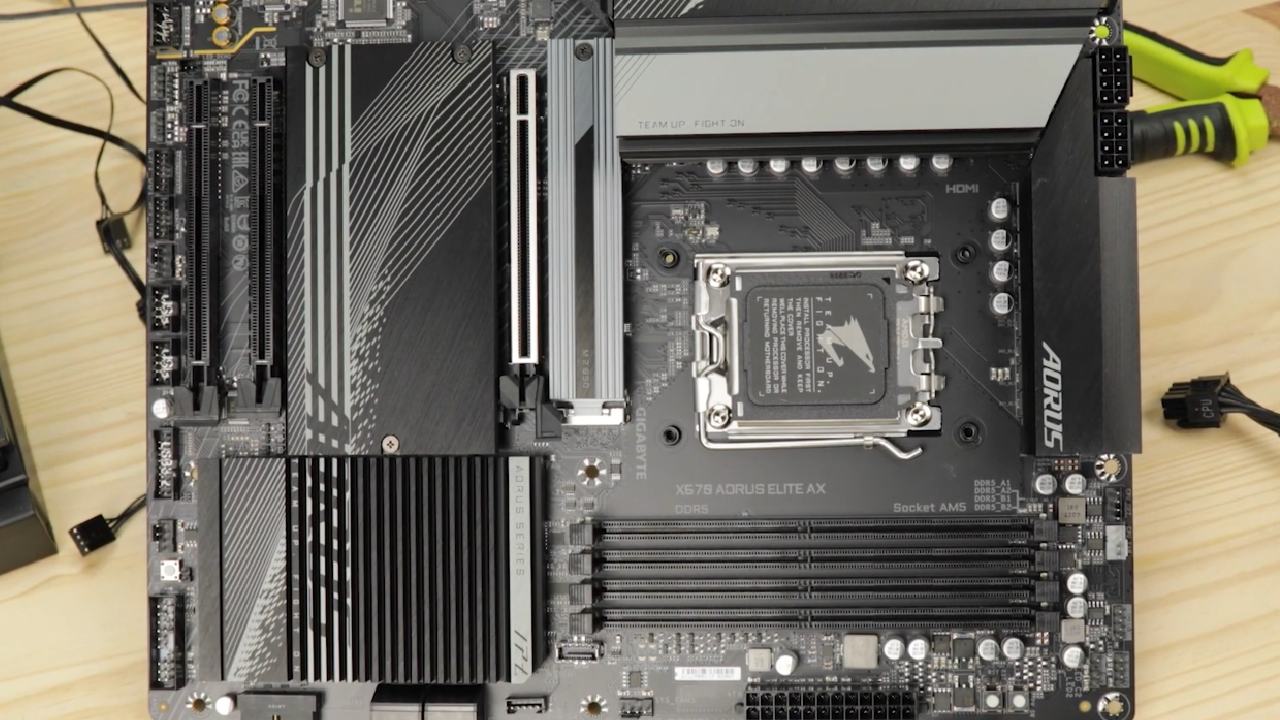
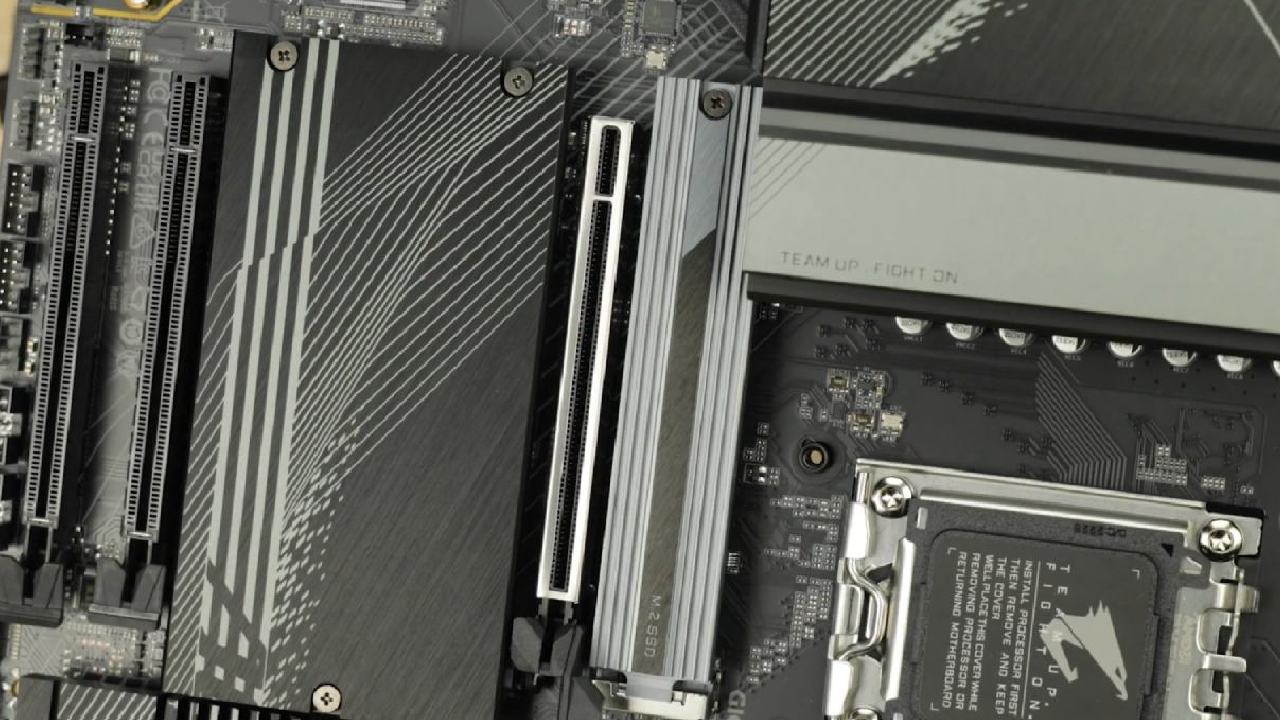
Storage capabilities are a standout feature. The board features 4 M.2 slots—1 with PCIe 5 support (128 Gbps) and 3 with PCIe 4 support (64 Gbps each). All slots come with thick thermal-padded heatsinks to prevent thermal throttling. Gigabyte has also included its own screwless M.2 installation system, which improves upon solutions from MSI and ASUS.
In total, the board delivers 320Gbps of combined bandwidth. Legacy support is still available through 4x SATA 3 ports.
PCIe Expansion
There are 3x PCIe slots, with the primary GPU slot running PCIe 4.0 x16 at 32 GB/s. The second slot operates at PCIe 4 x4 (8GB/s), and the third slot operates at PCIe 3 x2 (2GB/s), making it best suited for expansion cards rather than GPUs.
Compared to prior methods, a new GPU release tab makes card removal easier, and a reinforced design guarantees longevity for big GPUs.
Chipset X670
The hotter 11W X570 chipset has been replaced by the twin 7W X670 chipset. As a result, less active cooling is required. A large heatsink maintains chipset temperatures at around 55°C, although further cooling improvements may be desirable in future revisions. The main advantage over X570 is better USB support.
Back I/O
The rear I/O of the Gigabyte X670 Aorus Elite AX is well-equipped, featuring a flashback button for BIOS updates, Wi-Fi 6E support, an HDMI output for Ryzen 7000 integrated graphics, 4x USB 3.2 Gen2 (10Gbps), 6x USB 3.2 Gen1 (5Gbps), and 1x USB Type-C Gen2x2 (20Gbps).
It also includes a 2.5Gb LAN port and the Realtek ALC897 audio codec, enhanced with capacitors for cleaner filtering. While the audio codec is not the most premium available, it provides reliable recording performance, making it particularly useful for streamers and content creators.
Front Panel and Connectivity
Front panel headers include 2x USB 3.2 Gen2, 2x USB 3.2 Gen1, a 20Gbps USB-C, and support for Thunderbolt 4 add-in cards (40Gbps). This makes the board especially appealing for creators who require high-speed storage and transfer options.
Cooling support includes 5 hybrid fan headers capable of handling PWM fans, pumps, or flow sensors, offering full flexibility for both air and custom liquid cooling setups.
Troubleshooting Features
Despite being entry-level in name, the Aorus Elite AX provides advanced troubleshooting tools, including an EZ Debug LED and onboard buttons for Power, Reset, and Clear CMOS. These features greatly simplify troubleshooting and are typically present in higher-end models.
Final Thoughts
One of the greatest entry-level motherboards on the market is the Gigabyte X670 Aorus Elite AX, which retails for $290 before taxes in the US. With its high-end 8-layer PCB, robust VRM, PCIe5 storage, and sophisticated cooling, its feature set and design make every dollar invested worthwhile.
We appreciate how Gigabyte has introduced premium elements as standard, raising expectations not just for their Pro lineup but also for competitors.
If you are looking for a future-proof AM5 motherboard that combines performance, durability, and exceptional value, the X670 Aorus Elite AX is a clear winner.
Check Our Other AMD articles:
- AMD Ryzen 9 9950X3D Review: Setting The Standard For 2025 Gaming CPU
- AMD Ryzen 7 9800X3D Review: 3D V-Cache Goes God Mode with Stunning Gaming Performance
- AMD RX 9070 Performance Review: Thermals, Clocks, and Real-World FPS
- AMD Ryzen 5 7600 Review: Best Budget Gaming CPU of 2025?
- AMD Radeon RX 7800 XT Review: RDNA 3 Power For Midrange Gaming
- Sapphire NITRO+ AMD Radeon RX 9070 XT Review: The Ultimate 4K Gaming GPU
- AMD Ryzen 7 7800X3D: Delivers Gaming Performance Far Beyond Expectations
- AMD Ryzen 9 7900X Review: Powering the AM5 Era with DDR5 & PCIe 5.0
- ASRock Radeon RX 7800 XT Challenger OC Review: Best Price-to-Performance GPU of 2025
- Intel Core i9‑14900K vs. AMD Ryzen 7 7800X3D: Power Profiles & Gaming Benchmarks
Editor, NoobFeed
Gaming Hardware Updates
No Data.