
GPD Win 5 Hands-On: Strix Halo Power in a Portable Gaming Machine
GPD Win 5 delivers unprecedented handheld performance with Strix Halo CPU, high-capacity battery, and advanced cooling technology.
Hardware by Tanvir Kabbo on Nov 28, 2025
The GPD Win 5 is a new level of power for mobile computers. It is based on AMD's Strix Halo chip. It delivers performance more typical of full-sized laptops than of portable gaming devices.
Packed with unconventional engineering choices, a detachable high-capacity battery, and numerous industry firsts, the device challenges all expectations of what a handheld system can deliver.

First Impressions
When we first pick up the Win 5, the immediate impression is its weight, a direct result of the performance packed inside. The 180W power adapter alone feels substantial, and the detachable 80Wh battery is comparable to what many laptops use.
Strix Halo, the chip powering the handheld, supports up to 16 Zen 5 CPU cores, up to 128GB LPDDR5X memory, and Radeon 8060S graphics. We already knew how powerful the chip could be from earlier experiences, but seeing it inside a handheld is genuinely surprising.
Industry Firsts and Hardware Design
The Win 5 has many new features that are easy to see right away. It features a revolutionary capacitive joystick mechanism that doesn't require physical contact, along with an SSD format we haven't seen before. By monitoring voltage changes rather than relying on mechanical parts, drift problems are reduced, and dead zones are very small.
The battery attaches externally, adding significant weight but offering swappable flexibility. Even though the device does not include an internal battery, most users will attach the included battery umbilical cable. Hence, the weight rests away from the hands during gameplay.
Ports, Controls, and Build Features
The top edge features hall-effect two-stage triggers, traditional shoulder buttons, a USB-A port, a barrel jack, and ventilation for the Frost Wind cooling system. The cooler uses titanium-aluminum alloy fan blades and thickened purple copper heat pipes to handle high-wattage operation. USB4 support allows the use of an external GPU, and power delivery up to 100W is supported.
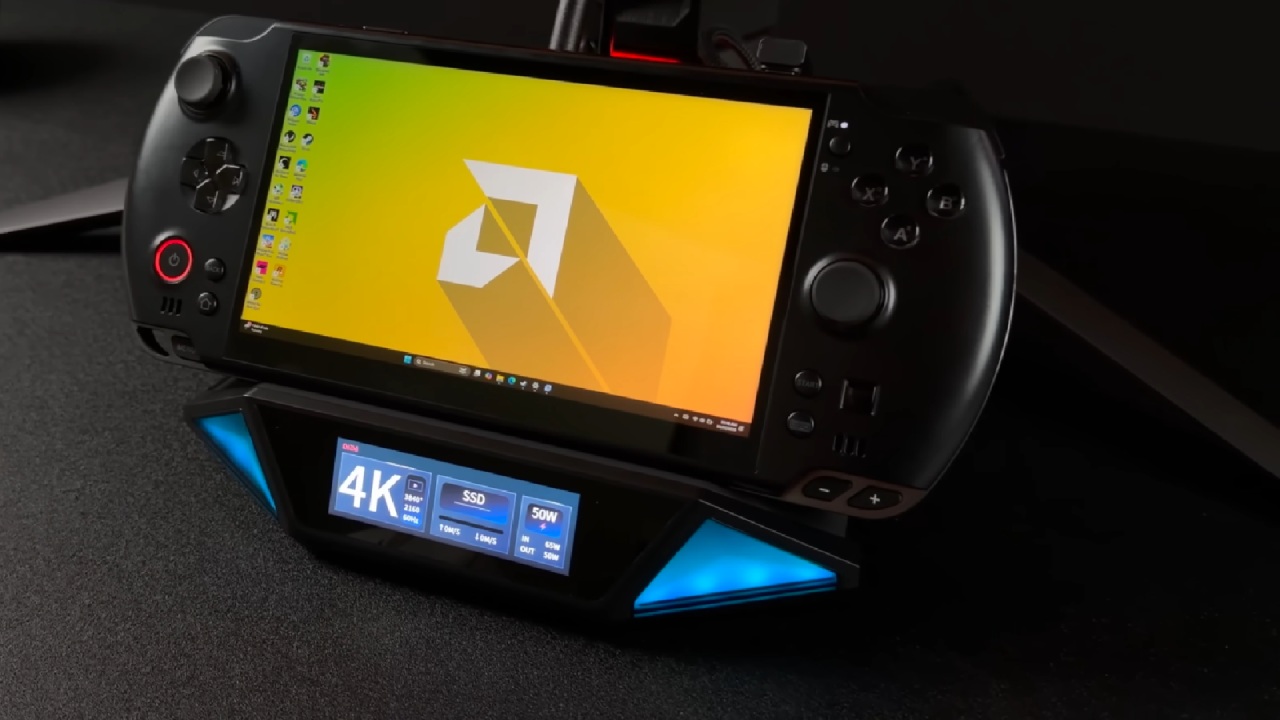
On the bottom, an SSD tray and an additional USB-C port provide versatility. The front features the capacitive joysticks, a respectable D-pad, a fingerprint-enabled power button, and a range of navigation buttons, including home, desktop, keyboard, menu, and mode toggles. On the rear, L4 and R4 buttons enhance input flexibility.
One especially unique inclusion is a built-in optical mouse sensor. Instead of moving a mouse across a surface, the device itself becomes the surface that moves over the sensor. We can toggle between sensor and joystick-based cursor control.
Display and Visual Experience
The Win 5 features a 1080p, 500-nit, 120Hz panel with variable refresh rate. Real-world testing reaches just above 500nits, and VRR makes gameplay feel smoother at fluctuating frame rates.
The visual quality is similar to that of displays on competing handhelds, but feels elevated by the system's raw performance.
Software and Performance Management
GPD's Motion Assistant utility provides deep system configuration options. While not as polished as overlays found in competing handhelds, it exposes nearly every performance, power, and fan parameter imaginable. We can change the TDP, set a CPU frequency restriction, adjust the fan speed, change the amount of VRAM allocated, and enable or disable gyro functions. When connected in, TDP can handle up to 75W, but when unplugged, it can only handle 45W.
The fan noise is loud when the system is under load, but that's normal given the power envelope. The exhaust heat is strong and evenly distributed through the vents, as the design says it will.
Gaming Experience and Real-World Performance
It's shockingly smooth to play contemporary games at 1080p. During testing, the game ran at 62-72 fps on medium settings at 45W, thanks to VRR. Performance improves significantly with higher wattage. Joystick behavior initially required dead-zone adjustments on the prototype unit, but once tuned, the capacitive sticks delivered responsive movement with exceptionally smooth aim correction.
Front-facing speakers help counteract fan noise, though louder audio output would be even better in a device this powerful.

Thermal Behavior, Ergonomics, and Practicality
The system gets heated when it has to work hard for a long time, and the fan noise is inescapable. But ergonomics are remarkably comfy for how heavy they are. The rounded grips help distribute the strain, but playing for a long time can be tiring. The detachable battery makes it more flexible, but it also makes it larger and harder to keep track of cables.
Even though the unit approaches laptop-level performance, carrying the battery, the handheld, and the large 180W charger together reduces mobility. Still, for users who prioritize power over portability, the Win 5 offers unmatched capability.
A Glimpse at Peak Handheld Engineering
For those seeking the most feature-rich and over-engineered handheld possible, the GPD Win 5 stands at the top. The combination of Strix Halo hardware, innovative design choices, modular storage, new joystick technology, and extreme wattage support makes it feel like a true no-compromise device.
A full-length long-term evaluation will reveal more about battery longevity, thermal tuning, and real-world day-to-day usability. For now, the Win 5 delivers a remarkable level of performance that defies what most consider realistic for a handheld form factor.
Also, check our other Handheld articles below :
- ASUS ROG Ally X Handheld Review: Double the Battery, Double the Comfort
- Nintendo Switch 2 Vs. Original Switch 1: A Full Comparison
- How To Connect A Camera And Join Voice Chat With Nintendo Switch 2
- Nintendo Switch 2 Review: Handheld Performance, Features & Value Breakdown
- ROG Xbox Ally X Vs. ROG Ally X: Display, Battery & Controls
- ASUS ROG Ally X vs. Steam Deck OLED: Display, Battery & Gaming Benchmarks
- MSI Claw 8 AI+ Review: Display, Controls & Gaming
- Nintendo Switch 2 vs. Steam Deck OLED: Gaming, Performance, Battery, Display and Value
- PlayStation Portal Review: Remote Play, Cloud Streaming & Travel Gaming
- PlayStation Portal vs. Lenovo Legion Go: Best Portable Gameplay
- Cyberpunk 2077 Patch 2.3 FPS Test on MSI Claw 8 AI+
Senior Editor, NoobFeed
Gaming Hardware Updates
No Data.