
Handcrafted vs. Randomized Design: What Will Shape the Next Generation of Games?
Other by Arisu Taiaya on Sep 22, 2026
For many years, procedural generation was seen as a solution to a production problem: it let developers create more worlds, encounters, and variations without authoring every detail by hand. However, scale and quality are not equivalent. Today, game design is beginning to highlight a harder question: what should actually be randomized?
The most promising games are getting better at telling the difference between what should be random and what should be under control, using computers where variability benefits the game while retaining control over elements that require meaning, consistency, or a planned dramatic structure.

Randomization is Older and Broader Than Procedural Worlds
The use of randomization in games rests on a basic principle: designers specify a range of possible outcomes without deciding in advance which one will occur at any given moment. Today, randomization can control loot tables, enemy behavior, map layouts, card draws, item properties, combat calculations, and world generation.
The mechanic in question predates the software. Lotteries and raffles are earlier examples of organized random selection since the possible entries are set up first and a chance process is then used to determine the outcome. The connection is one of mechanism, not an assertion that modern procedural generation has directly descended from any specific game format.
Digitalization has moved lotteries and raffles onto online services alongside their established offline forms. Such formats are available in abundance in the UK through internet-based platforms, providing users with more direct ways of finding services based on randomized drawings. That change makes it easier to find platforms for playing Powerball in the UK. Lotteries and raffles still use defined pools and random selection as their underlying mechanism.
Video games take that abstract principle and develop it into something much more complex. Rather than having a single outcome, the software can continually feed generated values into interconnected systems, creating variations in geography, encounters, resources, enemies, and progression.
Procedural Generation Still Depends on Handcrafted Rules
The most effective procedural systems don't exclude designers from the process; instead, they shift design work from creating each final output to establishing the rules that determine possible outputs. Dead Cells shows this difference by varying its stages from run to run while still supporting movement, combat, progression, and each area's specific structure.
Minecraft also shows this principle, but on a different scale: since worlds are generated as players explore, terrain doesn't appear through unregulated randomness because rules govern biomes, elevation, caves, structures, and other features.
Effective procedural design therefore depends on constraints such as:
- Compatibility rules preventing components from joining in ways that break movement or progression.
- Probability weighting - so certain probabilities are widespread and some are rare, but not every possibility is treated as equal.
- Structural requirements that allow for the existence of required paths, resources, encounters or steps.
- Authored components supplying recognizable rooms, objects, enemies, animations, and environmental pieces for systems to arrange.
- Validation rules excluding combinations that are technically possible but mechanically or visually incoherent.
The generator produces variation, but designers determine the grammar from which that variation is constructed.

Pokémon Randomizers Reveal What Uncertainty Changes for Players
Pokémon randomizers have the ability to alter the course of progression without having to create new environments or characters; for example, the Universal Pokémon Randomizer ZX does even more than just change encounters with wild Pokémon.
You can use it to replace the beginning Pokémon, shuffle the trainer’s teams, change the Pokémon’s kinds and abilities, change their moves and moveset, randomize the items they hold, and rearrange stuff across the field. Moreover, the settings also allow certain constraints to be enforced, for instance, by ensuring that the starter choices remain at a similar level of strength or by stopping some evolutions from becoming impractical.
Instead, controlled uncertainty is produced rather than unrestricted shuffling. A player might remember a particular route or trainer or battle from the original game, but they won’t know what Pokémon will be there, or what attributes and moves they’ll have. But as the overall development is still recognizable, the randomization might affect the squad composition, the choice of resources and the battle-planning.
Handmade Design Lets Developers Control Meaning
The handcrafted design provides creators total control over the connections between each section of a game. Instead of picking from a selection of conceivable combinations, developers are able to design characters, environments, encounters, progression paths, dialog and graphic features with a goal in mind.
This technique works especially well when context matters, environmental details can be used to predict future events, the way enemies are placed can affect the pace of the game, and character traits can be consistent in terms of how they look, what they say, how they behave and their role in the story. Moreover, designers can create intentional contrasts and patterns that a general generation system would find hard to reproduce reliably.
Thus, the output volume falls off. But each place, character, encounter, and variation takes development time; thus, a bigger game often implies more labor. That is why handcrafting guarantees content diversity and not correctness.
Its strength is that it ensures content has a purpose and that interconnected details convey a clear, unified idea rather than merely depicting one technically valid combination among thousands.
Fable's 1,000 NPCs Put Procedural Efficiency to the Test
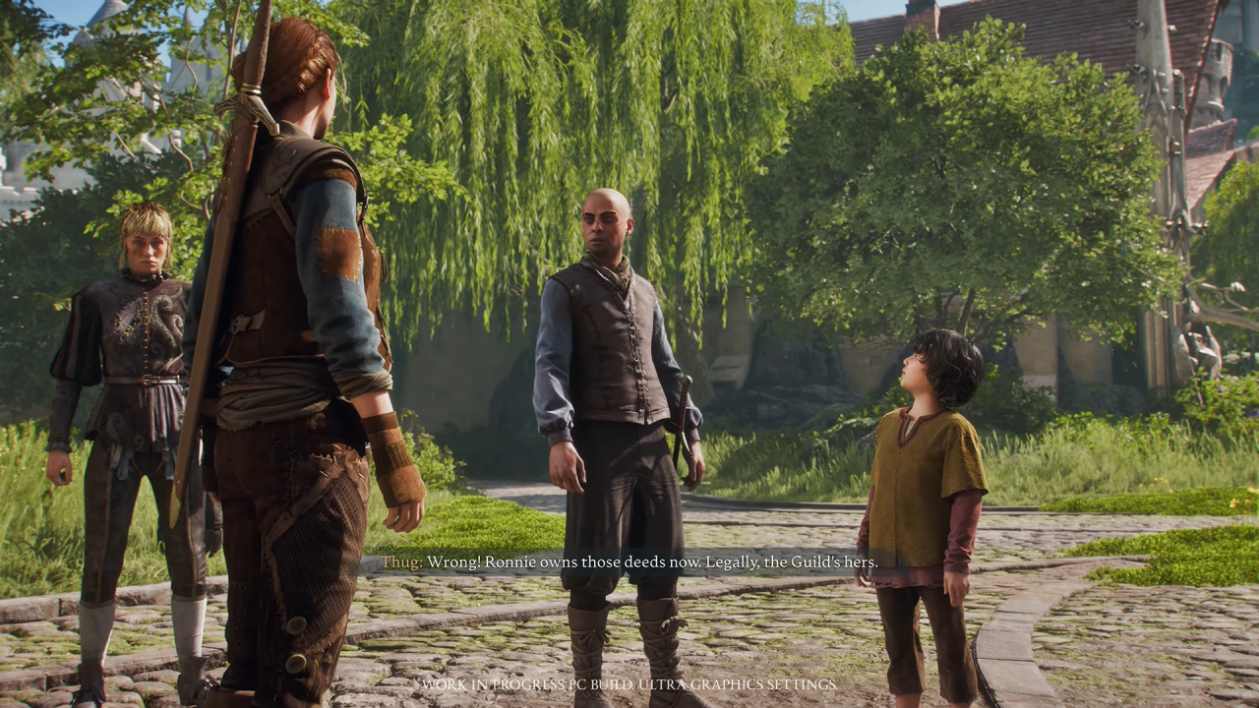
For Fable's Living Population, Playground Games faced an exceptionally large character-design challenge: about 1,000 residents, each needing a coherent identity in appearance, occupation, personality, and social characteristics.
At first, the studio created a tool that could automatically 'roll' these NPCs, reducing the work needed to build so many characters. However, testing revealed the difference between assigning technically valid traits and producing believable characters.
Random combinations could result in a resident's job, manner of life, and appearance no longer matching one another; for example, a butcher might end up looking like a vegan or a stylist might be given a deliberately unattractive hairstyle. Similarly, peculiarities might influence a person’s character and social habits and so damage the logic linking individuals to their positions and communities.
Playground consequently chose to select these characteristics individually. The decision required considerably more manual work, but it let each NPC's traits reinforce one another rather than existing as disconnected outputs from a generator.
The Next Generation Will Be About Choosing What Randomness Controls
The lesson from Fable is not that handcrafted NPCs are better than generated ones; the Living Population introduced a specific output seed: residents should have combinations of occupation, appearance, personality, and social behavior that players could perceive as intentional. Once coherence became a requirement, random generation proved inefficient.
In other games, randomness sits in the same place as uncertainty and strengthens their structure, suggesting a clearer path for future development. Before procedurally generating content, studios should ask themselves three questions: Does the element of unpredictability affect significant decisions? Are the rules able to reliably exclude nonsensical combinations? Does the generation process produce useful variation, or does it simply add more content?
If the answer is yes, randomization can multiply what an authored system produces. If not, automation risks creating thousands of outputs that still require human correction.
Moderator, NoobFeed
Latest Articles
No Data.