
Intel Core Ultra 5 225F Gaming Performance Review and Benchmarks
Budget Core Ultra 5 225F shows minimal performance improvement over older processors in modern games.
Hardware by Nahe Yan on Dec 13, 2025
The subject of today's discussion is a product that has received very little interest since its debut. One of the restricted, non-K Core Ultra CPUs that surreptitiously hit the market about a year ago is Intel's Core Ultra 5 225F.
Eventually, out of curiosity, I decided to purchase one, the F model, which does away with integrated graphics. The question of whether the 225F ultimately makes sense for gamers and regular users is raised by its steadily decreasing price, which is now firmly within budget.
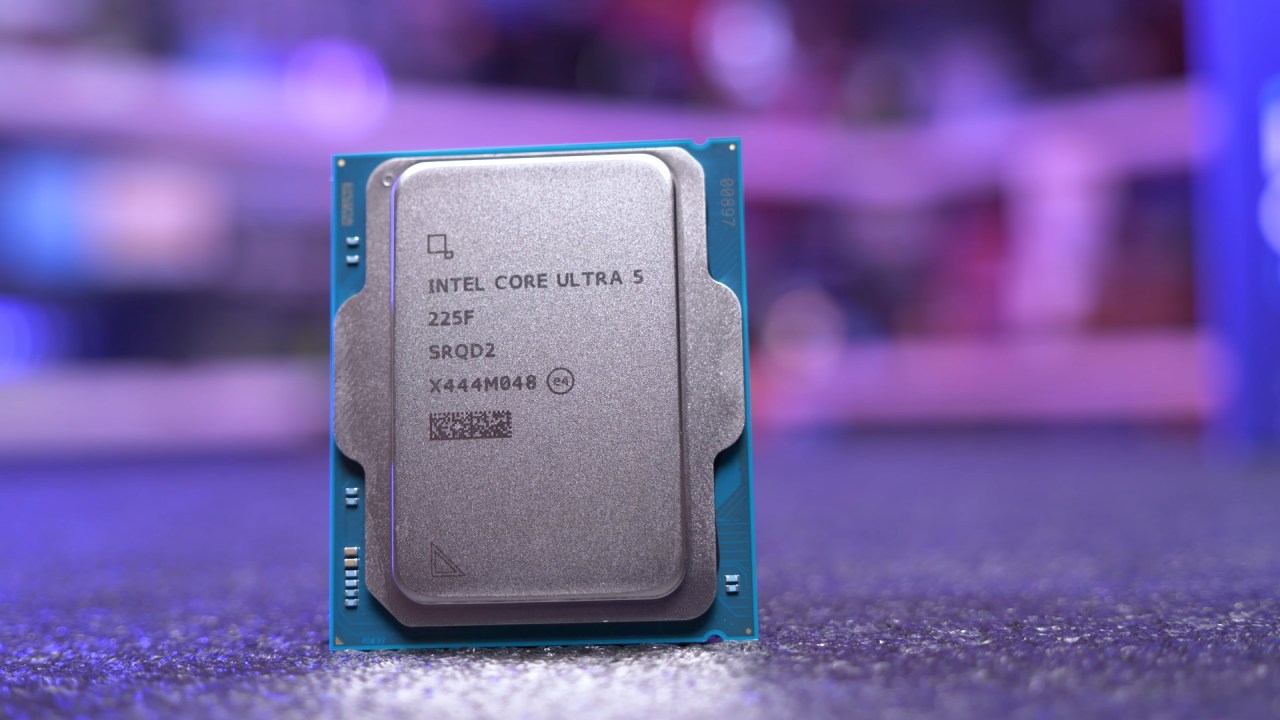
Details and Placement
With six P-cores and four E-cores, the Core Ultra 5 225F has ten cores total, ten threads if Hyper-Threading is not enabled. The 225F maintains the same number of P-cores but operates them at lower clock speeds, as with higher-tier Core Ultra components like the 245K. Base clocks are cut by about 21%, and boost clocks are cut by about 6%. With comparable decreases to base and boost frequencies, the E-core count is cut in half, from 8 to 4.
These modifications greatly reduce power consumption. The maximum turbo power decreases from 159W to 121W (a 24% decrease), and the base TDP decreases from 125W to 65W. Additionally, cache capacity is decreased; the smart cache's size is lowered from 24MB to 20MB.
Performance in Productivity
In terms of productivity, the 225F is not particularly noteworthy. It receives 123 points in Cinebench single-core testing, placing it about in line with components like the 14600K and Ryzen 5 7600X, but about 10% below Core Ultra 5 245K. Considering that the 245K is not a particularly good gaming CPU, it is not the best option for gaming.
Results from multiple cores are more worrisome. In certain situations, the 225F lags slightly behind six-core Ryzen processors and struggles to stand out. It is comparable to the previous 12600K in 7-Zip compression, but it performs worse in decompression, falling well short of both the 12600K and Ryzen counterparts. The performance of shader compilation is respectable but unimpressive; it again nearly resembles, rather than surpasses, six-core Ryzen components.
Overview of Gaming Performance
Core Ultra 5 225F's gaming performance was its biggest letdown. It often lags far below similarly priced Ryzen rivals and even older Intel components, and gains over prior budget CPUs are negligible across a wide range of titles.
Although Rainbow Six Siege averages around 300 fps, the actual performance varies. Though higher-tier CPUs offer noticeably greater frame rates, the uplift above the 12400F is just about 6% to 8%. Similar patterns can be seen in Marvel Rivals, where 225F barely beats the 12400F by 10% but still lags far behind its quicker rivals.
Performance differences are minimal in GPU-limited games like Assassin's Creed: Shadows, and 225F performs on par with previous low-cost CPUs. Again, nothing significant, but there are some slight improvements in Horizon Zero Dawn Remastered. With minor improvements over the 12400F and significant drawbacks when ray tracing is enabled, Cyberpunk 2077 makes the CPU's flaws more evident.
CPU-intensive, competitive titles further support the trend.

12-Game Average Outcomes
Depending on settings, the Core Ultra 5 225F only outperforms the 12400F by 7% to 9% on the 12-game average. Compared to the Ryzen 5 7500F, higher-tier CPUs are typically 13% faster, and that advantage increases with each tier. Even with its lower cost, the gaming performance of a current-generation processor does not justify the switch.
Considerations for Platform Value and Upgrades
Additionally, Core Ultra 5 225F has little attraction for upgrades. You may already have a better Core Ultra CPU if you have an LGA1851 motherboard. 225F is therefore not a logical drop-in upgrade. The main remaining audience is new builders, but even then, you are spending money on a platform with little long-term potential.
Final Thoughts
Core Ultra 5 225F doesn't make a strong argument. It is difficult to compete in games, provides no discernible productivity boost, and operates on a platform with no user appeal, even at its current price.
There isn't much reason to suggest it unless prices drop drastically and memory costs become less of an issue. Alternatives that provide better long-term value and superior performance are preferable if you are building on a tight budget.
Also, check our other Intel articles below:
- Intel Core Ultra 9 285K Review And Performance Breakdown (2025)
- Intel Core Ultra 9 285K vs AMD Ryzen 7 9800X3D: In-Depth Gaming Performance and Benchmark Comparison
- Intel Core i5-13400F Gaming Performance: Still Worth It in 2025?
- Intel Core i9‑14900K vs. AMD Ryzen 7 7800X3D: Power Profiles & Gaming Benchmarks
- Intel Core i9 14900K: Specs, Benchmarks, and Competitor Comparison
- Intel Core Ultra 5 245K Review: Gaming, Productivity & Power Efficiency Tested
- Intel Core Ultra 9 285 K's iGPU Gaming: In-Depth Benchmarks & Analysis
- Intel vs. AMD Gaming Laptop: Performance, Thermals & Battery Life Compared
- AMD Ryzen 7 9800X3D vs.7800X3D vs. Intel Core Ultra 7 265K: Gaming, Thermals & Price Analysis
Editor, NoobFeed
Gaming Hardware Updates
No Data.