
Ryzen 5 7500X3D Review: Gaming Performance, Benchmarks, and Value Analysis
Ryzen 5 7500X3D enters the market as a niche AM5 option balancing cache-heavy gaming gains against reduced clocks.
Hardware by Shinji Okazaki on Dec 24, 2025
The new AMD X3D CPU is not part of the latest generation. Still, it is a cost-effective gaming choice based on established technology. The Ryzen 5 7500X3D is a six-core, twelve-thread design that leverages X3D cache.
It is aimed at gamers who want good in-game performance without having to buy a higher-tier model. The price is in the middle range, which makes it an uncommon but intentional option to balance cost and game performance.
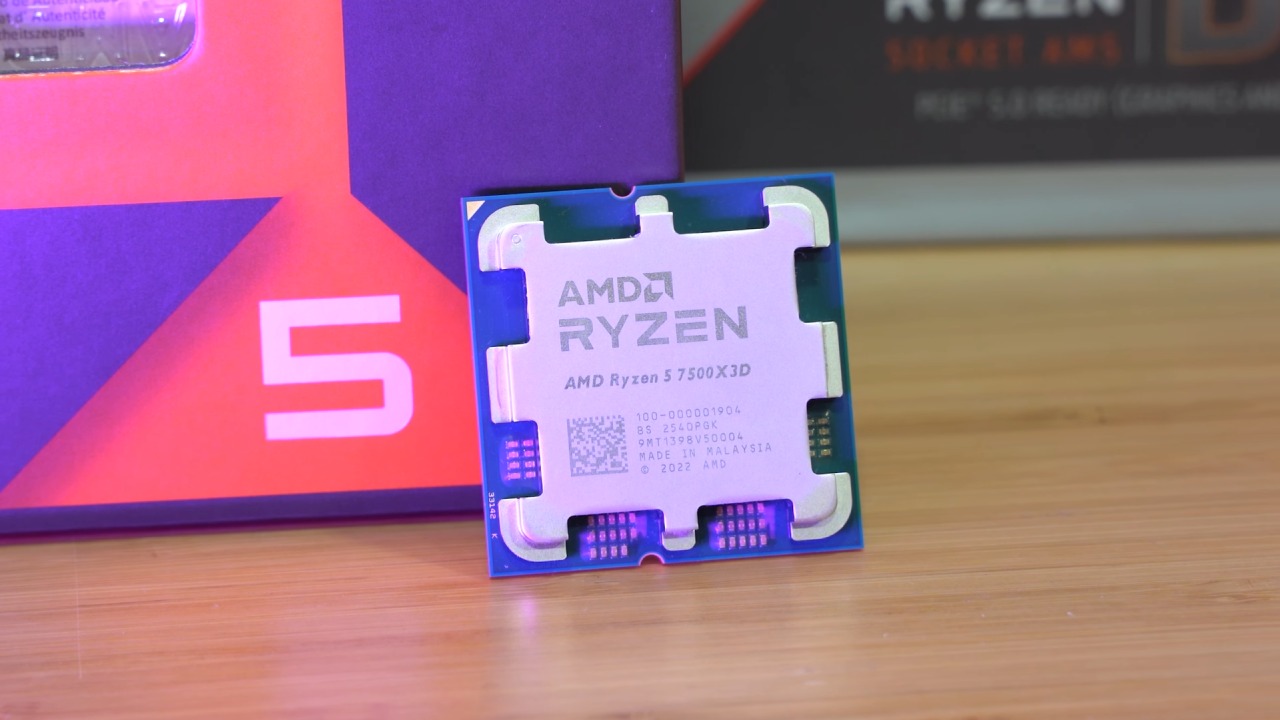
Core Specifications and Positioning
The Ryzen 5 7500X3D has six cores and 12 threads and uses AMD's X3D cache architecture. Even though it is part of an older series, it performs very well in gaming workloads compared to newer processors. In tests, the closest competitor was not from the same series but from a subsequent generation non-X3D processor. This created an interesting overlap between performance and value.
Behavior of Power and System Use
When choosing a power supply for a system, the graphics card should be the most important factor. You should follow the graphics card manufacturer's recommended power rating. The processor itself doesn't use much power, so choosing a power source that meets the GPU's requirements will keep things running smoothly.
A Quick Look at the Specs
7600X3D and Ryzen 5 7500X3D both have six cores and 12 threads. The highest boost frequency is 4.5GHz, which is 200MHz lower than the 7600X3D and 500MHz lower than 7800X3D. The frequency is 800 MHz lower than the normal 7600X. Because of this, the 96MB L3 cache is what speeds up supported workloads.
Setting Up the Test
We tested on a regular AM5 system with 32GB of DDR5 6000CL30 memory and a GeForce RTX 5090. This design was chosen to highlight performance problems caused by the CPU, not the GPU.
Power, Heat, and How it Acts
When running heavy tasks like Cinebench, Ryzen 5 7500X3D has an average all-core frequency of 4.43GHz and a max single-core boost of 4.55GHz. When using a 360mm liquid cooler, the CPU's peak temperature was 76°. This is what you would anticipate from Ryzen 5 processors with soldered heatspreaders.
Productivity Performance
In Cinebench's multi-core test, 7500X3D scored 792 points. This is the slowest modern CPU we've tested for this application because it has low clock speeds and only six cores. The single-core performance was also bad, but it was better than Ryzen 7 5800X3D. As expected, Cinebench didn't improve with 3D V-Cache.
There were also just slight changes in how well shaders compiled. 7500X3D took 14–16% longer to compile than the 7600X, which can make the game stutter.
Rainbow Six Siege: A Look at Gaming Performance
7500X3D was as fast as the 9600X, 17% faster than the 7600X, and 24% quicker than the 14600K when using the medium preset. At UltraPlus settings, it was again equivalent to the 9600X, 13% faster than 7600X, and only 5% slower than 7800X3D.
Marvel Rivals
It was 18% slower than 7800X3D at medium settings, but 5% quicker than the 9600X and 10% faster than 7600X. When set to high, which puts greater stress on the GPU, it was quite close to the 14600K, with an 8% edge over 7600X and the 7800X3D.
Assassin's Creed Shadows
This title doesn't use much CPU power, so 7500X3D was as fast as the 7800X3D at both medium and ultra settings. It stayed 10% ahead of the 7600X.
Horizon Zero Dawn: Remastered
7500X3D was 13% slower than the 7800X3D at medium settings, but 13% to 15% faster than the 9600X, 14600K, and 7600X. When set to very high, it was very close to 14600K, staying 16% ahead of the 7600X and 17% behind the 7800X3D.
Cyberpunk 2077
The performance improvements were minor. When ray tracing was on, the 7500X3D was 9% quicker than the 7600X. When ray tracing was off, it was 12% faster. It was still 12% slower than the 7800X3D at medium settings, but only 5% slower with ray tracing enabled.

Counter Strike 2
7500X3D did very well here, surpassing the 7600X by roughly 20% and the Zen5-based 9600X.
Space Marine 2
Even though it required a lot of CPU, 3D V-Cache didn't make the game significantly bigger. The slower clock speed kept the improvements down, so 7500X3D was only 15–16% faster than the 7600X and 16% slower than the 7800X3D. But it was still faster than the 14600K.
The Last of Us Part 2: Remastered
The 3D V-Cache made the 1% lows a lot better. The average frame rate only increased by 6% over the 7600X, but the 1% lows increased by 25%, which improved the game's performance.
At medium settings, the 7500X3D got roughly 215 fps, which is 16% faster than CPUs that got about 190fps and 6% slower than the 7800X3D. The performance was about the same as the 7600X and 9600X with the highest ray tracing preset.
The increased cache largely offset the slower clock speed, so some performance was roughly the same as the 7600X and 9600X. But the 1% lows improved as the settings increased.
Assetto Corsa Competizione
For this title, 3D V-Cache had a tremendous effect. 7500X3D got 260 fps at medium settings, which was 21% faster than the 9600X and 31% faster than the 7600X. It was only 11% slower than the 7800X3D.
Baldur's Gate 3
With 3D V-Cache, the performance climbed up to 172 fps, which is 34% faster than the 7600X and around 20% faster than the 14600K and 9600X. Average Performance in Games
Even though it had fewer cores and ran at lower frequencies, the 7500X3D was 11% slower than the 7800X3D at medium settings. This was true for a geometric mean of 12 games. It worked 10% better than the 9600X and 16% better than the 14600K and 7600X. On ultra settings, it was 7% slower than the 7800X3D and 13% faster than the 7600X.
Evaluation of Value
Ryzen 5 7500X3D isn't worth anything at its current price. It costs roughly 25% less per frame than the 7800X3D, but it offers much less value than cheaper choices, which cost almost 70% more per frame. It costs roughly 10% more per frame than the 7600X, but that might be worth it for greater gaming performance.
Prices would have to go down below what they are now to make it more appealing to more people. This is especially true for lower-end computers, since most test results are based on scenarios where the CPU is the limiting factor.
What Happens When You Overclock
With Cinebench, a minor overclock with a +200MHz boost and a -15 voltage offset increased the all-core frequency to 4.725GHz. This gave a 6% improvement in performance that was easy to see coming and didn't consume additional electricity. Many-core performance was almost as good as the 5800X3D, but single-core performance only improved by around 4%.
Some games ran up to 11% faster with the enhanced boost behavior, while most only ran 6–7% faster. In practice, this tune isn't very beneficial due to worries about stability.
Final Thoughts
Ryzen 5 7500X3D isn't a terrific deal right now, but it does offer another option in the AM5 lineup. It might be more tempting for gaming systems if prices fall over time. For now, it makes sense for folks new to AM5, but not for those already on it.
Also, check our other AMD articles below:
- AMD Ryzen 9 9950X3D Review: Setting The Standard For 2025 Gaming CPU
- AMD Ryzen 7 9800X3D Review: 3D V-Cache Goes God Mode with Stunning Gaming Performance
- AMD RX 9070 Performance Review: Thermals, Clocks, and Real-World FPS
- AMD Ryzen 5 7600 Review: Best Budget Gaming CPU of 2025?
- AMD Radeon RX 7800 XT Review: RDNA 3 Power For Midrange Gaming
- Sapphire NITRO+ AMD Radeon RX 9070 XT Review: The Ultimate 4K Gaming GPU
- AMD Ryzen 7 7800X3D: Delivers Gaming Performance Far Beyond Expectations
- AMD Ryzen 9 7900X Review: Powering the AM5 Era with DDR5 & PCIe 5.0
- Intel Core i9‑14900K vs. AMD Ryzen 7 7800X3D: Power Profiles & Gaming Benchmarks
Editor, NoobFeed
Gaming Hardware Updates
No Data.