
Zotac RTX 5080 Solid Review: Performance, Thermals, and Overclocking
Zotac 5080 Solid delivers slightly higher performance than the Founders Edition with improved thermals and moderate acoustic levels.
Hardware by Masaru Hoshino on Sep 05, 2025
One of the newest partner models in the RTX 50 series lineup is the Zotac RTX 5080 Solid. Although the card is dependable and maintains good thermals and acoustics, its high price of $1,270 makes it a dubious choice when compared to the normal RTX 5080's $1,000 MSRP.
The card is significantly heavier than other variants, which partially accounts for its price, and marks a return to Zotac designs we've reviewed in the past. Improvements over previous generations include proper contact between MOSFETs and thermal pads, a large heatsink, and elevated out-of-the-box clocks, offering about 5% higher performance compared to the Nvidia Founders Edition (FE) 5080.
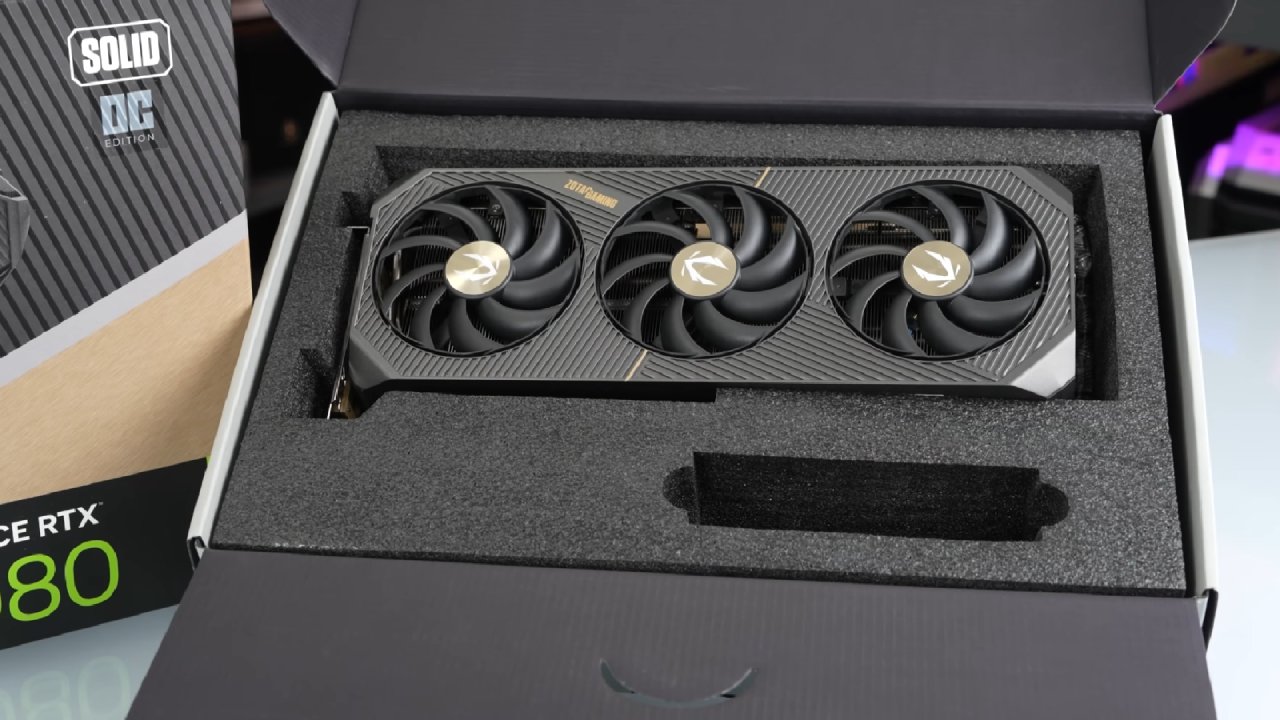
Design and Marketing
The Extreme Infinity and the Solid are Zotac's two primary RTX 5080 versions at the moment. The Solid is marketed as a simple, all-action option, while the extreme Infinity is marketed as radical and limitless.
There are also marketing terms like "Mirror Spectra ARGB," "Ice Storm 3.0," and "Firestorm Overclock Utility." Other phrases, like "up to nine composite heat pipes" or "card-length heatsink," may seem impressive but often lack precise specifications.
Despite these marketing claims, the Solid series maintains a straightforward approach, focusing on performance rather than flashy features. The card also features practical enhancements, including an LED indicator for improper 12V 2x6 power connector insertion and a dual VBIOS switch.
Tear-Down and Assembly
Zotac RTX 5080 Solid is much bigger than the FE cards because it has three slots and a strong three-fan design. Even if plastic restricts some airflow, the general design ensures that the structure remains strong and cools effectively. Fans move air across the PCB, which is approximately 95 mm wide and features grooves that enhance airflow.
The metal backplate, made of aluminum, efficiently covers the memory modules and parts of the VRM with 2–2.5mm thermal pads, improving heat dissipation compared to past Zotac models.
Internally, the card uses a vapor chamber design, separate memory contact plates, and seven 6mm heat pipes. MOSFETs now make proper contact with thermal pads, resolving a common issue in older Zotac cards. Fuses are included for RMA diagnostics, although they do not act fast enough to protect the card in real-time.
Fan replacements are accessible with minimal disassembly, and the main GPU die measures 45080GB203-400-A1, which is smaller than the 5090 counterpart.
.jpg)
Thermals
Thermal testing reveals that the Zotac 5080 Solid remains cooler than the FE card, despite consuming more power. The FE 5080 operates at 32dBA and consumes 315W of board power, which increases the GPU temperature to 65°C and the memory temperature to 72.8°C.
Zotac 5080 Solid runs at 31.1 dBA with a 360W board power, which lowers the GPU temperature by 4°C and the memory temperature by 7–8°C. The card's large heatsink helps maintain stable thermal performance even as clock speeds increase.
Acoustics
Noise levels remain controlled, with Zotac Solid avoiding the high-frequency spikes seen in the FE cards. Marginally higher noise occurs in the 1,000–1,600Hz range, but overall, the card remains unobtrusive.
The dual VBIOS options offer nearly identical performance, with the silent VBIOS running 3–4°C warmer on the GPU due to slightly reduced fan speeds.
Gaming Performance
Non-traditional gaming shows that Zotac 5080 Solid consistently performs 3–6% better than the FE model. In Resident Evil 4 at 4K, the Solid's average frame rate is 128 fps, 4.2% quicker than the FE's 123 fps.
The Solid achieves 237 frames per second at 1440p, which is 6% faster than the FE's 224 fps. Black Myth Wukong, Final Fantasy XIV Dawn Trail, and ray-traced scenarios with upscaling are among the titles that continue to see performance gains.
Overclocking
Overclocking produces a range of outcomes. With 3DMark Steel Nomad, we achieved a 700MHz core offset, resulting in a 28% improvement in simulated performance. However, this increase was not reproducible in real-world gaming scenarios. Overclocking headroom was limited by the instability caused by memory offsets.
In Final Fantasy XIV at 4K, applying a 500MHz core offset and 1,200 memory offset increased performance from 117.5fps to 125.75fps, a 7% uplift and almost 12% lead over the FE model. Compared to simulated benchmarks, real-world gains are not very significant; yet, with careful tuning, the card has significant overclocking potential.
Final Thoughts
Robust Zotac RTX 5080 Solid card performs well both thermally and acoustically. The MOSFET contact issues from earlier Zotac models have been resolved, and memory temperatures have been increased by 7 to 9°C.
Check Our Other NVIDIA Articles:
- GeForce RTX 5090 Unleashed: Is NVIDIA's New Flagship the Ultimate 4K Gaming GPU?
- NVIDIA GeForce RTX 5080 Review (2025): Still A 4K Gaming Powerhouse?
- RTX 5090 Performance Testing In GTA 5 – 1080p, 1440p, and 4K Max Settings Benchmark
- RTX 5090 Laptop Vs. M4 Max MacBook Pro: Ultimate Raw Performance Vs. Battery Endurance
- NVIDIA RTX 5070 Review: Mid-Range Muscle or Marketing Hype?
- RTX 5070 Ti Review: Performance, Thermals & Power Efficiency Tested
- Asus ROG RTX 5090 Astral OC Vs. Founders Edition: The 4K Gaming Benchmark
- ASUS ROG Astral RTX 5090 OC Edition Review: 32GB GDDR7 & 4K Gaming Benchmark
- ASUS GeForce RTX 5090 LC Liquid Cooled GPU Review: Unmatched Silence & Speed
- MSI GeForce RTX 5090 32GB SUPRIM SOC Review: Power Efficiency, Cooling, and Gaming Performance
- INNO3D RTX 5060 Ti 16 GB X2 Review: Gaming Benchmarks, Temps, and Power Efficiency
- HP Omen 45L Review: RTX 5090 Performance, Thermals, and Value Analysis
- ASUS TUF Gaming GeForce RTX 5060 Ti Review: DLSS 4, Power Efficiency, and Gaming
- ASUS Prime RTX 5060 Ti OC 16GB Review: DLSS 4, Ray Tracing, & Thermals Tested
- NVIDIA GeForce RTX 5060 Review: Specs, Gaming, and Cost per Frame
- MSI GeForce RTX 5090 GAMING TRIO OC Review: A Monster Power GPU
Editor, NoobFeed
Gaming Hardware Updates
No Data.