
Generation Exile Review
PC
Generation Exile’s solarpunk world and clever ideas stand out, but the struggle between puzzle-heavy systems and city-building freedom makes this early access debut feel promising, uneven, and hard to recommend at full price.
Reviewed by Mahi Araf on Apr 23, 2026
Small indie strategy projects often succeed or fail based on their ability to turn ambition into something playable, and that’s what makes Generation Exile so interesting. You can feel a small team reaching for something much bigger than its scale suggests. This isn’t another routine survival builder leaning on tired post-apocalyptic imagery.
It’s trying to carve out a different identity, pulling from solarpunk ideas, colony simulation, narrative RPG elements, and turn-based strategy all at once. That kind of mashup can collapse under its own weight, but even in rough early access form, Generation Exile has a sense of purpose.

What stands out almost immediately is how much care seems to sit underneath the project. Even where systems stumble, there’s a clear sense that the developers aren’t tossing together mechanics for the sake of complexity. There’s intent behind the world, the environmental storytelling, and even the way resource management ties into the fiction. You can tell this comes from a team aiming to build something distinctive rather than chasing whatever city-builder trend is working.
That also makes the game’s flaws easier to notice, because the ambition is so visible.
Generation Exile often feels like a game caught between breakthroughs and growing pains. There are moments where you can see it becoming a defining solarpunk strategy game down the line, and others where it still feels like an early framework searching for its final shape.
The setup places you aboard a generation ship fleeing a ruined Earth, trying to rebuild life inside a massive vessel while reclaiming polluted sectors. That premise immediately separates Generation Exile from standard colony sims. Instead of building across medieval fields or alien wastelands, you’re shaping settlements inside layered biomes on a giant ark, balancing survival with long-term recovery.
That concept is where much of the intrigue comes from. Pollution isn’t just another hazard meter. It shapes expansion, determines risk, and pushes the game closer to survival puzzle territory. The story around mysterious “scales,” ecological collapse, and eventual planetfall hints at something bigger than the early access content currently reveals. Even with only a few hours available, the narrative setup leaves room for larger ideas.
At the same time, the game’s current scope feels limited despite its ambition.
With only a couple of biomes available and roughly three hours of campaign content, Generation Exile sometimes feels like a strong prologue more than a full strategy experience. But that prologue carries enough atmosphere and mechanical experimentation to make you pay attention.
For a colony sim, Generation Exile leans surprisingly hard into narrative. Story events break up city management, often putting you in choices involving colonists, political tensions, or environmental crises. These moments can feel reminiscent of narrative strategy games, where your settlement becomes a collection of people rather than a series of production chains.
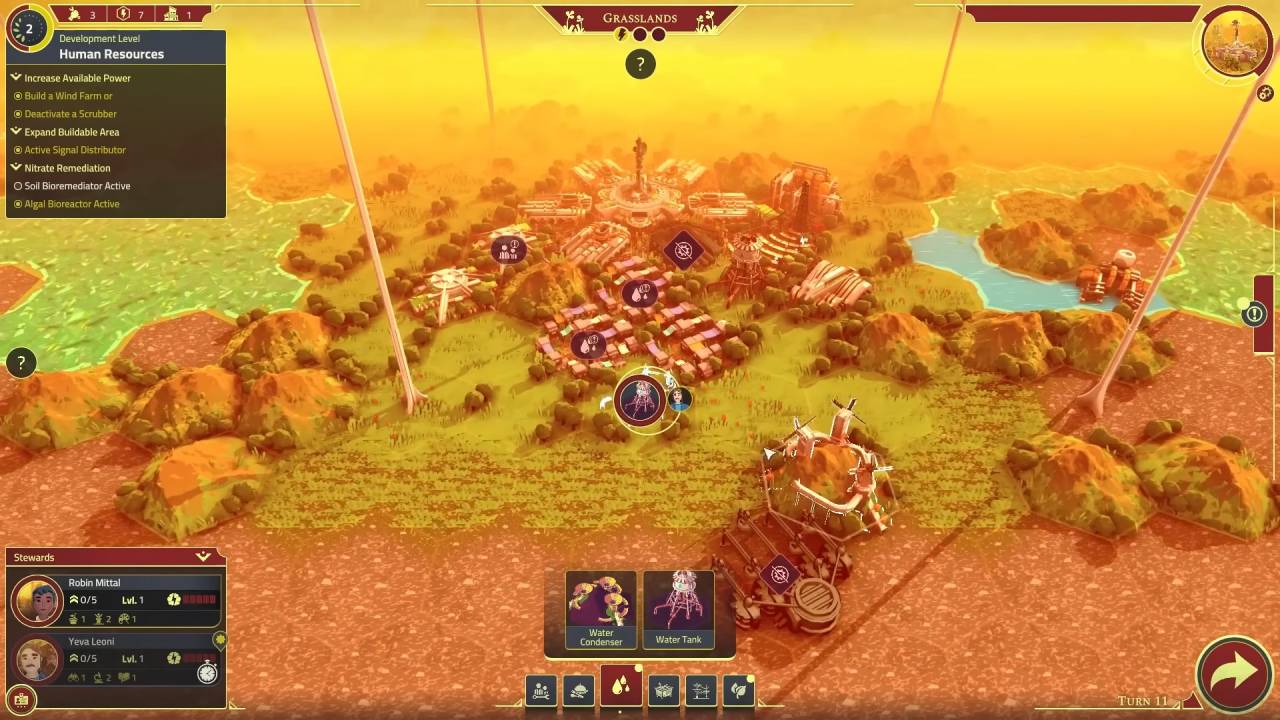
Some of those events work really well because they make your colony feel inhabited. Your citizens don’t just consume food and generate waste; they have problems, reactions, and sometimes conflicting priorities. Those story beats can make the ship feel alive. They also feed into the game’s influence checks through steward characters, adding another layer to decision-making.
Not every narrative moment lands perfectly.
Some dialogue can feel exaggerated compared with the grounded tone the game otherwise aims for, and there are moments where reactions feel written for drama rather than realism. But even when the writing stumbles, the effort to blend story with colony management gives Generation Exile an identity that many city-builders lack.
There’s also a bigger narrative mystery humming in the background. The game doesn’t explain everything clearly, sometimes too little, but the broader sci-fi premise has appeal. For players drawn to speculative science fiction, Generation Exile feels like a world with more to reveal than the current build allows.
This is where Generation Exile gets both fascinating and frustrating. On paper, the turn-based colony layer has a lot going for it. Every turn gives you limited actions, often managed through specialist stewards, forcing constant prioritization. Expand too aggressively, and pollution or shortages punish you. Focus too much on stability and you stall progression.
That pressure can make the game satisfying when systems click.
Solving a supply chain issue or surviving a resource crunch can feel genuinely rewarding. Building around water systems, power needs, housing demands, and environmental hazards creates a constant logistical challenge. You’re not just decorating a settlement. You’re wrestling with survival.
But the game often leans so hard into optimization that it stops feeling like city-building and starts feeling like puzzle-solving. Building placement can become rigid. One poorly placed structure can snowball into major problems hours later. Water production limits, waste storage range, demolition rubble, specialist actions—all these systems overlap in ways that can create soft locks or punishing recovery situations.
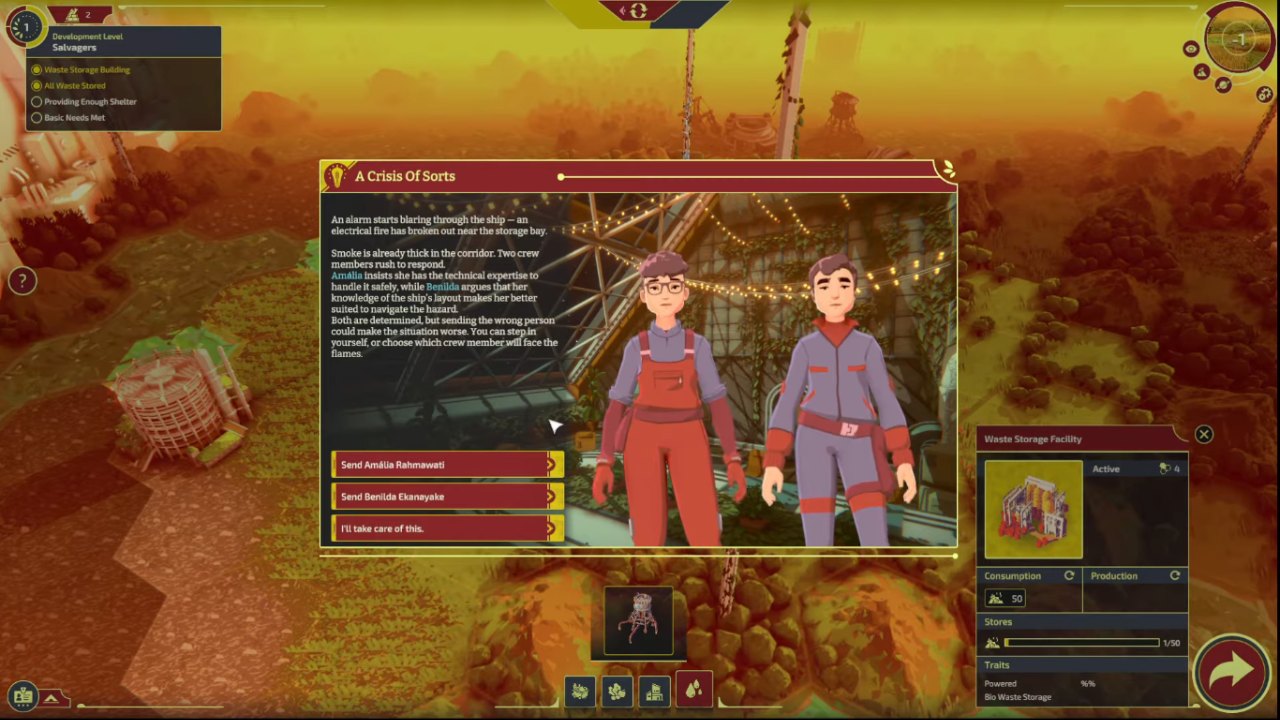
That’s where Generation Exile struggles most right now.
Information delivery swings between too much and too little. Some mechanics are layered and interesting, but barely explained. Others punish mistakes before you understand what mistake you made. Demolishing a structure and leaving waste behind without clearly warning you can derail a run. Running out of prefab flexibility because of early layout errors can trap you.
Then there’s the steward action system. It’s one of the more interesting mechanics, mixing skill checks, random outcomes, and tactical assignments, but early on it often feels like you’re accepting risks without meaningful ways to manage them. Negative traits or failed actions can push players toward save reloading instead of adaptation. The bones of a deeper system are there, but it needs more transparency.
Progression ties into this in unusual ways. Rather than traditional XP grinding, progression comes more through unlocking systems, steward growth, upgrades, and story milestones. Upgrade tokens influence colony efficiency, though sometimes in oddly restrictive ways. Because so much of Generation Exile revolves around tight resource planning, progression often affects whether systems feel liberating or even more constrained. When it works, progression opens strategic possibilities.
When it doesn’t, it reinforces the boxed-in feeling.
The world-building might be Generation Exile’s strongest asset. The biomes aren’t just visual themes. They influence strategy. Terrain shapes where systems can be placed, what resources can be extracted, and how pollution pressures expansion. There’s a constant relationship between environment and mechanics.
Exploration usually happens by returning to dangerous areas rather than finding new places on a map. Polluted areas, dangers, and random encounters make expansion feel risky. You’re not just uncovering the fog of war; rather, you’re deciding whether opening a new section is worth possible injuries, contamination, or resource strain.
Where things get complicated is how much this exploration layer overlaps with puzzle design. Space is tight. Storage limits can feel punishing. Clearing rubble creates its own logistical problems. Water infrastructure can feel under-explained. Instead of experimenting creatively, you often feel pushed toward hyper-efficient tile optimization. That’s where some players may feel Generation Exile behaves more like a logistics puzzle than a colony sandbox.
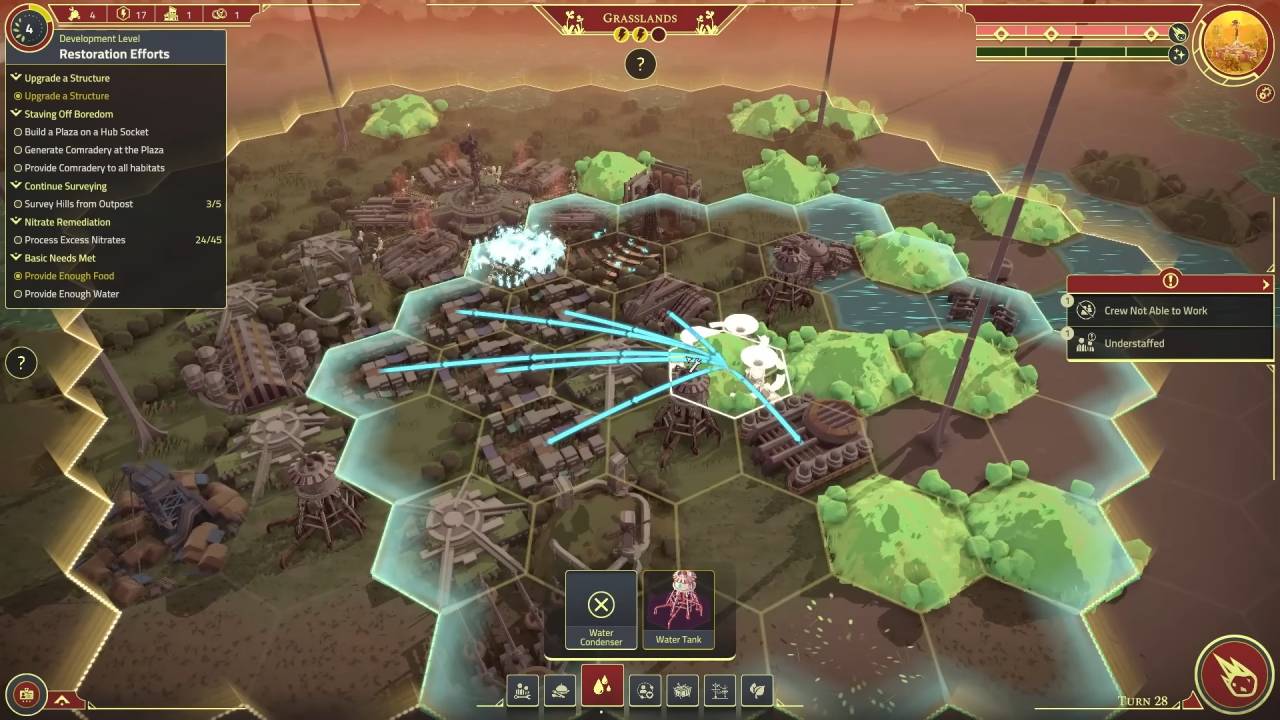
That tension cuts both ways. The puzzle-like structure can be rewarding when solving systems under pressure. But it can also make creativity feel restricted. Bigger maps, broader placement flexibility, or expanded storage could help the world-building breathe more. Right now, the world invites imagination, while the mechanics often constrain it.
Combat isn’t really the focus here, but risk systems and steward encounters function as a kind of tactical substitute. They’re conceptually strong, though the randomness sometimes undermines strategy. The good is that these systems add tension and variety. The bad is that unclear probabilities and weak risk control can make setbacks feel arbitrary.
Visually, Generation Exile punches above what you might expect.
The solarpunk aesthetic alone gives it a rare identity. Instead of gray industrial decay, you get vibrant tile maps, animated structures, shifting environmental detail, and a world that feels alive. There’s hope in the visual design without losing the sense of struggle.
The map work deserves a lot of credit. Subtle animation in buildings, environmental color shifts, and biome distinctions make even routine management enjoyable to look at. More importantly, the visuals aren’t separate from mechanics. Terrain communicates gameplay information while reinforcing atmosphere. That connection matters.
Sound design helps sell the world just as much. Ben Prunty’s soundtrack is very effective, often feeling active rather than background filler. The music supports both the reflective sci-fi tone and the tension of colony management. Ambient sound work is restrained but effective, and even interface sounds have a satisfying polish.
For an Early Access strategy game, Generation Exile often sounds remarkably cohesive.
The biggest takeaway from spending time with Generation Exile is that a genuinely compelling game is trying to emerge here. The setting is unusual. The art direction is striking. The soundtrack is exceptional. Some colony systems feel inventive. There are moments where Generation Exile looks like it could become a standout in the solarpunk strategy space.
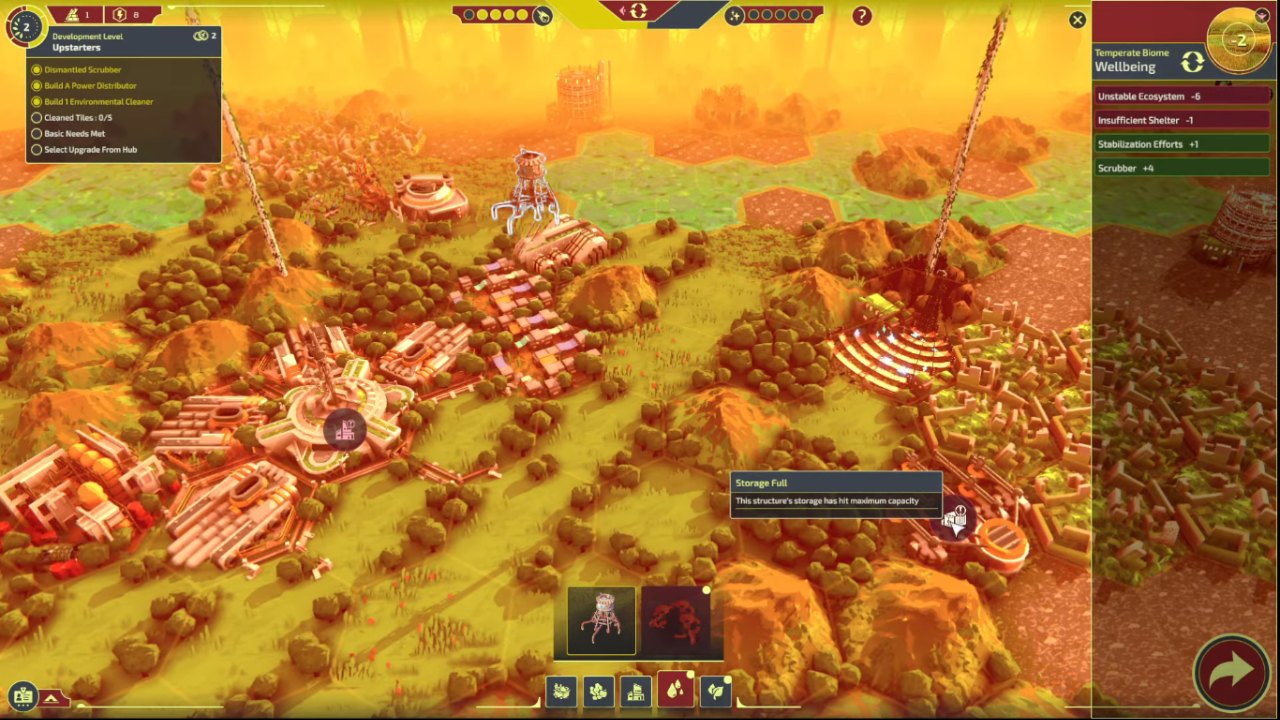
But right now, it’s also difficult to ignore how rough parts of the experience feel. The pacing of mechanics can be overwhelming. The rigid puzzle-like design can fight against creative city-building. Some systems lack clarity. Bugs and early access instability are still part of the package. And the limited content makes the $30 asking price difficult to defend.
That price becomes the main issue. Generation Exile feels expensive given that it offers only a few hours of campaign content, two biomes, no real sandbox mode, and limited replay value in its current form. There’s enough promise to justify playing it. There may even be enough for dedicated early adopters to support it now. But for most players, waiting makes more sense.
That doesn’t mean Generation Exile isn’t worth playing eventually. It means it feels like a game worth revisiting rather than urgently buying. If future updates expand content, improve onboarding, rebalance the puzzle-heavy rigidity, and refine progression, this could grow into something special.
As it stands, Generation Exile feels like a beautiful, ambitious project with real personality, uneven execution, and enough brilliance to keep you interested despite the friction. At full price today, it’s hard to call it an easy recommendation. At a lower price or after major updates, that answer could change dramatically.
Senior Editor, NoobFeed
Verdict
Beautiful world-building, clever ideas, and great atmosphere carry Generation Exile, but rough systems and thin content make $30 hard to justify right now.
65
Related News
No Data.