
K-pop Idol Stories: Road to Debut Review
Nintendo Switch
Managing a girl group turns out to be equal parts spreadsheet, soap opera, and rhythm game, and not always in perfect harmony.
Reviewed by Adeela Tas on Jul 16, 2026
Idol management sims have mostly stayed on the other side of the Pacific, tucked away in Japanese-only releases that Western fans could only watch from a distance. That's part of what makes K-pop Idol Stories: Road to Debut stand out the moment you boot it up. It comes from Wisageni Studio, an Indonesian developer, and is published by PQube.
The game is aimed squarely at the K-pop wave rather than borrowing from idol culture already covered elsewhere in gaming. There's no long legacy of sequels behind it and no returning cast from an earlier release. Going in, you're not managing an already-famous act. You're starting from nothing, with a failed former group behind you and a fresh shot at redemption under a brand-new label.
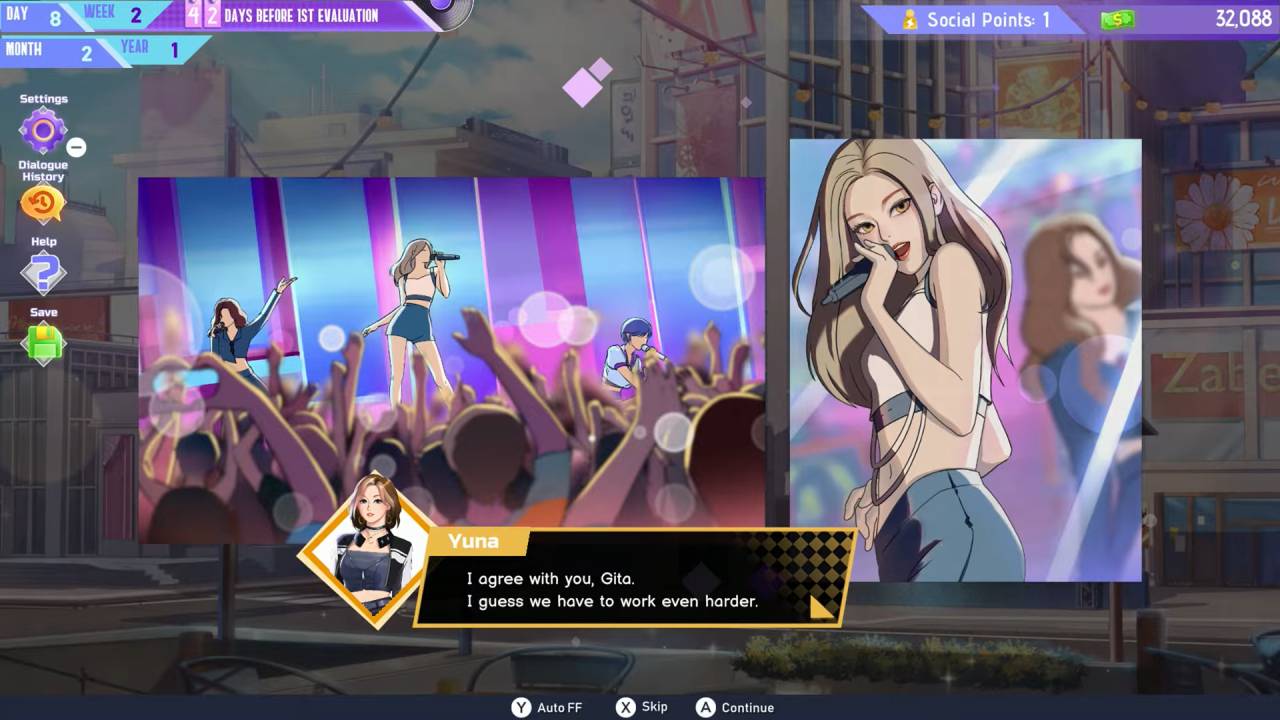
This game is about second chances and is designed to make you appreciate their importance early on.
Your story kicks off with your last idol group giving its final performance. The money ran dry, the act folded, and your friend Joo Won isn't exactly thrilled with how you handled things. That disappointment doesn't last long, though, because an email from WG Entertainment arrives almost right away, offering you a manager position on their newest venture, Project KIS.
After sitting down with the company's CEO and Vice President, you're asked to settle on a direction for your group, choosing between Fantasy, Cute, or Glamor, before you're handed the reins. From there, K-pop Idol Stories: Road to Debut lets you hold auditions, pick trainees, and build a lineup anywhere from a single solo act to a full eight-member group.
Every one of the potential trainees available to recruit has their own arc that depends on which of them you choose to hire and whether or not you pay enough attention to them. One may be the sort of person whose presence can literally make or break the entire troupe, whereas another one requires constant support just to make it through training.
The plot does not hesitate to touch on more difficult themes as well. It raises issues such as stalkers and obsessive fans, as well as concerns about getting too old for the industry. However, most of these topics are randomized. Storylines stall out unresolved, background staff repeat the same lines, and bonding with one trainee can lock you out of everyone else's arc.
It's a structure clearly built around replaying the game rather than seeing everything in one sitting.
On top of picking a group concept, you're also asked to settle on a management style early in K-pop Idol Stories: Road to Debut, choosing between The Marketer, The Realist, or The Risk-Taker in how you deal with your trainees and with the board above you.
It affects many choices in terms of dialogue that come later on in the game, whether or not you withhold certain facts from your idol until after their debut, whether you are honest or not about what is happening as it happens, and whether or not you want to satisfy the needs of the board.
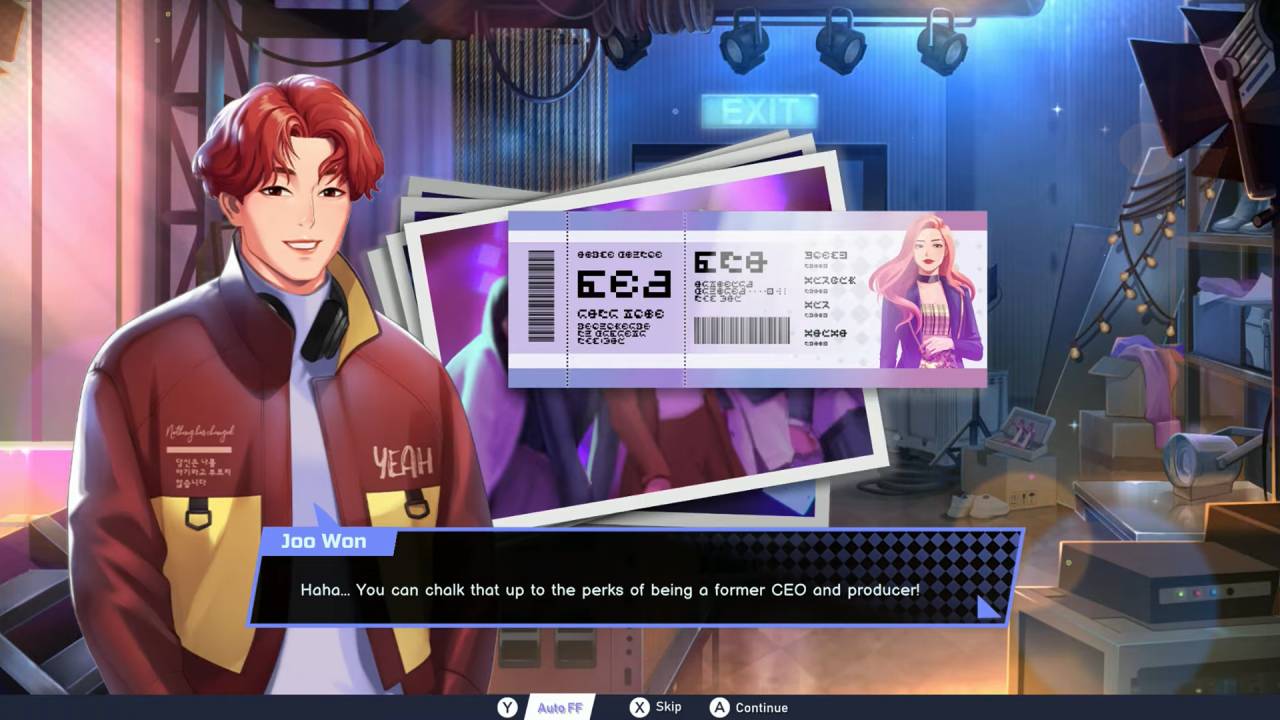
It just adds another layer of depth to the game, even if it is difficult to gauge how it affects the overall story elements. One run might see a trainee chase down a personal goal and end up bonding with you in a genuinely touching way by the end, while a completely different run might follow a trainee whose grades are slipping and whose parents are pressuring her to quit, only for that thread to trail off without a real conclusion.
Because so much of it is randomized, two people playing K-pop Idol Stories: Road to Debut back-to-back could walk away with almost entirely different stories to tell, even while following the same general path toward debut. After that, K-pop Idol Stories: Road to Debut becomes more routine and weekly oriented.
Each week will provide a set framework of schedule slots for you to do.
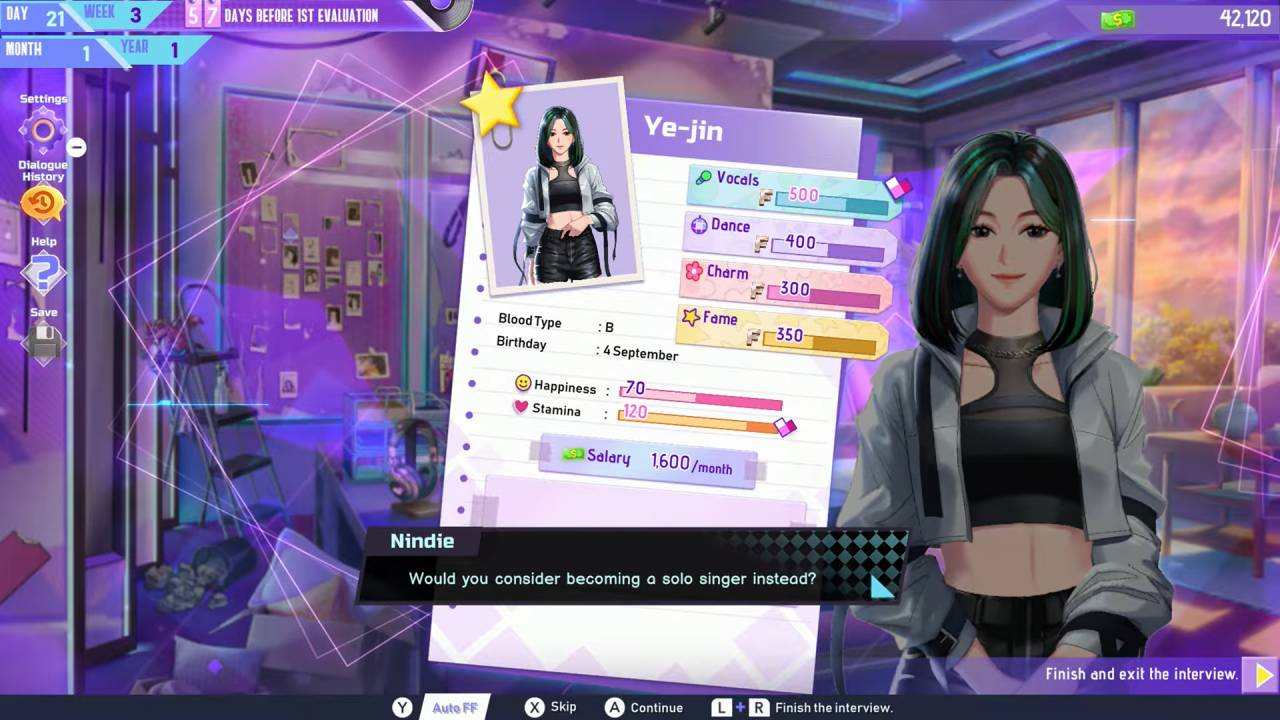
These may include some dance training, vocal training, make appearances to build your fame, or simply rest, while every idol you hire will have 4 key attributes: vocals, dance, charm, and fame. The concept you picked early on decides which stat matters most, so your schedule should, in theory, follow that priority.
What becomes clear fairly quickly, though, is that you're rarely in control of exactly who benefits from a given activity. You decide the type of training for the day, and the game applies those scheduled benefits to the group as a whole. While you can use your limited weekly social points and items to give an individual trainee a targeted boost, the main calendar blocks give you very little control over micro-managing a single member's stats.
Money is tight from the start, and it stays that way for a good while. Every trainee costs a monthly salary along with food and health expenses, and hiring more girls only adds to that pile without necessarily strengthening your group right away, since a new recruit joins with base stats that can actually pull your averages down until she catches up to everyone else.
You'll also unlock perks as your connections within the organization grow: a chauffeur so traffic doesn't cost you bookings, insurance to cover accidents, and a bodyguard to protect your idols from danger. All of it costs money, and all of it eats into the same tight budget.
As it were, the happier and more stamina your team has, the more they can work.
When either runs out, performance suffers. Time off, spas, and vacations restore your idols, but at the cost of practice time elsewhere. You also get two social interaction points a week to spend with staff or trainees, unlocking bonuses, extra training options, and occasional paid work like magazine shoots or acting roles, though those particular opportunities have frustratingly low odds of landing.
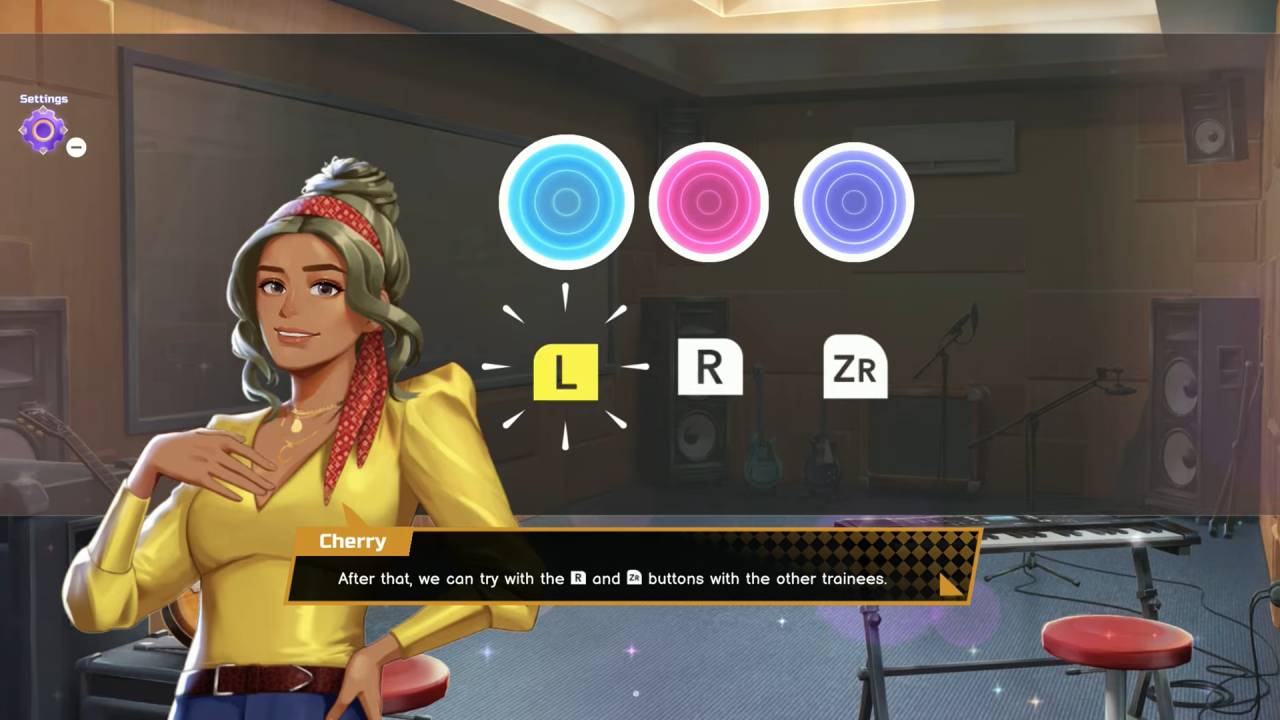
In addition to the core gameplay, there is a constant flow of mini-games that add some variation to the process: serving drinks to a certain mark, cooking food on a grill without burning it, sequencing of lights, spinning a prize wheel for stat boosts, and, during auditions, aligning a moving spotlight with podiums in a tight timing challenge to successfully recruit talent.
Later on, you'll even design your group's album cover, though the buggy tool makes it more frustrating than fun. There's also a memory-matching mini-game, a rhythm game, and merch customization, like designing fan lightsticks, for another small stat boost. All three games have no depth whatsoever, but they succeed at preventing grinding from becoming a monotonous process of clicking menus.
Money troubles can hit at almost any point, too, and not always in a way that feels entirely fair. It's easy to sink your budget into extra auditions or the wrong person, and if things get bad enough, the game drops you into a loan segment to keep the company afloat. That safety net exists, but lean on it too often, and you risk getting shut down by the CEO, so the early hours demand real budgeting care.
A full playthrough, from first audition to closing awards ceremony, runs roughly four to six hours, depending on how efficiently you manage your schedule.
There is a New Game Plus option waiting once you finish a run, though it doesn't carry over much beyond a modest head start on funds compared to the fifty thousand dollars you begin with the first time around. Considering how much of the story is locked behind random chance, a stronger set of carryover bonuses would have gone a long way toward making a second or third attempt feel more rewarding than simply starting over from zero.
Every so often, your weekly routine pauses for an evaluation, where your group faces off against a rival act in something resembling a turn-based RPG battle. Attacks pull from your idols' trained attributes, and each turn comes down to picking one of three dialogue-based options, each tied to a stat cost.
On paper, this is where all those weeks of training are supposed to pay off directly, with the numbers you built deciding how the confrontation plays out. In reality, K-pop Idol Stories: Road to Debut does not provide you with enough information for these confrontations to seem like strategy games.
All three options provided usually revolve around one and the same stat, which has the same effects or damage values, so you have to guess what will happen. After the confrontation phase is over, you can calculate your final ranking score; however, it rates your idols separately rather than evaluating how well they can form a team.
A mechanic where you spend weeks balancing a team, only to be scored as individuals; a disconnect that carries into how your idols actually grow.
Of course, it might look like a good decision to turn all your efforts into confrontation at first sight. Your idols' actual growth in K-pop Idol Stories: Road to Debut runs almost entirely on percentages and an unlock tree rather than anything resembling traditional experience points.
As you play, a visible tree of training methods gradually opens up, gated behind small odds and how close you've gotten to certain staff members. Luck into making some connections, and you'll gain access to items like picnic, backup dancing jobs, and extra sources of income that increase your popularity along with your wallet.
The thing is that many of these pieces of content are locked under such unlikely conditions that you will probably never see them during your career, and hence, much of what K-pop Idol Stories: Road to Debut offers remains inaccessible to you in any particular playthrough.
Another feature implemented in the game is the achievements system, which records your accomplishments in terms of income earned, competition victories, and relationship development with others, but these accomplishments don't offer anything significant enough to encourage you to pursue them.
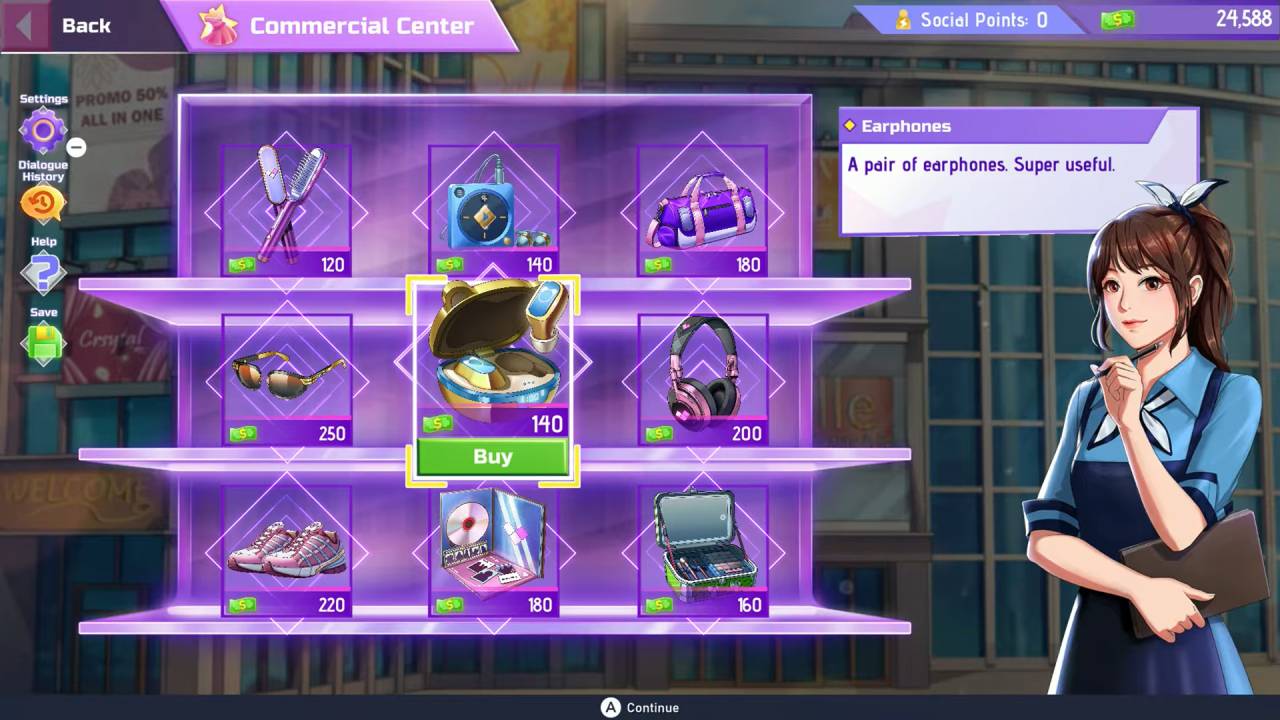
Visually, the game features a bright, anime-inspired art style centered on Live2D-style character portraits.
Trainees have distinct expressions that shift along with their mood, which goes a long way toward making conversations feel lively even when the writing behind them is thin. During training sequences, your idols switch to a chibi form with small animated touches depending on the task at hand, a nice bit of charm even if it doesn't extend much further than that.
The visuals fall flat during the bigger moments. Your debut concert reuses the same standing poses in your chosen outfits while a music video plays behind them, with barely any real movement to sell the moment you've spent hours building toward. There's also a phone-based gallery, but oddly enough, none of the CGs you unlock during a playthrough actually show up there, and there's no other way to revisit them either.
The soundtrack is where K-pop Idol Stories: Road to Debut earns some real credit. Original songs were composed specifically for the game, and they sound close enough to genuine idol releases that hearing your group's debut single for the first time actually lands as a payoff after everything leading up to it.
Training sequences get their own upbeat, non-intrusive background music, and quieter scenes lean on softer melodies to support the more emotional character moments. There's no voice acting anywhere, so a lot of that weight falls on the music and the writing to carry individual scenes, and for the most part, the soundtrack manages to fill that gap reasonably well.
What stays with you most about K-pop Idol Stories: Road to Debut is how close it gets to something special without quite closing the gap.
There's real charm in watching a full roster of your chosen trainees grow into something resembling a group, and the tension between training, money, and rest genuinely keeps you engaged for a solid stretch of playtime. But all of this positivity is undermined by the game's harsh and somewhat unfair decisions.
The inability to load any saved data, evaluation battles that offer no explanation for their results, and a possible abrupt ending that does not clearly state why this happened. Managing the same maximum cap of eight trainees per group also means that once you've seen what the game has to offer, there isn't much pulling you back for another attempt, even with the promise of different story branches along the way.

A handful of smaller rough edges add up over a full run as well. Some of the background dialogue clearly wasn't proofread carefully, since a few male staff members are referred to using the same lines written for female characters.
The interface can also get a little cramped once your roster and unlock tree both start growing, and a few of the discussion-based social minigames come down to guessing rather than genuinely reading a character, since the correct option seems to be randomized rather than tied to anything you've learned about them.
None of these issues is a dealbreaker on its own, but stacked together, they chip away at how polished the rest of the experience feels.
But none of the above detracts from the strong elements in K-pop Idol Stories: Road to Debut. It is a game clearly developed with dedication, and this shines through in its music, artwork, in the fact that it portrays the idol world as having actual consequences rather than as mere entertainment, and in the feeling of satisfaction that comes from watching your numbers rise each week despite any odds stacked against you.
What it needs most of all is a little more transparency, clearer explanations for why something goes wrong, more control over how your trainees develop, and some way to fix mistakes without throwing out weeks' worth of work. In other words, everything around K-pop Idol Stories: Road to Debut was not quite ready yet.
Editor, NoobFeed
Verdict
K-pop Idol Stories: Road to Debut is an engaging management simulation game with beautiful music and art design. More clarity regarding its mechanics would go a long way toward fulfilling its promise.
77
Related News
No Data.