
Stellaris: Nomads Review
PC
A fresh expansion that replaces planets with roaming Ark Ships and transforms survival into a constant balancing act.
Reviewed by Tahmid Mahi on Jun 16, 2026
Stellaris: Nomads has been one of the most flexible and ambitious grand strategy games on the market for almost a decade now. Paradox Interactive has given players a wealth of options with countless expansions, updates, and reworks, allowing them to create everything from galaxy-spanning machine intelligences to authoritarian empires and peaceful federations.
Many of these expansions added new mechanics and playstyles, but most still followed the same basic premise: building colonies, gaining territory, and managing a network of planets across the galaxy. This familiar structure helped maintain continuity across expansions, but it also made innovation feel gradual rather than transformative.
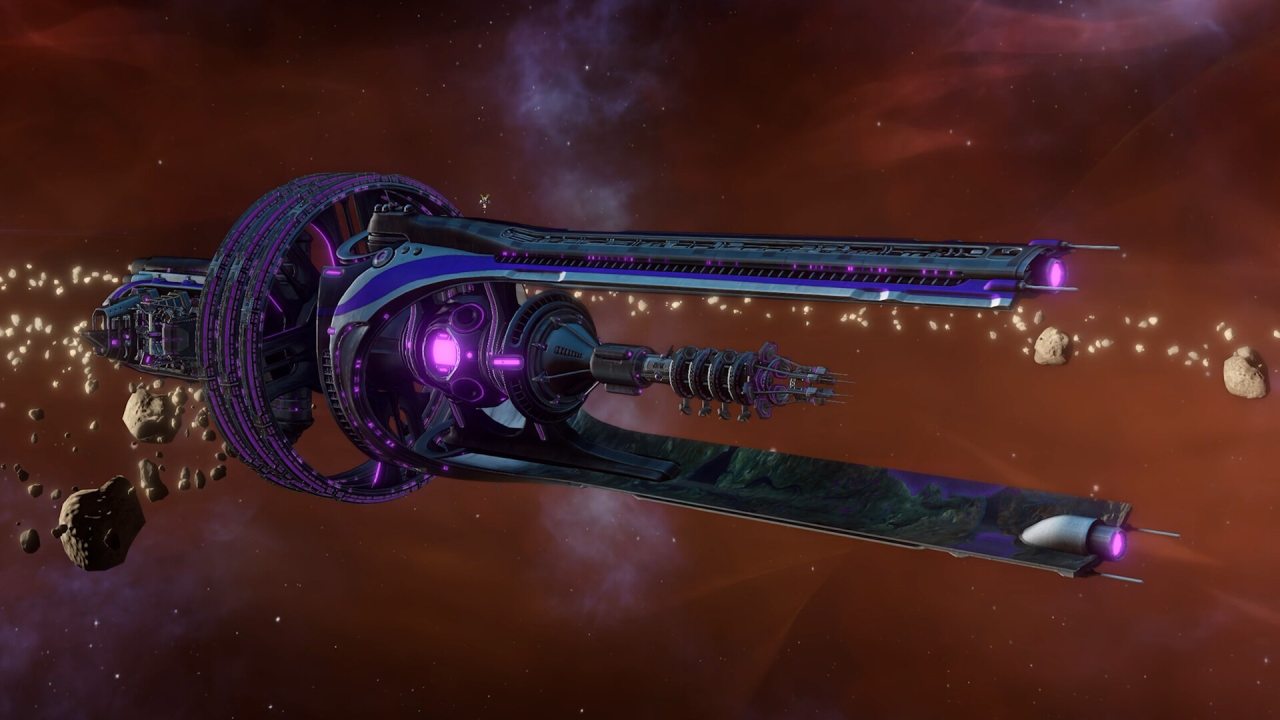
Stellaris: Nomads takes that formula and bends it in a big way.
The expansion has players commanding a civilization that lives exclusively aboard massive Ark Ships, rather than encouraging them to colonize worlds and build a traditional interstellar empire. These giant vessels function as moving cities, carrying populations, industries, infrastructure, and the entire future of the species through the stars.
The result is one of the most transformative expansions Stellaris has received in years. Stellaris: Nomads is not about territorial conquest or planetary colonization. It is about mobility, logistics, resource management, and long-term survival. Each decision involves keeping your civilization’s advancement in motion while addressing the needs of a populace living solely on mobile homes.
Stellaris: Nomads replace these with mobile population centers, creating a fundamentally different experience that feels both familiar and refreshingly new. It breaks long-held assumptions of how Stellaris is to be played without losing the exploration, storytelling, and strategic depth that have always been the hallmarks of the series.
The expansion introduces players to a civilization whose ancestors abandoned the idea of permanent settlement generations ago. Their society revolves around the Oros, a giant Ark Ship. It is the very heart of their culture and the foundation of their survival.
The story goes that the Oros people opted for a future among the stars rather than rooting themselves to individual worlds. Over centuries of travel, a whole culture grew up around life on the vessel. Political institutions, social traditions, economic systems, and even personal identities became inseparable from the experience of living inside a vessel that never really stops moving.
The Oros has several uses throughout the campaign. It is your capital city. Your homeworld. Your most precious resource. The physical history of your civilization. A series of story events will reveal forgotten parts of the ship, long-suppressed conflicts, and the hidden costs of maintaining a society within a ship that has been traveling through space for generations.
Many of these events are among some of the most compelling storytelling moments of the expansion.
People vanish into desolate areas, strange populations emerge from sealed rooms, and odd shortages uncover mysteries hidden in the heart of the ship. These scenarios add to a sense of the Ark Ship as a living environment with a history and unanswered questions.
.jpg)
Beyond the Oros, the galaxy keeps flinging emergent storytelling at you, just as Stellaris: Nomads is known for. Ancient civilizations leave behind ruins and artifacts for you to discover. Scientists are puzzled by strange anomalies. Probes sent out before the days of FTL travel are still out there, long after their creators have disappeared.
But the real strength of these stories is the way they play with the nomadic premise. The people of the Ark Ships live entirely in the galaxy’s threats and possibilities, unlike the old empires that only visited the distant systems. Exploration is not simply the pushing of borders but the discovery of the resources and knowledge necessary for continued survival.
Instead of colonizing planets, players build their civilization around Ark Ships. These massive ships are mobile cities, with housing, industry, resource generation, infrastructure, and population management. Your empire focuses on keeping those ships running and efficient. This immediately alters the rhythm of the game. In a typical Stellaris campaign, the expansion consists of claiming territory and setting up colonies on promising worlds.
In Stellaris: Nomads, expansion means improving your fleet's capabilities and eventually building more Ark Ships to support growing populations. In terms of balance, an Ark Ship has to be treated with kid gloves. Population growth drives up housing and job demand. Improving infrastructure drains scarce resources. New modules increase efficiency but require limited space. Every decision must weigh short-term survival and long-term development.
The economy of the expansion sustains this change in perspective.
Players do not mine planets for resources; instead, they use specialized ships to harvest minerals, energy, and other resources from space itself. Resource acquisition is not passive collection from established colonies; it is an active process involving planning and movement. This makes for a much more dynamic economic experience. Resource-rich systems are a temporary opportunity, not a permanent asset.
Players are always weighing up where to go next, how long to stay somewhere, and whether the potential rewards are worth the logistical costs involved. One of the most interesting additions of the expansion is the Way Station system. You can build these structures in explored areas to serve as logistics hubs. They store resources, assist fleets, and help maintain supply lines over long distances.
The civilization is constantly moving, so logistics is one of the most important strategic considerations. A poorly designed network can leave fleets under-supplied and Ark Ships unable to meet their basic operational requirements. Conversely, well-planned routes can significantly improve efficiency and support further growth.
.jpg)
Another important feature is the operational reserves system. Players have to oversee a larger reserve of resources than individual stockpiles alone, one that signals the preparedness and viability of their civilization overall.
This system gives you meaningful decisions about risk and reward.
If you aggressively use resources, you can increase your productivity and growth potential, but you also become vulnerable to shortages. If reserves are low, penalties can kick in that impact many parts of the economy and turn small problems into big crises if nothing is done. As the campaign progresses, research becomes more and more important.
New technology unlocks more Ark Ship modules, better harvesting systems, improved logistical infrastructure, and more sophisticated fleet designs. Players can build more Ark Ships over time. And these ships also act as a perfect replacement for colonies as a primary method of expansion. Each new Ark Ship serves as a self-contained population center, capable of operating independently while still connecting to the larger civilization.
It’s a strong sense of progression to go from managing one Ark Ship to managing multiple mobile cities. It maintains the growth feel that Stellaris players expect while also keeping in line with the expansion’s nomadic philosophy. Stellaris: Nomads doesn’t have traditional puzzle mechanics, but it constantly throws complex strategic problems at players, which often feel like large-scale logistical puzzles.
Every choice you make about how to spend resources, how to deploy a fleet, and how to develop infrastructure can have a profound impact. Every decision has consequences that reverberate throughout the empire. Taking resources away from one area may increase output in the short term but can leave another area under-resourced. New infrastructure development could underpin future growth and put temporary pressure on operating reserves.
These interlocking systems create a constant stream of meaningful choices that keep players engaged from session to session in the campaign.
Normally, in a normal campaign, losing a fleet is just a setback. In Stellaris: Nomads, an Ark Ship can hold a large percentage of your population and industrial capacity. There are few losses that can cripple an empire like its destruction. Fortunately, Ark Ships are not unarmed. Players can personalize them with weapon systems, fighter hangars, defensive modules, armor upgrades, and other military enhancements.
.jpg)
They can thus be population centers as well as powerful strategic resources. The extra vulnerability increases the tension of the conflicts. All major battles have major consequences, as the survival of your civilization often depends on them—literally on the battlefield. This aspect creates a stronger emotional investment in every engagement, as a single defeat can jeopardize years of growth and careful planning.
The military side of the expansion also has interesting economic tradeoffs. Building big fleets is an expensive business, and military production uses resources that could be used for other things. The balance between security needs and economic development goals is often a challenge for players.
This tension contributes to the impression that warfare is consequential, not routine. "But aggressive expansion can create opportunities, and it also adds risk." Defensive preparations are expensive in terms of resources. But their absence can be disastrous when hostile powers arise.
Visually, Stellaris: Nomads maintains the strong presentation standards established by the base game and previous expansions.
The galaxy is still filled with colorful nebulae, detailed star systems, ancient megastructures, and a wide variety of celestial phenomena. Exploration is still rewarding because any new system might turn up something unusual or valuable. The new Ark Ships really are something special. Their size immediately sets them apart from normal ships, helping to underscore their importance to both the game’s story and mechanics.
They really feel like huge mobile cities rather than oversized starships. Stellaris’ interface design has been improved as well, which also benefits the expansion. Mobile civilizations are difficult to control, so the user interface can become very cluttered. Otherwise, the different management screens generally do a satisfactory job of presenting information clearly and efficiently.
Resource displays, logistics tools, and Ark Ship management menus provide key information without creating clutter. There’s still a learning curve, but the interface does a decent job of supporting the expansion’s more demanding mechanics. The sound design is what you would expect from Stellaris. The music is moody and helps create a sense of scale and wonder.
The game announces important events through subtle sound effects that do not distract the user. The soundtrack may not be a total game changer for the sound experience, but it still works nicely into the themes of exploration, discovery, and survival in the game. Along with these elements, the visual presentation adds to the atmosphere that makes it easy to get lost in long campaigns.
.jpg)
Stellaris: Nomads works because it is not just about adding content; it is about changing the way the game can be played.
The expansion replaces traditional colonies with mobile Ark Ships, creating a new strategic paradigm. Logistics, mobility, and resource sustainability are just as important as diplomacy, exploration, and military power. Stellaris: Nomads' way of life is always pressing on you. You need to build up resources, keep reserves, protect fleets, and develop supply chains. Every success brings with it new opportunities and new responsibilities.
At the same time, the freedom of movement around the galaxy creates possibilities that are unavailable to conventional empires. Players no longer belong to specific worlds or territories. They are able to adapt to changing circumstances, to chase opportunities wherever they may arise, and to look at the galaxy from an entirely different perspective.
The expansion is not always kind. Its systems are interconnected and need attention; mistakes can snowball easily. Players who are used to traditional Stellaris strategies may need some time to adjust to its priorities and mechanics. But for those up for the challenge, it offers one of the most unique and rewarding playstyles the game has ever had. Stellaris: Nomads pulls off the tricky feat of feeling entirely different, yet retaining the identity that makes Stellaris compelling.
Editor, NoobFeed
Verdict
Stellaris: Nomads successfully rethinks the Stellaris formula with mobile civilizations, deep logistical systems, meaningful resource management, and high-stakes strategic choice.
75
Related News
No Data.