
MSI B850 Tomahawk Max WiFi Review: Best Budget AM5 Motherboard for Gaming
Designed for gamers and creators, MSI MAG B850 Tomahawk Max WiFi combines PCIe 5.0 performance with durable 8-layer PCB stability.
Hardware by Masaru Hoshino on Aug 31, 2025
It is an exciting time to be a motherboard reviewer simply because the B850 chipset-powered motherboards are flooding the market with boards that can do so much more for so much less. MSI is taking this opportunity to give a masterclass to its competition in terms of PCIe 5.0 integration.
MSI MAG B850 Tomahawk Max WiFi is an excellent board that delivers strong performance, durability, and future-proofing at a price point that makes it hard to ignore.
Build Quality and PCB
MAG B850 Tomahawk Max WiFi features a solid 8-layer PCB reinforced with two additional insulating copper plates. This provides one of the most durable foundations you can hope for, ensuring not only stability and insulation but also a cooler operating environment.
Design and RGB
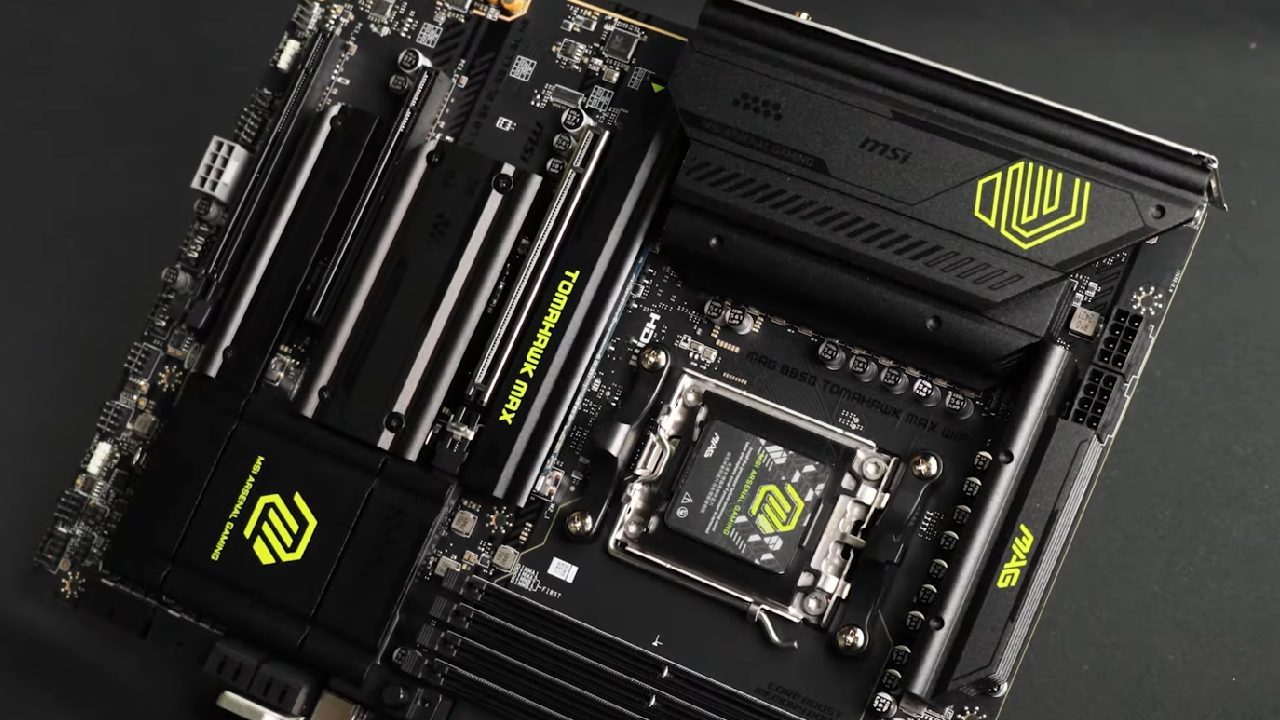
Design-wise, the Tomahawk B850 Max WiFi closely resembles other Tomahawk boards released over the past year. The military-inspired block design dominates the aesthetics, contrasted by punk green neon accents.
While not everyone may appreciate it, this approach works surprisingly well. RGB lighting remains discreet, maintaining the industrial theme. However, the board still includes three RGB connectors, allowing you to showcase your personality if you wish.
CPU and Chipset
Although some PCIe 3.0 and PCIe 4.0 lanes are cut, the board retains access to the CPU's full 24 PCIe 5.0 lanes. The trade-off is reduced USB bandwidth, fewer ports, and limited to no USB4 support. However, the B850 motherboards remain capable of delivering everything that makes 2025 gaming exciting at a more affordable price.
The AM5 socket continues to support three different Zen generations of processors, ensuring excellent value and at least two more years of platform support.
VRM and Power Delivery
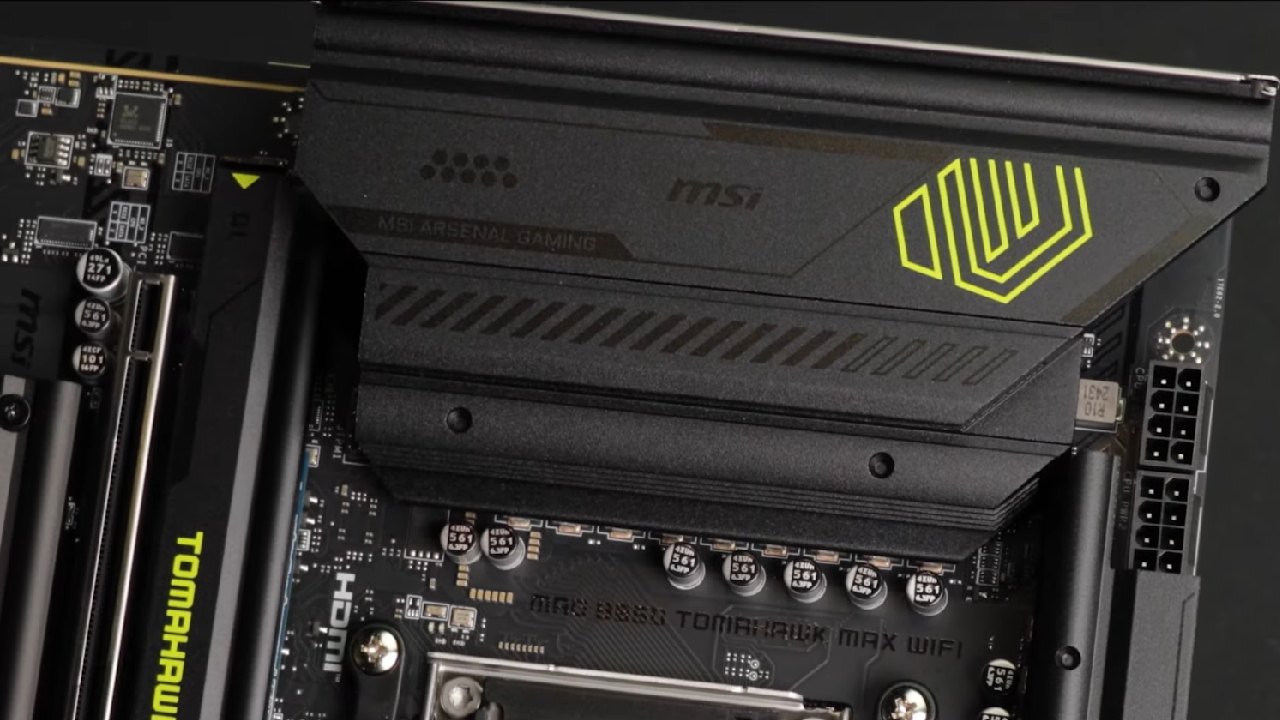
The VRM setup includes 1780A power stages organized in a 14+2+1 configuration, providing around 1350A of total output. This is the same VRM configuration seen on the more expensive MAG X870 Tomahawk, making it a fantastic value.
While flagship motherboards push toward 3000A VRM solutions, this configuration is more than sufficient to run the most demanding Ryzen 9000 CPUs, even with overclocking enabled.
MSI equips the VRM with serious passive cooling, using extended heatsinks with larger radiating areas, solid thermal mass, and a dual-contact design for efficient heat dissipation. Thermal testing demonstrates that even under prolonged stress tests, temperatures stay substantially below 50°C, even in the absence of a connecting heat pipe.
Memory Support
With a dual-channel rating of up to 8400MT/s, the board can accommodate up to 256GB of DDR5 RAM. This surpasses the 192GB limit placed on some rivals' B850 models by ASUS. The ability to use higher-capacity sticks enables greater flexibility in achieving top speeds, making them particularly useful for 3D rendering, video editing, and other memory-intensive tasks.
Storage Options
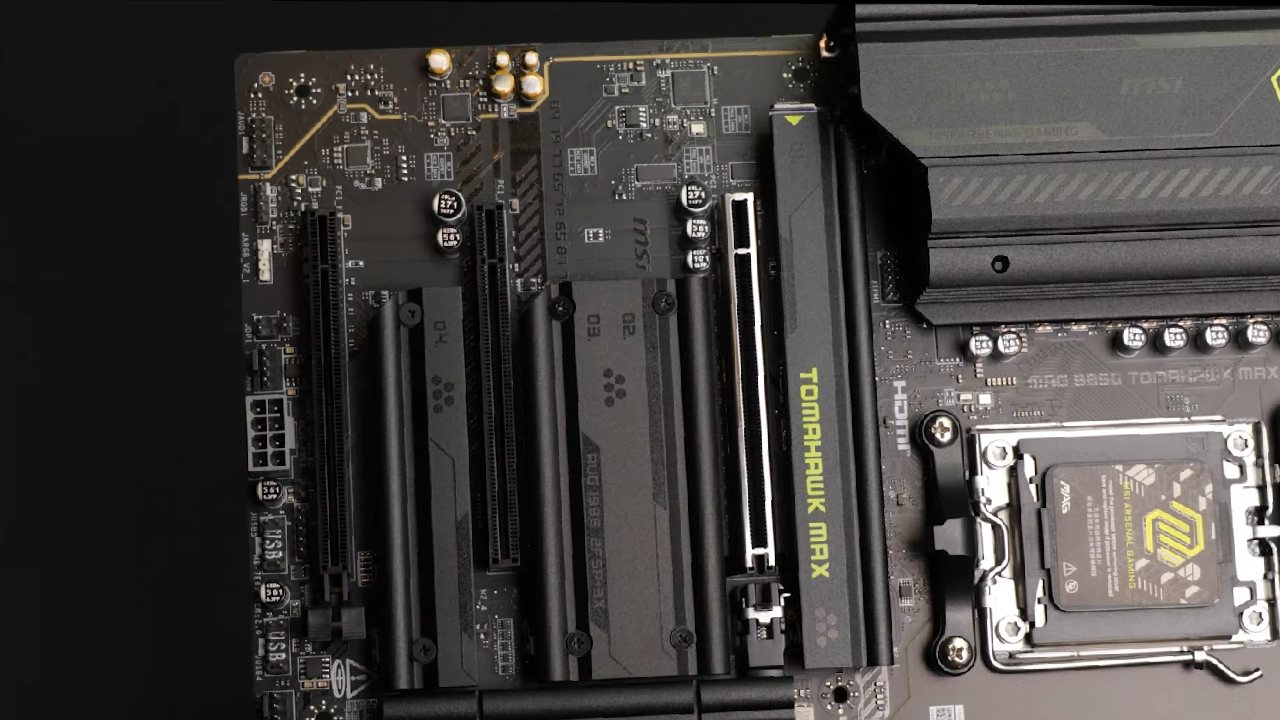
Storage is one of the strongest aspects of the MAG B850 Tomahawk Max WiFi. It features four NVMe slots, two of which are PCIe 5.0 enabled, each capable of delivering speeds up to 128GB/s. More impressively, both slots are non-bifurcated, allowing potential RAID setups reaching up to 256GB/s.
The other two slots run on PCIe 4.0, with one supporting 4 lanes (64Gbit/s) and the other supporting 2 lanes (32Gbit/s). All slots include thick, screwless heatsinks to prevent thermal throttling. Compared to previous MSI solutions, the new tool-free M.2 locking system is easy to use, long-lasting, and a significant improvement in quality of life.
PCIe Expansion
The board features three PCIe x16 slots. Maximum GPU performance and future-proofing are ensured by PCIe 5.0 reinforced steel main slot. Visual verification of correct GPU installation is made possible by its locking mechanism.
The third slot, fed by PCIe 4.0 lanes, is less useful due to its limited bandwidth and poor positioning under large GPUs. MSI didn't even include a locking mechanism here, making it the weakest point of the expansion design. Fortunately, the primary GPU and storage-related bandwidth remain fully preserved in all configurations.
Back I/O and Connectivity
The rear I/O reflects the chipset's budget focus with fewer USB ports than X870 motherboards, but still manages around 55GB/s of total bandwidth, including three Type-C ports. However, USB4 is missing.
Wireless connectivity is modern, with WiFi 7 dual-band support and Bluetooth 5.4. Ethernet is handled by a premium 5GbE LAN port. For audio, MSI includes the high-end Realtek ALC4080 codec, combined with robust copper-layer isolation and capacitors, to deliver one of the best onboard audio experiences available today.
Cooling
Cooling support is extensive, with eight PWM fan headers, including one dedicated to AIO pumps. This may seem overkill to some, but it guarantees that even builds with high airflow or water cooling are adequately supported. For simpler AIO installations, the board also has streamlined connectors.
Troubleshooting Features
Only a simple debug LED and a clear CMOS button on the back I/O provide troubleshooting alternatives. For a motherboard in this budget bracket, this is to be anticipated, even though it is not as sophisticated as premium boards.
Final Thoughts
One of the first genuinely inexpensive PCIe 5.0 motherboards that strikes a balance between price and performance without compromising necessities is MSI MAG B850 Tomahawk Max WiFi, which retails for $230 before taxes. At a price of less than $250, it offers an 8-layer PCB, a powerful VRM, non-bifurcated PCIe 5.0 storage, and high-quality audio.
For gamers and power users seeking a reliable, future-ready motherboard without overspending, this board sets a new standard in cost efficiency while keeping the features that matter most.
Check Our Other AMD articles:
- AMD Ryzen 9 9950X3D Review: Setting The Standard For 2025 Gaming CPU
- AMD Ryzen 7 9800X3D Review: 3D V-Cache Goes God Mode with Stunning Gaming Performance
- AMD RX 9070 Performance Review: Thermals, Clocks, and Real-World FPS
- AMD Ryzen 5 7600 Review: Best Budget Gaming CPU of 2025?
- AMD Radeon RX 7800 XT Review: RDNA 3 Power For Midrange Gaming
- Sapphire NITRO+ AMD Radeon RX 9070 XT Review: The Ultimate 4K Gaming GPU
- AMD Ryzen 7 7800X3D: Delivers Gaming Performance Far Beyond Expectations
- AMD Ryzen 9 7900X Review: Powering the AM5 Era with DDR5 & PCIe 5.0
- ASRock Radeon RX 7800 XT Challenger OC Review: Best Price-to-Performance GPU of 2025
- Intel Core i9‑14900K vs. AMD Ryzen 7 7800X3D: Power Profiles & Gaming Benchmarks
Editor, NoobFeed
Gaming Hardware Updates
No Data.