
BioEden Review
Nintendo Switch 2
A calm restoration sim where rebuilding a broken planet means balancing resources, animal needs, and the damage your own infrastructure can cause.
Reviewed by Adeela Tas on Sep 03, 2026
You step into BioEden as a Keeper, taking responsibility for a dying planet and the job of making it livable again. The setup is straightforward. The world is polluted, extinct creatures can be restored, and you need to rebuild an ecosystem without pushing the planet toward collapse.
The interesting part is that restoration and industry are tied together. You need machines, power, water, research, and construction to repair the world, but every structure can also increase the environmental pressure you are trying to reduce. That tension gives BioEden its identity.
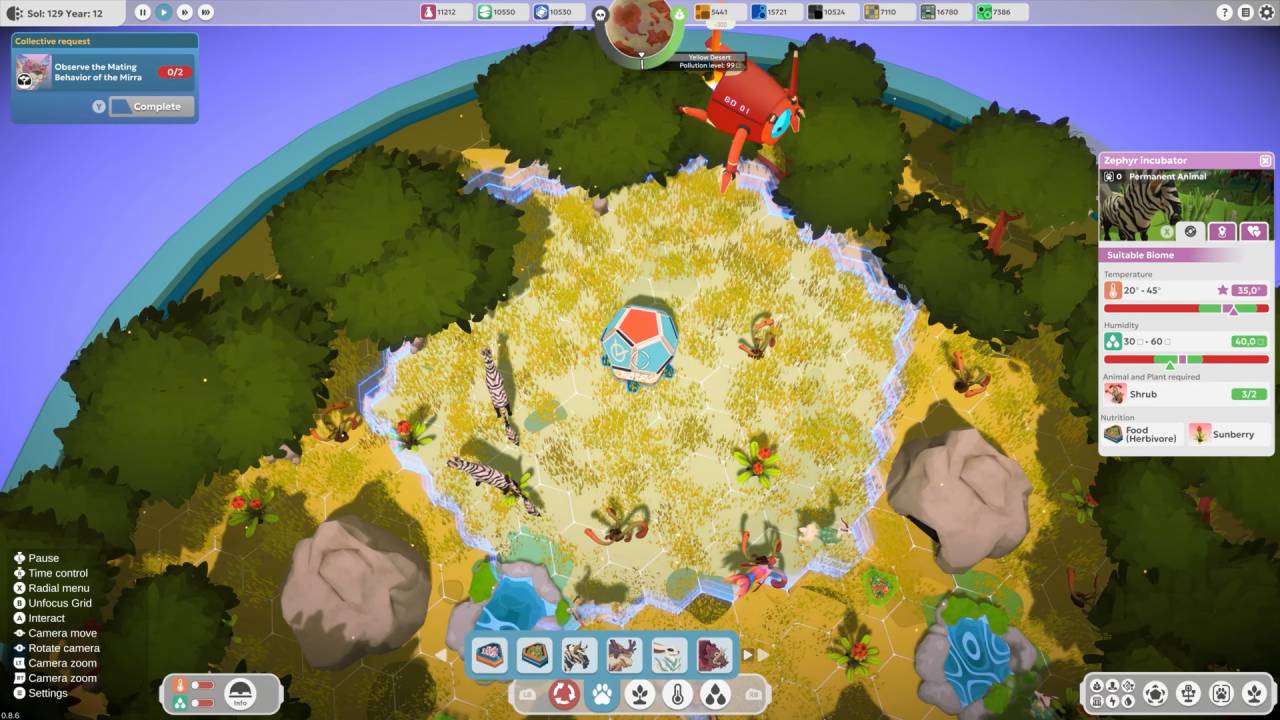
You cannot simply expand whenever you have enough materials.
You have to consider whether another building or connection is actually useful, because unnecessary infrastructure raises your impact. When something has finished its job, you can dismantle it and recover the resources used to build it. As a result, your base is constantly changing rather than becoming a permanent collection of buildings.
Broken Arms Games has built the game around this slower approach to management. The Italian studio previously made Hundred Days, a winemaking simulator, and Under Par Golf Architect, and that background fits the accessible design here. BioEden does not try to make management intimidating.
You start with a small set of systems and gradually take on more responsibility. There are also six guilds, with different identities, perks, and starting biomes, giving you different ways to approach the same larger goal. Your first real project is bringing an animal back.
You begin with a DNA fragment, analyze it, and discover that it belongs to a Laghop. Inside your biodome, you create a safe habitat to incubate it. The savannah climate suits it, but the creature also needs particular vegetation. You need research points to unlock the necessary bushes, which immediately sends you outside the dome.
That is where the BioEden resource loop begins.
Research needs water and electricity, so you build a solar energy system and a water system, connect them through power poles, and establish a research center. Once it is operating, you can unlock the bush, plant it inside the dome, and wait for it to grow. Once the habitat is ready, the first animal appears.
Breeding takes that simple idea further. After the Laghop arrives, you need additional bushes, blueberry bushes, and a water bowl before it will reproduce. You arrange the habitat, let the plants grow, and eventually the animals move into their cave and produce a baby. The satisfaction comes from creating the conditions yourself, rather than simply selecting a breeding option.
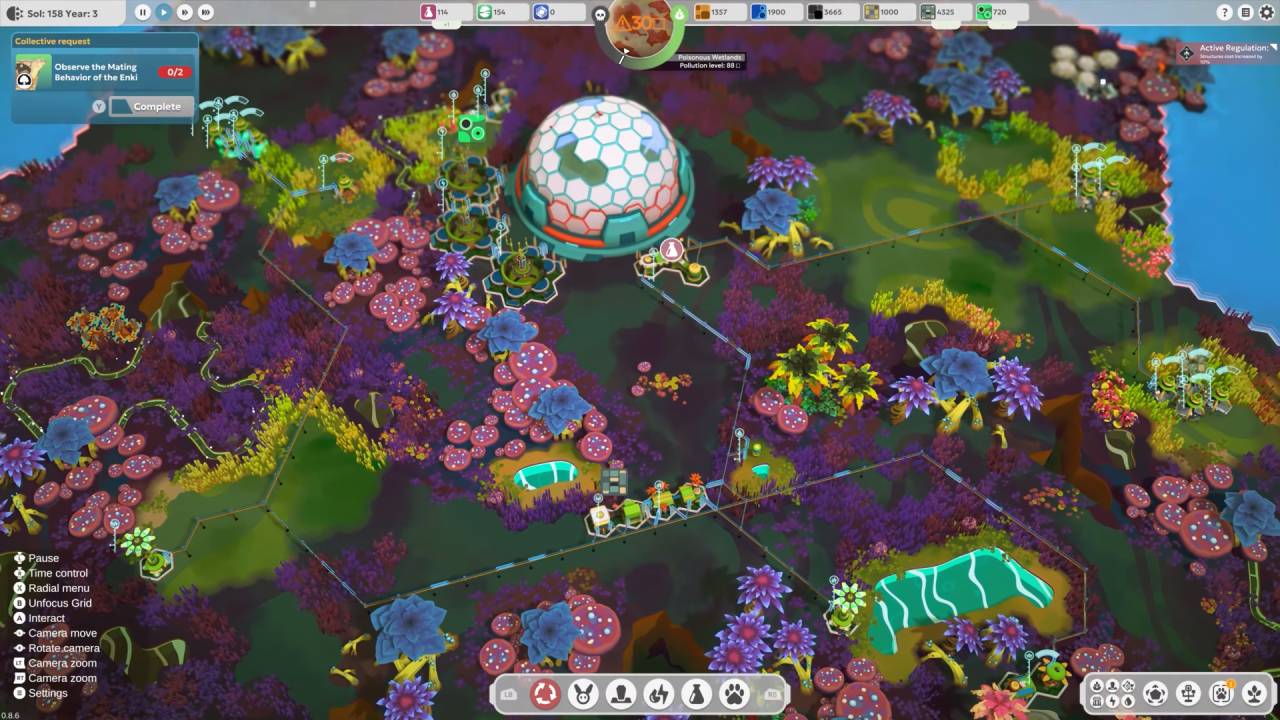
The same system continues with new species. The Vaex is a cat-like creature that eats blueberries and Laghops, turning the first animal into part of a food chain. You then work with maples and water to complete its habitat. Later, the Anky introduces an alien turtle that needs bushes, maples, and suitable humidity. As the creatures become more demanding, your placement becomes more important.
Requirements are based on ranges, so a plant can look close enough while still being outside an animal's usable area. You may need to move a maple or relocate sunberries because part of the habitat doesn't reach far enough. It is a small problem to solve, but it makes the dome feel like an actual habitat rather than a checklist.
Eventually, predators enter the picture.
Zephyrs resemble alien zebras, while Prowlpads are predator cats that hunt them. Zephyrs need shrubs and sunberries, while Prowlpads have their own requirements. Carnivores can be supplied through dedicated feeding stations, which help stop them from constantly hunting the herbivores you are trying to maintain.
There is no conventional combat, so the food chain becomes the closest thing to an encounter system. Step outside the dome, and BioEden becomes a different kind of game - one centered on resource extraction. Scattered waste sites hold a range of raw materials: ferosine, benzorite, silicate, dinitrogen, phosphorine, titanite. The process is simple enough.
Set up mining rigs next to deposits, wire them into your network, and the harvested materials feed directly back into construction and research. But the loop has a neat tension: you pull resources from contaminated ground to fund the restoration meant to clean it up, even as running that extraction equipment risks adding to the damage.
Power and water in BioEden are therefore more important than they first appear. A research center needs both, while a ruin study site also depends on the energy network. Later shortages can slow research and other systems. Power poles themselves contribute to impact, so creating a huge network just because you can is rarely sensible. You need to think about where you place infrastructure and how much of it you actually need.
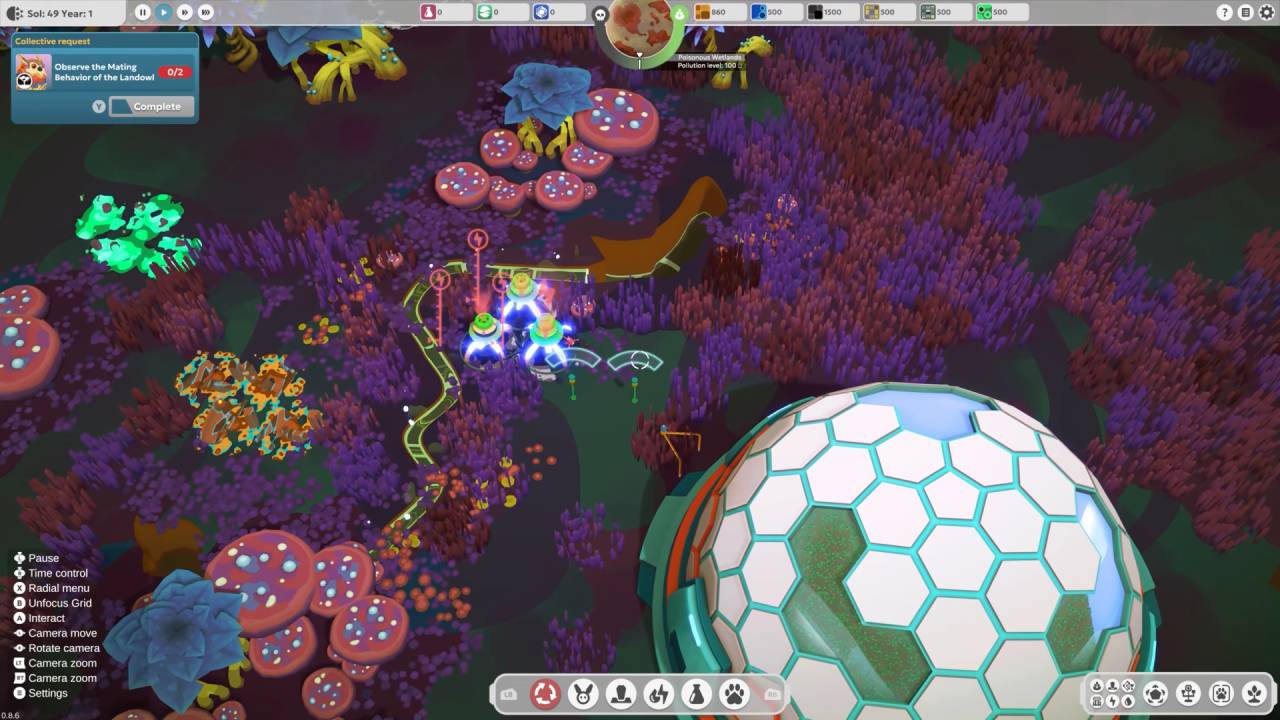
Recycling in BioEden makes this much easier to manage.
Once a mining site is exhausted, you can remove the miner and reclaim resources. You can also replace inefficient connections, shorten long routes, and swap older energy infrastructure for better options. Wind turbines, for example, provide stronger energy production with less environmental impact than the earlier solar setup.
That becomes especially useful during an eclipse, when solar generation is temporarily reduced or stopped. The environmental gauge is the real pressure behind your decisions. Finishing a polluted mining site can restore some land, while cleaning contaminated lakes moves the planet toward recovery.
Construction does the opposite. Research stations, mining equipment, water systems, and other structures can increase your risk of crisis. If that level gets too high, the environment starts imposing penalties, including reduced water production.
One of the most effective countermeasures is water purification. Drop a cleaner onto a contaminated lake, let it work through the pollution, then reclaim it for reuse elsewhere once the job's done, and running several cleaners at once speeds things up considerably.
Restore enough lakes, and the crisis percentage starts dropping fast.
Better still, the payoff isn't just numerical: watching the terrain shift toward green as you go gives all that resource juggling something concrete to show for itself. Everything ties back together through BioEden's research tree. Early on, you're spending research points to bring basic vegetation online, while technology points, earned by picking apart the ruins scattered across the map, open up separate avenues of progress.
Even breeding has a role here: successful pairings feed into your guild or collective's advancement, unlocking further options down the line. Push far enough, and you'll start unlocking new DNA samples, rarer creatures, better energy infrastructure, water purification, and room to expand your domes further.
It's a system built around variety rather than a single resource treadmill; you're rarely just grinding one currency, but always angling toward the next unlock that reshapes what's actually possible. The progression also keeps you moving between the dome and the outside world.
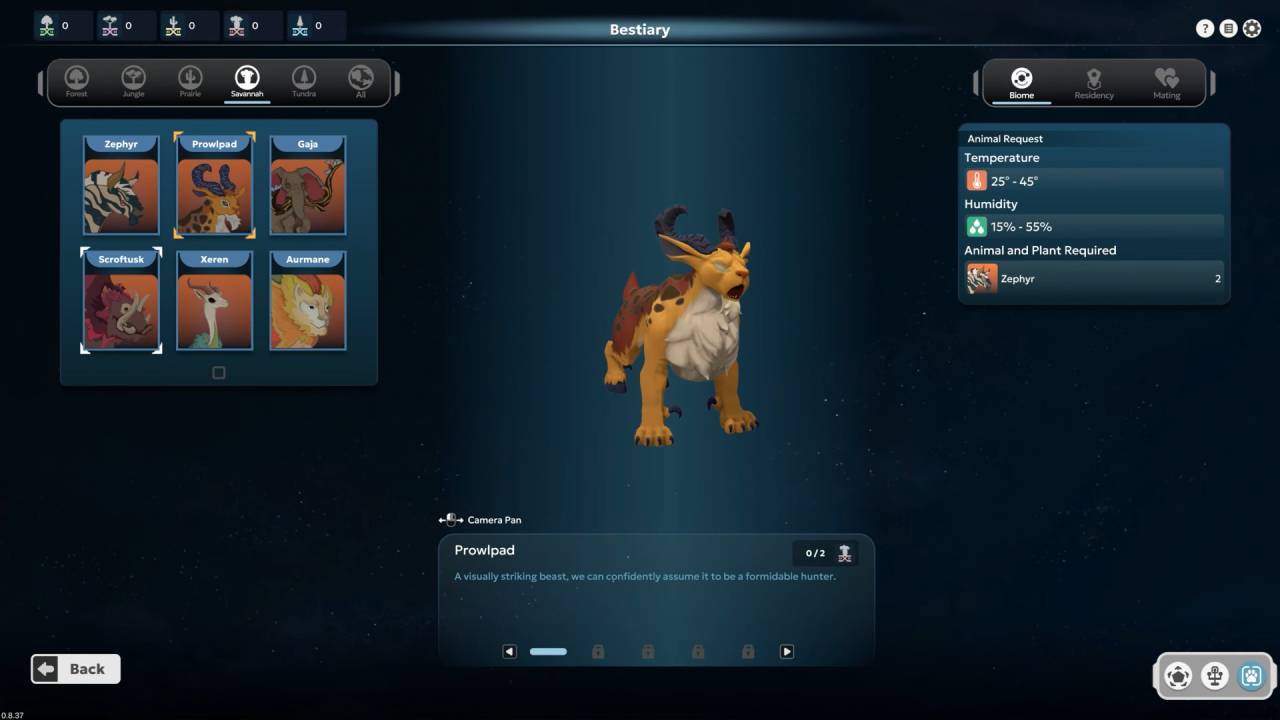
You might return to check whether an animal has enough plants, notice that you need more silicate, travel across the map to a deposit, build a connection, and then realize that your crisis risk has become too high. That sends you back to recycling or restoring polluted areas. The back-and-forth is the main rhythm, and it keeps the two halves of the game connected.
The tutorial lasts around an hour and a half and starts by explaining almost every step.
As you advance, though, the game gradually stops giving you as much direction. Some mechanics remain locked until later, and when they become available, the game doesn't always explain them in detail. I liked having room to experiment, but at times I had to work out systems that could have been explained more clearly.
The help menu is available, but it does not always solve those problems. Water purification is a good example. At one point, the training path lets you clean lakes, but rivers require a separate purifier unlocked elsewhere. If the lakes are clean while rivers remain polluted, releasing animals can still be blocked.
Once you understand the separate systems, it makes sense, but clearer information in the tutorial or help section would make the situation much less confusing. Rather than chase realism, BioEden commits to a stylized look, and it's the right call.
That bright, saturated palette feels right at home in a solarpunk world, and it does real work highlighting the contrast between the scarred land beyond the domes and the neatly cultivated life within them. The animals themselves land in a sweet spot too; charming enough to love, but never so cutesy that they overshadow the management depth underneath.
Few things feel as rewarding as watching dead soil slowly regain its color; a small but visible reminder that your efforts are actually adding up.
The environments themselves are less detailed. There isn't much animation or small environmental activity, so the presentation clearly emphasizes systems over spectacle. That is not a major problem because restoration provides its own visual progression. You can see the planet changing as your decisions begin to have an effect.
Performance holds up just as well. Running at 1440p and 60 frames per second, the experience stays smooth; no stutters when transitioning between areas, no mid-session crashes, no framerate dips even after hours of play. Nothing here demands much from the player's attention, either. The technical side simply fades into the background, which is exactly what you want when you're juggling multiple networks and habitats at once.
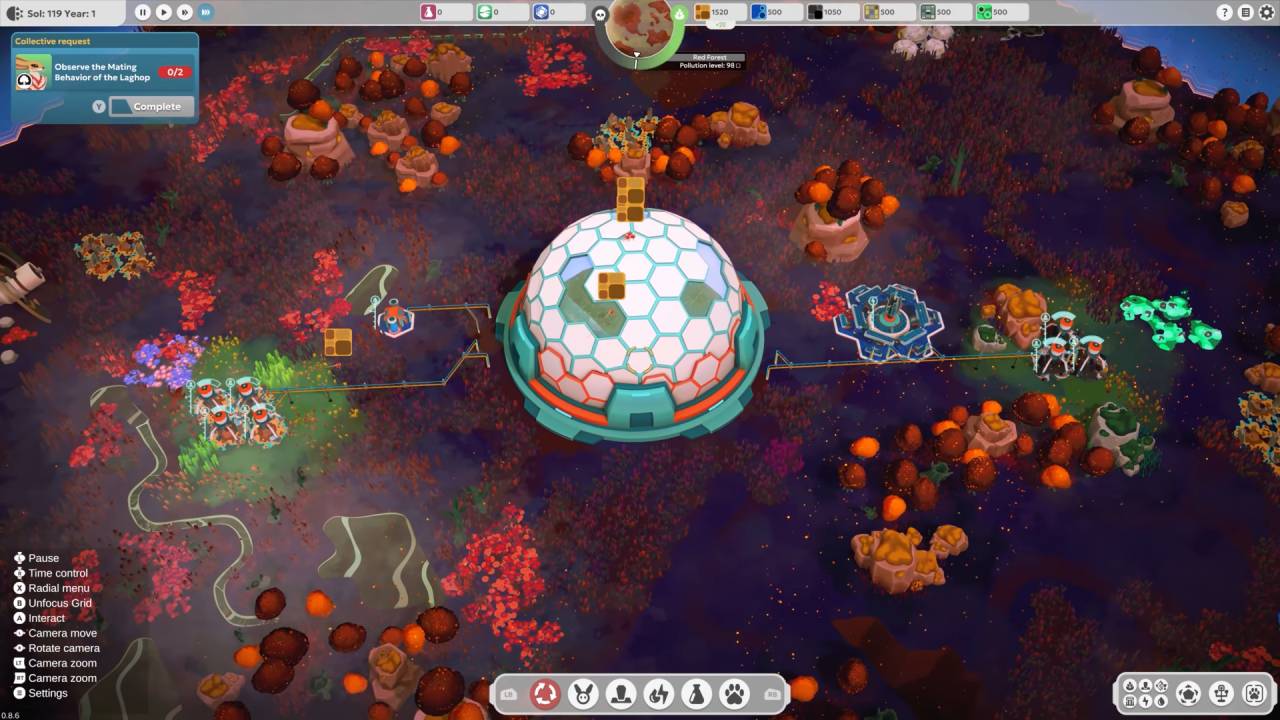
The interface is generally readable, although some icons and notifications could stand out more. Once the tutorial ends, it becomes easier to overlook a small message or indicator. The systems themselves remain approachable, but stronger visual communication would make the transition from guided play to independent management smoother.
Sound doesn't dominate BioEden, which fits its slower pace. You spend your time watching resources collect, plants grow, habitats settle, and polluted areas recover rather than dealing with constant threats. Time acceleration is available for waiting periods, which helps when research, vegetation, or resources take a while.
Speeding time through such a calm game is slightly amusing, but the option is practical.
BioEden simply doesn't let you lose. There's no game-over screen, no ticking clock, no cap on turns. Even outright mistakes are forgiving; dismantle a building, and you'll recover its resources, no harm done. That safety net makes the game a genuinely low-pressure way to learn its management systems without getting punished for every misstep.
If you need real stakes to stay hooked, though, that same forgiveness can wear thin over time. But if you're the type who finds reward in steady improvement, that's exactly what you'll get here: fulfilling a request, hatching a new animal, cleaning up a lake, retiring a played-out miner, chipping away at the crisis percentage; each one lands because it's part of something bigger.
The planet isn't set dressing. It's the project itself, changing bit by bit because of what you do. The guild system gives that loop more room to breathe. The six choices offer different identities, perks, and starting environments, so moving beyond the training guild can change the way you approach progression.
With more creatures, technologies, and biome requirements opening up, the system has enough variety to make another run feel worthwhile. Priced at $22 in the United States, the package feels fair given how much time the systems can absorb. The game is available on PC, PlayStation 5, XBOX Series X and S, and Nintendo Switch 2. After spending time with it, the strongest part is how consistently the systems support the central idea.
You need industry to restore nature, but industry creates environmental pressure.
You need animals for progression, but animals demand resources and carefully arranged habitats. You need research for better solutions, but research requires the same infrastructure that can raise your impact. Every part feeds another. BioEden is not aiming for the complexity of a hardcore management simulation.
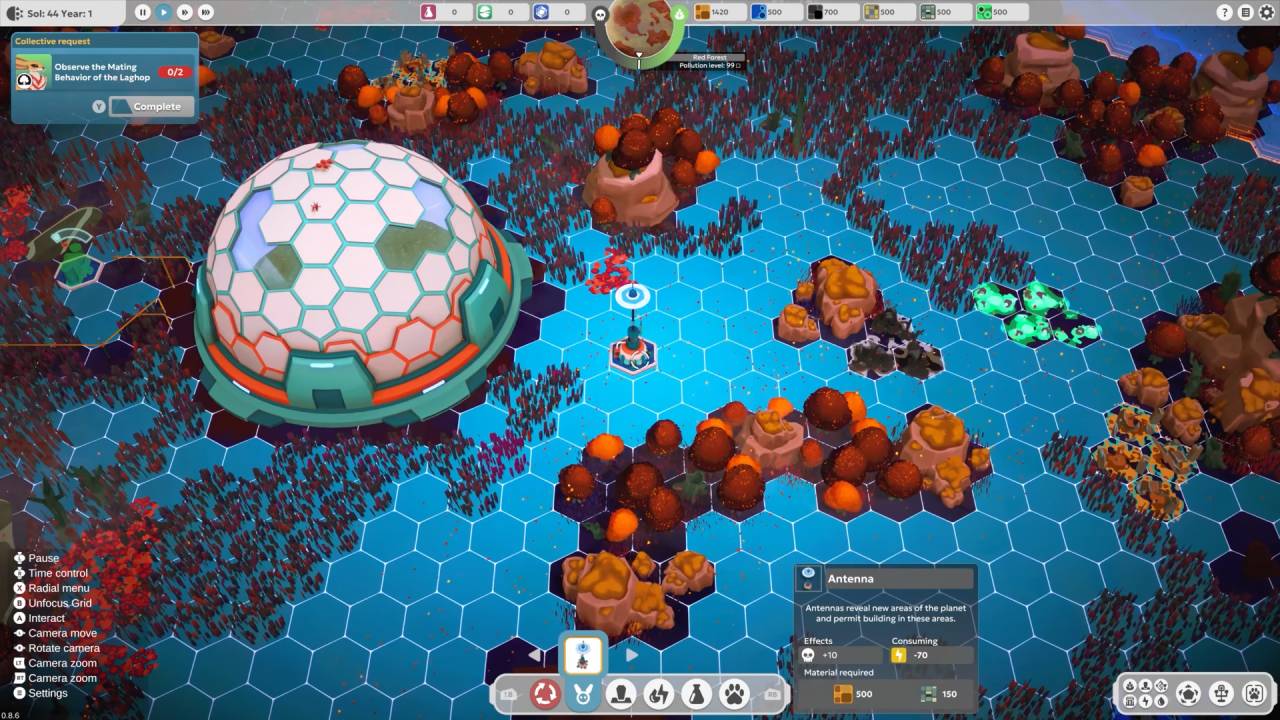
Its challenge is gentler, and its forgiving design lets you experiment without destroying a run. The pace is also deliberately slow. You wait for plants, research, resources, and purification, then make your next adjustment. If you accept that rhythm, an evening can disappear surprisingly easily. The result is a management game built around patience rather than pressure.
You begin with polluted land and a piece of DNA, then gradually create habitats, connect networks, restore water, remove waste, and bring species back. You don't need combat or dramatic failure to make those steps rewarding. The objective becomes the simple act of leaving the planet healthier than you found it.
BioEden works because its animal habitats, resource systems, research, and environmental impact are tied together, rather than feeling like separate features. There's no fail state, which keeps the game welcoming, but the pollution gauge still gives your choices real stakes. It won't be for everyone.
The pacing is unhurried, some mechanics aren't explained as clearly as they could be, and the presentation doesn't reach for spectacle. Even so, the restoration loop at its core is easy to sink into, and more engaging than it might sound on paper.
Editor, NoobFeed
Verdict
BioEden is a relaxed, welcoming management sim built around a genuinely satisfying restoration loop. Animal breeding and resource planning complement each other nicely, and the low-stakes design keeps things easygoing.
78
Related News
No Data.