
Star Trek: Voyager - Across the Unknown Review
PC
Why Star Trek: Voyager - Across the Unknown feels like the most thoughtful Star Trek game in years.
Reviewed by Mahi Araf on Feb 19, 2026
When you first load up Star Trek: Voyager - Across the Unknown, you immediately get the sense that this is not trying to be a flashy, action-heavy sci-fi spectacle. Instead, it feels like a game that knows exactly what kind of audience it is aiming for.
It is built for players who enjoy slow-burn strategy and meaningful choices. It is also clearly designed for longtime Star Trek fans who have been waiting for a game that respects the franchise's tone and intelligence.
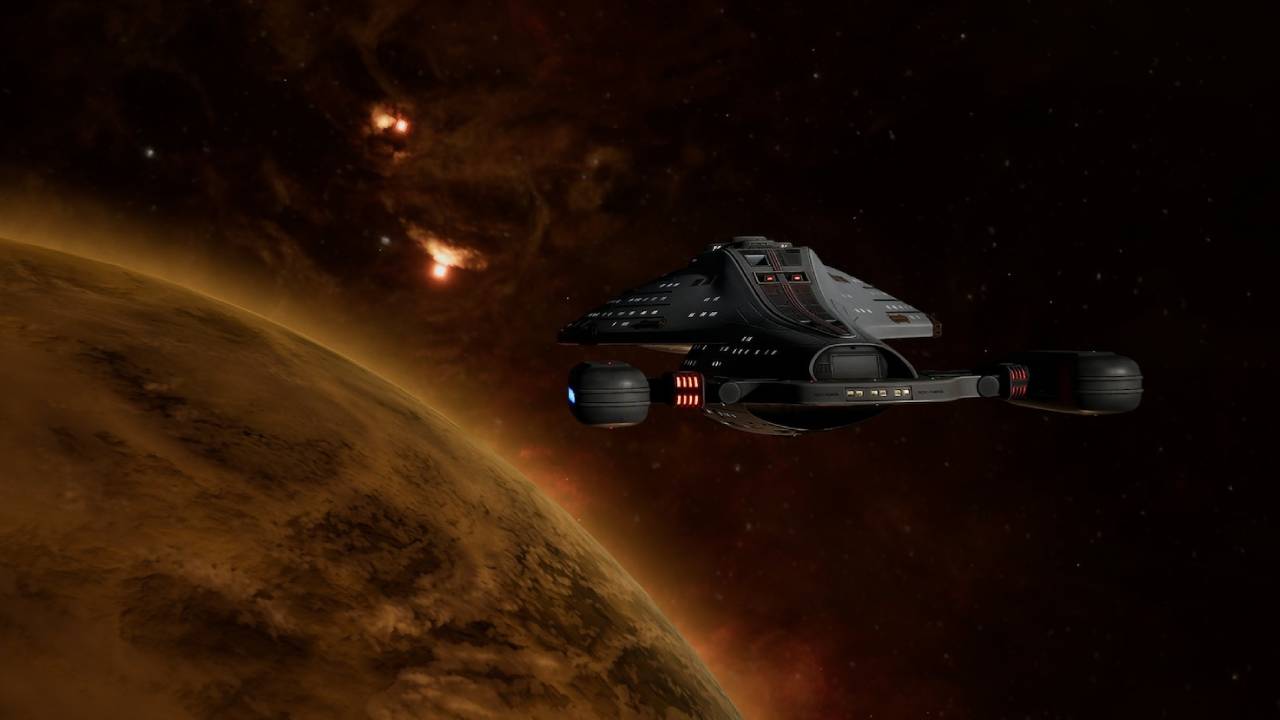
You are not jumping into fast-paced dogfights or constant explosions. You are stepping into the captain’s chair and being asked to think and survive. From the very beginning, it makes clear that this is about leadership and long-term decision-making, not quick wins, which embodies Star Trek through and through.
The developers behind this project, Gamexcite, clearly understood that Voyager’s story is different from most Star Trek series. This is not about boldly going with full Starfleet support behind you. This is about being stranded and forced to rely on your crew and your judgment. That idea shapes everything in this game, from its structure to its mechanics.
Rather than creating a brand-new story loosely inspired by the show, the game closely follows Voyager’s original narrative arc.
You start at the moment of displacement into the Delta Quadrant, when everything goes wrong. The ship is damaged, the crew is reduced, systems are failing, and the journey back home looks almost impossible. This grounding in familiar territory helps the game feel authentic right away, especially if you already know the series.
At the same time, the game does a good job of making this setup accessible even if you are not a hardcore Trek fan. You still understand what is at stake. You are far from home. You are alone. You have limited resources. You have people depending on you. That is pretty much the setting.
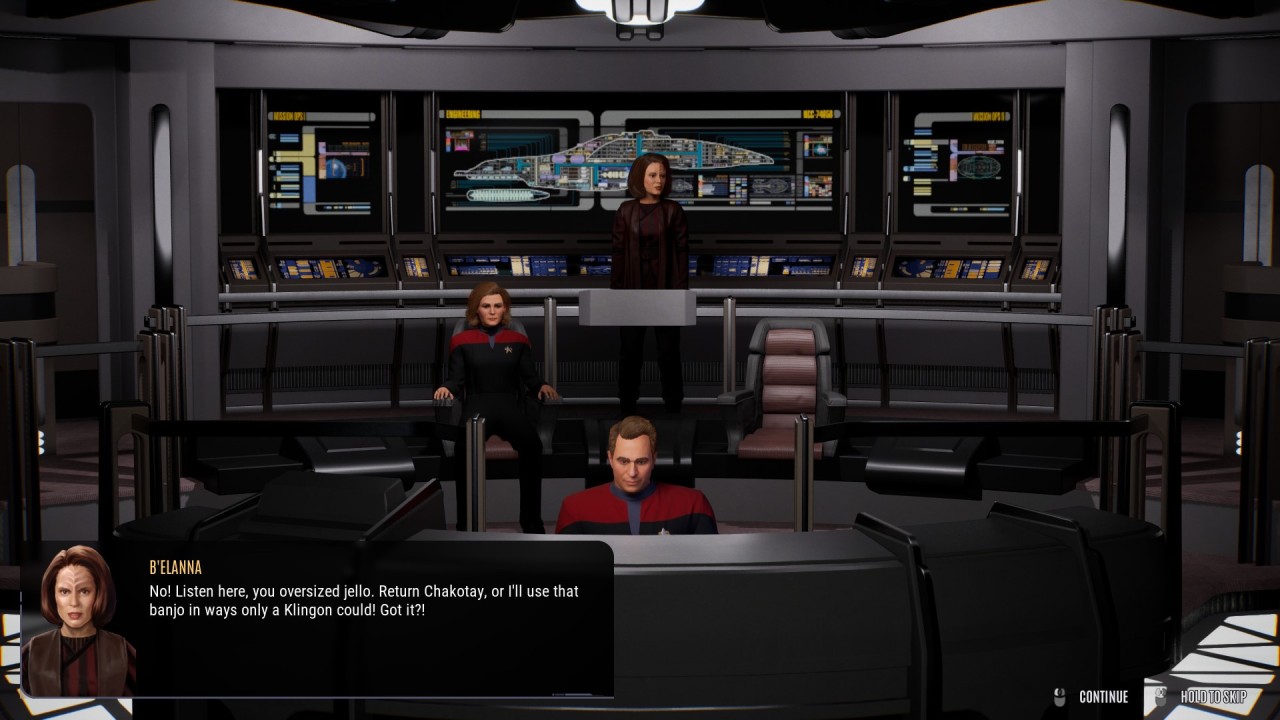
The narrative is easily one of the strongest parts of the experience. It feels like playing through an interactive season of Voyager. Exploration, diplomacy, moral dilemmas, and survival all blend together naturally. You are constantly faced with situations where there is no perfect solution. Every choice comes with consequences, and those consequences actually matter.
There is no simple "good" or "bad" meter guiding you. If you make a questionable call, you might lose crew members, miss out on future opportunities, damage your ship, or waste precious resources.
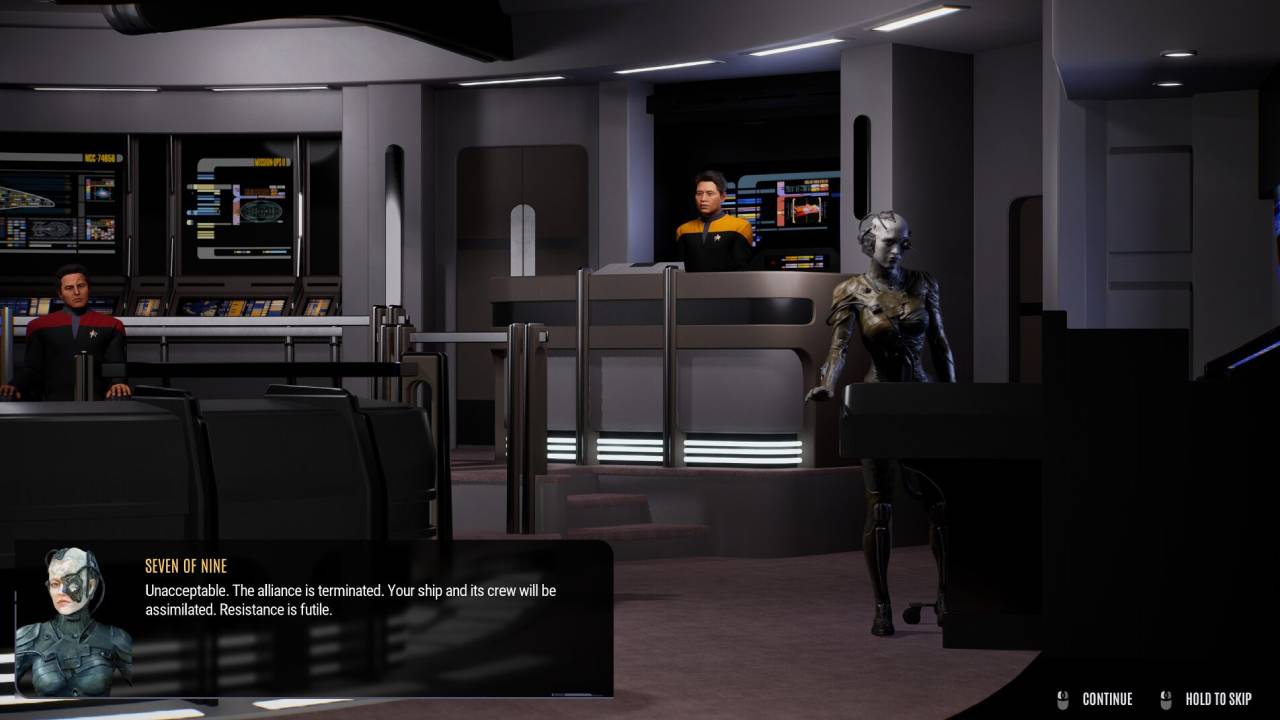
Over time, these small decisions stack up. You start to feel the weight of being in charge. You begin to understand why Janeway’s role was always so complex in the series.
The game also does a good job of pacing its story. You move through different sectors that feel like chapters in a long journey. Each one brings new challenges, new factions, and new ethical problems. You are not just jumping from mission to mission. You are slowly progressing through a massive voyage, and that sense of scale never really disappears.
Where the game truly shines is in how it blends storytelling with systems. The narrative is not something that exists separately from gameplay. It is woven into everything you do. Your ship’s condition, your crew’s morale, and your available resources all directly affect how story events play out. In return, story choices influence your long-term survival.
Most of your time is spent managing the USS Voyager itself. After being thrown into the Delta Quadrant, the ship is barely functional. Entire decks are offline. Rooms are destroyed. Life support is unstable. Energy is limited. You start in survival mode, not exploration mode.
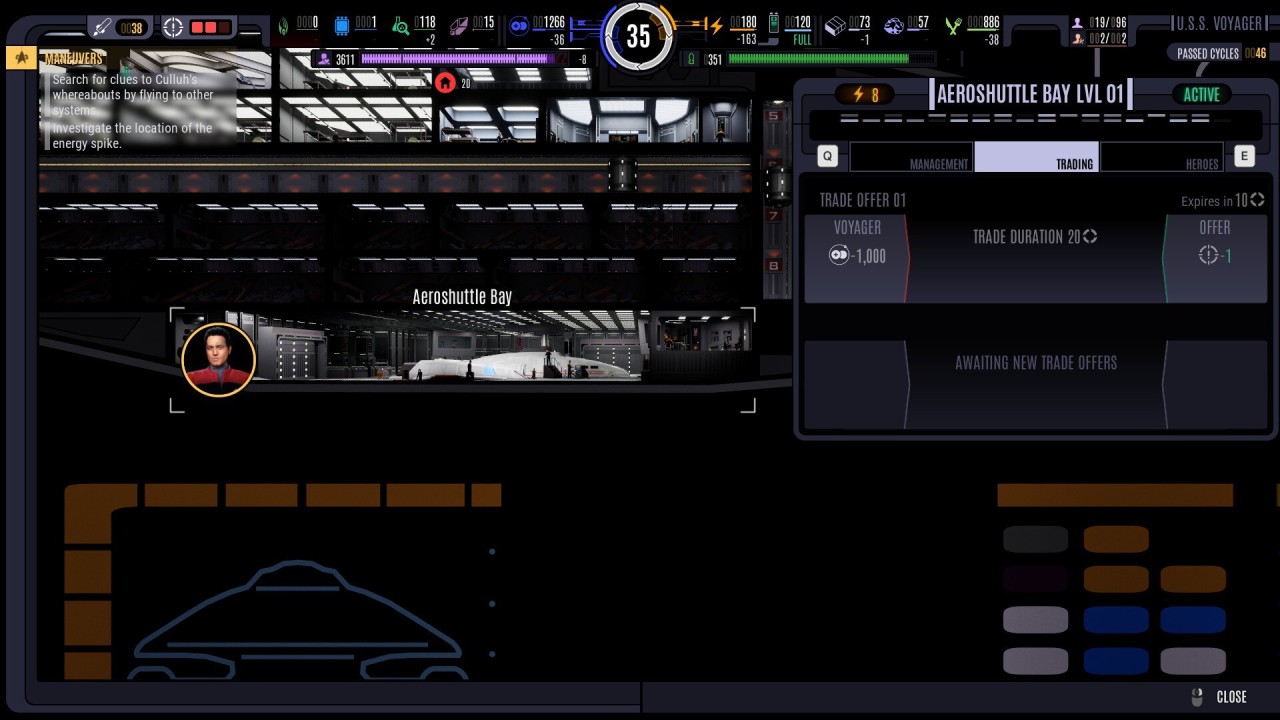
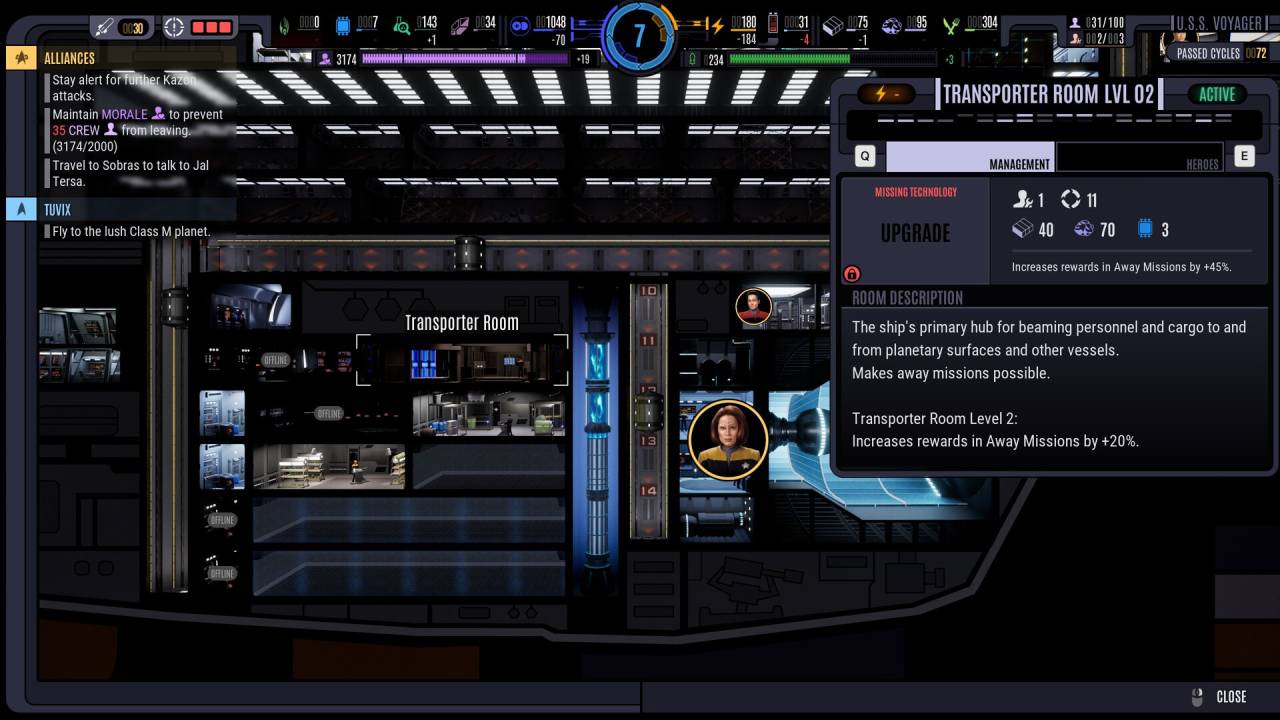
The ship is laid out in a grid-based system that feels similar to XCOM’s base management, but on a much larger scale. You clear debris, repair damaged sections, build new facilities, and decide how each deck is used. Every floor requires life support. Every room consumes power. Every upgrade costs materials.
Almost everything in the game operates on cycles, which act like turns.
Building, healing, researching, and repairing all take time. Each cycle consumes resources. That means every decision has delayed consequences. You cannot instantly fix mistakes. If you miscalculate, you might feel the impact ten or twenty cycles later.
This system rewards patience and planning. You are constantly thinking several steps ahead. Storage limits, crew availability, energy output, and material reserves all matter. You cannot ignore any of them for too long without problems appearing.
One of the most impressive aspects of this system is how seamlessly integrated it feels into the story. You are not just building generic rooms. You are restoring sections of Voyager. Turbo lifts move between decks. Life support needs to be active before areas can be salvaged. Hull repairs are done externally, while internal construction is done inside. It all feels like you are actually rebuilding a damaged starship, not just managing numbers on a screen.
Away missions add another important layer to the gameplay. You choose three crew members and send them on planetary or station-based missions. Each character has unique skills, strengths, and weaknesses. Some are better at diplomacy. Others excel at engineering or combat. Matching the right team to the right mission becomes essential.
These missions play out through narrative scenarios and skill checks.
You are presented with situations and given multiple ways to respond, depending on your team’s abilities and equipment. Outcomes are often determined by dice rolls combined with stats, which means there is always an element of risk.
Using the same characters repeatedly will cause fatigue. Tired crew members perform worse and need time to recover. This forces you to rotate your roster and invest in developing multiple officers rather than relying on a single overpowered team.
XP and progression are managed in a rather conventional manner. Missions and story events give characters XP. Their stats improve as they level up, and they become better in challenging situations. It feels earned when a character you have spent hours training completes a crucial mission.
Ship combat exists, but it is not the main focus. Battles take place in real time, with pauses in three-dimensional space. You issue high-level commands like attacking specific enemy systems, reinforcing shields, repairing hull damage, or changing formations. You can manually fire torpedoes and manage positioning.
This mechanic makes you feel somewhat detached. You are more of an observer than an active participant. You make decisions, then watch them play out. This fits the role of a captain, but it also makes combat feel less exciting than it should be.
The system is not broken. You can win fights through smart positioning and system management. However, it rarely feels tense or thrilling. Compared to the depth of ship management and narrative choices, combat feels like the weakest part of the design.
Most of the puzzle parts are built into the exploration and missions.
Star Trek: Voyager - Across the Unknown usually doesn't feature traditional logic puzzles; instead, it focuses on resource allocation, skill checks, or problem-solving in an environmental setting. You might have to figure out how to get power to where it needs to go, fix broken infrastructure, or deal with a diplomatic standoff. These "puzzles" are more about decision-making and planning than about finding patterns.
This works well for the type of game it is trying to be. You are solving problems as a leader, not as a puzzle gamer. Sometimes, though, outcomes can feel overly dependent on random rolls, which can be frustrating when you feel you made the right choice but still failed.
Visually, the game is a mixed experience. On the positive side, the interface is excellent. Given how many systems you manage, clarity is crucial, and the UI delivers. Menus are clean and readable, and also inspired by classic Star Trek aesthetics.
The ship interiors look good when zoomed in. You can see crew members working, moving between stations, and performing tasks. This adds a sense of life to the environment. Sector maps and space backgrounds are also well-designed and capture the feel of deep-space exploration.
However, animation quality is noticeably dated.
Cutscenes can feel stiff. Character movements lack fluidity. Emotional moments sometimes lose impact when the visuals fail to fully support the writing. It does not ruin the experience, but it does remind you that this is not a big-budget production.
Voice acting is another uneven area. Some performances are solid and believable. Others feel flat or under-rehearsed. What makes this more noticeable is that not everything is voiced. You might hear dialogue during combat, but major story scenes sometimes play out silently. This inconsistency is a weak point of Star Trek: Voyager - Across the Unknown.
The soundtrack does a lot of heavy lifting. It delivers sweeping, cinematic sci-fi themes that fit Star Trek perfectly. During tense moments or major story beats, the music helps carry emotional weight that visuals and voice acting sometimes struggle to convey.
From a technical standpoint, the game runs smoothly. Performance is stable, and major bugs are rare. For a system-heavy strategy game, this reliability is important. You are not constantly worrying about crashes or glitches interrupting long play sessions.
Over time, you start to see the game’s design philosophy clearly. This is a project made by developers who understood their limits and focused on what mattered most. Gamexcite prioritized narrative depth and strategic management. They did not try to cram in overly complex combat systems that they could not properly support.
It also becomes clear that this is a game built for a specific audience.
If you love action-heavy space shooters, this will probably feel slow. If you want a constant spectacle, you may get bored. But if you enjoy thoughtful strategy and story-driven experiences, you'll find it very easy to sink dozens of hours into this.
That "plate-spinning" feeling is where the game truly excels. You are never fully comfortable. Even when things are going well, you know one bad decision or unlucky roll could start a downward spiral. This constant tension keeps you engaged far more effectively than flashy visuals ever could.

There is also something refreshing about a Star Trek game that focuses on leadership and ethics rather than just combat. You are often rewarded for diplomacy, patience, and empathy. Sometimes, avoiding a fight is the best outcome. Sometimes, sacrificing short-term gains for long-term stability is the smartest move. These values feel very true to Star Trek’s spirit.
Of course, the game is not without flaws. Still, when you look at the full package, it is hard not to appreciate what it accomplishes. It delivers one of the most faithful and thoughtful Star Trek gaming experiences in years. It treats its audience with respect. It trusts you to think, plan, and reflect on your choices.
By the time you are deep into later sectors, carefully managing a rebuilt Voyager and a seasoned crew, you genuinely feel like you have earned every success. The journey feels personal. Your ship feels like your ship. Your crew feels like your responsibility. That sense of ownership is rare, and it is Star Trek: Voyager - Across the Unknown's greatest achievement.
Senior Editor, NoobFeed
Verdict
Star Trek: Voyager - Across the Unknown is a strategy game with a story that is full of depth and choices that capture the spirit of Voyager. Not great for combat or presentation, but very rewarding for Star Trek and strategy fans.
77
Related News
No Data.