
AMD Threadripper 9980X Review: 64-Core Beast
Examination of single-thread frequency scaling and multi-thread optimization achieved by AMD Threadripper 9980X during Cinebench evaluations.
Hardware by Tanvir Kabbo on Aug 06, 2025
High-end desktop processors occupy a unique niche in the computing landscape, addressing the needs of professionals who push the boundaries of simulation, rendering, and data analysis. These processors provide the raw multi-threaded throughput needed for detailed financial risk modeling, extensive 3D content production, and complex scientific research.
With configurations up to 64 cores and 128 threads, they command a premium price—typically around $5,000—and enable tremendous parallelism that is much above the capability of common desktop CPUs.
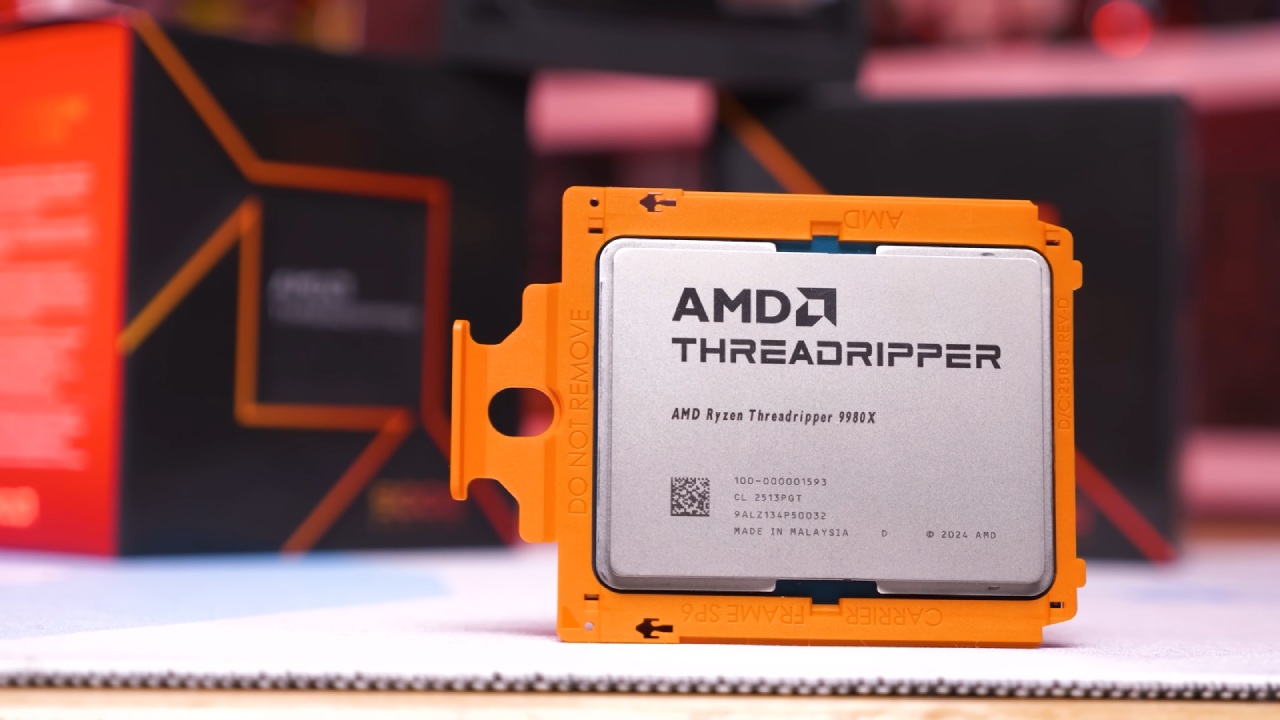
With such technology, both individual hobbyists and businesses can complete tasks that range from compiling large codebases to executing intricate medical simulations in a fraction of the time, all inside a single-socket platform.
In order to assess the AMD Threadripper 9980X's practical capabilities and generational advancements over its predecessor, we have broken down a thorough set of production and gaming tests below.
Specifications and Platform Overview
The flagship model we tested features a boost clock of up to 5.44 GHz, 256 MB of L3 cache, and a 350 W TDP within the STR5 platform. In addition to the 64-core SKU, AMD's lineup now offers 32-core and 24-core versions, which differ in base frequencies and cache allocations but have the same maximum boost frequency.
At $5,000 for the top model, $2,500 for the 32-core, and $1,500 for the 24-core, the pricing is the same as it was for the previous iteration.
Production Workload Performance
When we ran 7-Zip compression, 9980X achieved 520,000 MIPS—only a 2.3% uptick over the 7980X's 508,000 MIPS—but decompression performance rose by 8%, reaching 926,000 MIPS compared to 857,000 MIPS previously.
In SPECworkstation 4.0's options pricing test, which simulates Monte Carlo and Black-Scholes financial models, we saw an 18% gain with a score of 7.8 versus 6.6. OpenFOAM fluid dynamics simulations improved by 9%, moving from 21.4 to 23.3.
A convolution filter benchmark delivered a striking 58% uplift, scoring 9.3 against 5.9, thanks to Zen 5's enhanced AVX execution. Molecular modelling in LAMMPS showed a 17% boost, while data science workflows using Pandas, scikit-learn, and XGBoost ran 10% faster.
NAMD protein simulations also improved by nearly 18%, aligning with other life-science tests. In contrast, Rodinia CFD delivered a more modest 6% increase, rising from 3.5 to 3.7. Compiling the Chromium codebase took 48 minutes—7.5% faster than the 52 minutes of the previous generation. Tile-based rendering in Blender completed a frame in 2.1min rather than 2.5 min before.

Creative Application Benchmarks
When we turned to Adobe Photoshop with the PugetBench suite, the many threads proved underutilized, and frequency advantages alone could not vault 9980X to the top, placing it squarely in the middle of the field.
Adobe Premiere Pro workloads gained just under 5% generationally, which is rarely enough to justify an upgrade. Experimental DaVinci Resolve tests showed the 64-core chip outperforming its predecessors, though the advantage over desktop platforms remained marginal for most real-world editing tasks.
Gaming Test
We included gaming tests to confirm basic compatibility rather than to recommend the 9980X for gaming. In the Stellaris simulation, our test completed in 43.2s compared to 37.1s on a more gaming-focused chip.
Final Fantasy XIV: Dawntrail exhibited frame‐rate swings between 248 fps and 274 fps, underscoring scheduler variability with so many cores.
Dragon's Dogma 2 at 1080p placed 9980X in the lower half of the chart, affirming that extra cores and lower per-core frequency hinder pure gaming performance.
Cyberpunk 2077 and Baldur's Gate 3 produced passable frame rates but trailed mid-range desktop parts, demonstrating that while you can game, you shouldn't build a system like this solely for gaming.
Power, Thermals, and Frequency Behavior
Under a sustained all-core Blender workload, power draw measured 371W at the EPS12V rail—about 20 W above the previous generation, highlighting the cooling challenge. Using a 360 mm liquid cooler, steady-state temperatures hovered around 58 °C, benefiting from the large die area that spreads heat more evenly.
All-core clock speeds settled around 3.95 GHz with occasional spikes to 4.2 GHz, while single-thread Cinebench runs reached 5.425 GHz, slightly above the 5.4 GHz specification.

Final Thoughts
Generational performance gains ranged from as little as 2% in simple compression tasks up to 58% in AVX-heavy convolution workloads. If your primary focus is gaming, a desktop CPU with a higher per-core frequency will serve you far better.
But if you're running financial simulations, medical modelling, or large-scale rendering, the productivity benefits and ample PCIe lanes justify the investment.
You'll want to research specific applications to determine whether 32 or 64 cores best suit your workflow, but either way, you'll command some of the highest multi-threaded performance available in a single-socket desktop platform.
Check Our Other AMD articles:
- AMD Ryzen 9 9950X3D Review: Setting The Standard For 2025 Gaming CPU
- AMD Ryzen 7 9800X3D Review: 3D V-Cache Goes God Mode with Stunning Gaming Performance
- AMD RX 9070 Performance Review: Thermals, Clocks, and Real-World FPS
- AMD Ryzen 5 7600 Review: Best Budget Gaming CPU of 2025?
- AMD Radeon RX 7800 XT Review: RDNA 3 Power For Midrange Gaming
- Sapphire NITRO+ AMD Radeon RX 9070 XT Review: The Ultimate 4K Gaming GPU
- AMD Ryzen 7 7800X3D: Delivers Gaming Performance Far Beyond Expectations
- AMD Ryzen 9 7900X Review: Powering the AM5 Era with DDR5 & PCIe 5.0
- ASRock Radeon RX 7800 XT Challenger OC Review: Best Price-to-Performance GPU of 2025
- Intel Core i9‑14900K vs. AMD Ryzen 7 7800X3D: Power Profiles & Gaming Benchmarks
Senior Editor, NoobFeed
Gaming Hardware Updates
No Data.