
Intel Core Ultra 9 285K Review: A Comeback or a Misstep?
Gaming workloads showcase contrasting results with strong performance in some titles and visible CPU bottlenecks in others.
Hardware by Nahe Yan on Nov 04, 2025
Intel needed a hero after a decade unchallenged in the CPU market. A resurgent Ryzen had already landed strong blows, and a self-inflicted PR disaster in the wake of Raptor Lake left Team Blue battered through 2024.
A new socket, a new process node, and even a new identity were meant to help Intel shake off years of missteps and start fresh. Yet, almost a year later, most new-build recommendations still revolve around AMD. The question is whether it's too soon to count Intel out.
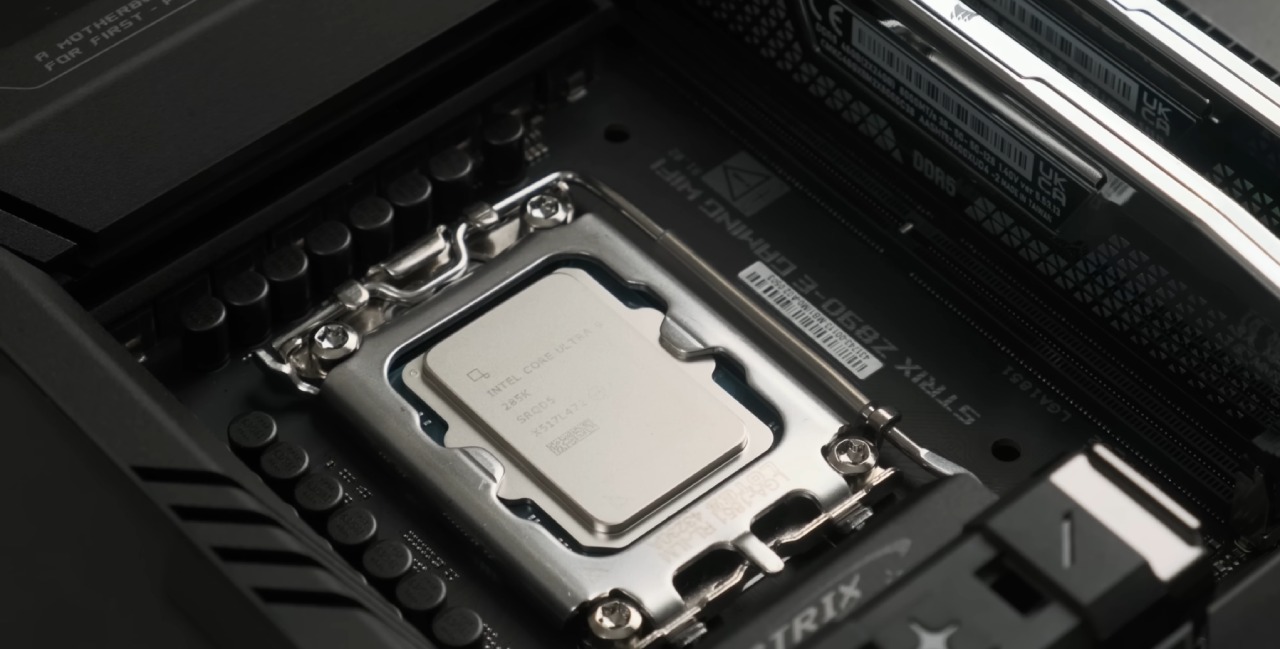
The first enthusiast to hear about the new tile-based Intel Arrow Lake generation was the desktop 200 series, codenamed Arrow Lake. Initial reports were discouraging. Early data at launch suggested that the Ultra 9 285K was a step backward from the unstable i9s of the Raptor Lake era, failing to match AMD's gaming prowess.
However, time and updates have changed things. With BIOS improvements, including the new 200S Boost profile, and widespread availability of high-speed CU-DIMM memory, it's worth revisiting the Ultra 9 to see if it's finally worth buying in 2025.
Architecture and Specifications
The Core Ultra 9 285K, note, not the i9-285K, is a 24-core CPU with 24 threads. Intel's new plan does away with hyper-threading (SMT) completely and instead uses more efficient cores to make up for it. The 285K still has eight full-performance cores, made using the Intel 3 process to make them more efficient and possibly use less power.
The P-cores operate at a 3.22 GHz base frequency, boosting to 5.7 GHz, while the 16 E-cores run at 3.2 GHz with a boost potential of up to 4.6 GHz. The P-cores share a 36MB L3 cache pool, while the E-cores are limited to L1 and L2.
Intel has also retained integrated graphics with the ARXE-LPG GPU featuring 64 execution units running at 2 GHz. Although often overlooked, Intel's iGPUs remain popular for media encoding and streaming tasks. The QuickSync engine handles hardware encoding and decoding for nearly every video format, often outperforming discrete GPUs in efficiency.
Unlike the mobile variant, which features XMX cores for hardware XeSS upscaling, the desktop 285K lacks this hardware acceleration. Still, this CPU is designed for systems paired with dedicated GPUs.
Platform and Memory
One of the biggest benefits of the 200-series platform is support for CU-DIMMs, DDR5 memory modules featuring onboard clock drivers. These support higher frequencies and greater stability than traditional DIMMs. The kit used here runs at 8000 MT/s out of the box, with room for overclocking.
We used an ASUS ROG Strix Z890 motherboard, 48GB of Corsair CU-DIMM memory, and an RTX 5090 to test the Ultra 9 285K. This ensured the GPU didn't slow down. The power came from a Corsair HX1200 PSU, while the cooling came from an Arctic Freezer III 280mm AIO.
The test lineup also included several Ryzen CPUs for comparison: the Ryzen 9 7950X3D, the Ryzen 7 7800X3D, and the Ryzen 7 7700. The Ryzen CPUs were tested with DDR5-6000 CL36, tuned for optimal timings, since they lack CU-DIMM support.

Gaming Performance
Starting with Battlefield 6 at 1080p low with DLSS Quality, the 285K averaged around 230 fps—good enough for 240 Hz displays. Boost mode added roughly 4%, a minor improvement that raises questions about its practicality. Despite this, performance still fell between the Ryzen 7 7700 and the 7900X3D operating on six cores.
In Counter-Strike 2, benchmarking was conducted in a real-world deathmatch on Dust 2 at 1080p, low settings. The 285K performed well, averaging 326 fps without boost and only gaining a few frames with boost enabled. However, Ryzen's X3D lineup outperformed it by 10–20%, and older Intel chips like the 13900K still managed to edge ahead slightly.
The Last of Us Part II showed a turnaround. At 1080p Very High with DLSS Quality, the 285K averaged 177 fps and 187 fps in Boost mode, about a 6% uplift. With the RTX 5090, it matched or slightly surpassed the 7800X3D, marking an impressive result for Intel.
Spider-Man 2 was another standout. Running at Very High settings, it averaged 149 fps standard and 165 fps boosted, a 10% gain. Even with Ultimate Ray Tracing enabled, frame rates held at 99 fps and 105 fps, outperforming the 7800X3D.
In contrast, Cyberpunk 2077 proved more CPU-limited. The 285K stayed at 100 fps no matter the DLSS settings, but the 7800X3D was about 10% faster. Warhammer 40K: Space Marine 2 was also a letdown; the 285K only got 80 fps on average and 8% more with boosting. The 7800X3D was the only one to reach more than 100 fps, showing that AMD is still the best for gaming.
Baldur's Gate 3 reflected similar trends. The 285K averaged between 130 and 139 fps, aligning with the Ryzen 7 7700, though it's worth noting that such performance is already overkill for the title.
Disabling E-cores didn't help gaming results. In fact, Cyberpunk 2077 dropped 7–15% depending on settings, while The Last of Us and Baldur's Gate 3 also saw mild reductions. There's no measurable gaming advantage to disabling E-cores.
Productivity and Workstation Performance
Where the Ultra 9 285K shines brightest is productivity. In DaVinci Resolve, exporting a 5-minute 4K 60fps timeline took 3 minutes 18 seconds, 4 seconds faster with Boost. Even the fastest Ryzen CPUs were almost a minute slower, giving Intel a strong edge in content creation.
In Blender's Classroom render using CPU cycles, the 285K completed the task in 2 minutes 12 seconds, the fastest result observed, outpacing a tuned Ryzen 7945HX3D by over 20 seconds. Boost mode, however, had a negligible or slightly negative impact.
Synthetic benchmarks also favor Intel. In Cinebench 2024, the 285 K's multi-core score was 50% higher than the 7900X3D and more than double the 7800X3D, with a single-core lead of about 20%. Geekbench 6 results show a 10% single-core and 20% multi-core lead over Ryzen's top-tier offerings.
Boost mode, while free to use and warranty-safe, remains inconsistent. Not all chips handle it reliably, with some samples reportedly unable to engage Boost at all. Even when active, it delivers modest 3–4% gains or sometimes minor regressions.
.jpg)
Power Consumption and Efficiency
Performance numbers alone don't tell the full story. The 285 K's impressive Cinebench score, 50% above the 7900X3D, came for 247W peak CPU power draw. The 7950X3D peaked at just 120W, meaningIntel'ss performance lead demanded over twice the energy.
Although slightly more efficient than the 13900K, Intel remains far behind AMD in performance per watt. For users unconcerned about power draw, this may not matter, but for others, it translates directly to higher long-term cost and heat output.
The 285K is undeniably powerful, an absolute brute-force processor. Yet it behaves more like a high-performance SUV than a precision-engineered sports car: capable, loud, and thirsty.
Final Thoughts
The Intel Core Ultra 9 285K is a big step forward for Intel after years of no advancement. It finally has the power to compete with productivity tasks and even excel in some challenging games. But it can't take back the gaming crown from AMD's X3D series because it uses a lot of power, doesn't always boost performance, and isn't as good at gaming.
For creators, streamers, or professionals who prioritize raw CPU throughput, the 285K is a compelling option. For pure gamers, however, Ryzen's efficiency and consistency remain difficult to ignore. In 2025, Intel's comeback feels real but not yet complete.
Also, check our other Intel articles below:
- Intel Core Ultra 9 285K Review And Performance Breakdown (2025)
- Intel Core Ultra 9 285K vs AMD Ryzen 7 9800X3D: In-Depth Gaming Performance and Benchmark Comparison
- Intel Core i5-13400F Gaming Performance: Still Worth It in 2025?
- Intel Core i9‑14900K vs. AMD Ryzen 7 7800X3D: Power Profiles & Gaming Benchmarks
- Intel Core i9 14900K: Specs, Benchmarks, and Competitor Comparison
- Intel Core Ultra 5 245K Review: Gaming, Productivity & Power Efficiency Tested
- Intel Core Ultra 9 285 K's iGPU Gaming: In-Depth Benchmarks & Analysis
- Intel vs. AMD Gaming Laptop: Performance, Thermals & Battery Life Compared
- AMD Ryzen 7 9800X3D vs.7800X3D vs. Intel Core Ultra 7 265K: Gaming, Thermals & Price Analysis
Editor, NoobFeed
Gaming Hardware Updates
No Data.