

AMD RX 9070 XT Features Explained: AI Compute, Gaming, and RDNA 4
AMD brings dedicated AI acceleration into mainstream gaming GPUs with the RDNA 4 architecture and Navi 48 design.
Hardware by Godrics01 on Jun 26, 2026
These days, graphics cards aren't just made for games. Modern GPUs have hardware designed to speed up AI tasks as well as regular graphics rendering. As AI-powered features become more common in artistic and gaming software, technologies once found only in business hardware are starting to appear on consumer graphics cards.
AMD's latest GPU architecture is one of the best examples of this change because it adds AI hardware to a standard graphics card. This is a $700 gaming graphics card, but there's a piece of hardware inside it that, just a few years ago, required a room costing more than a house to keep running. Having worked in one of those rooms, seeing what AMD silently put inside this card was surprising. Once you notice it, it becomes difficult to ignore.
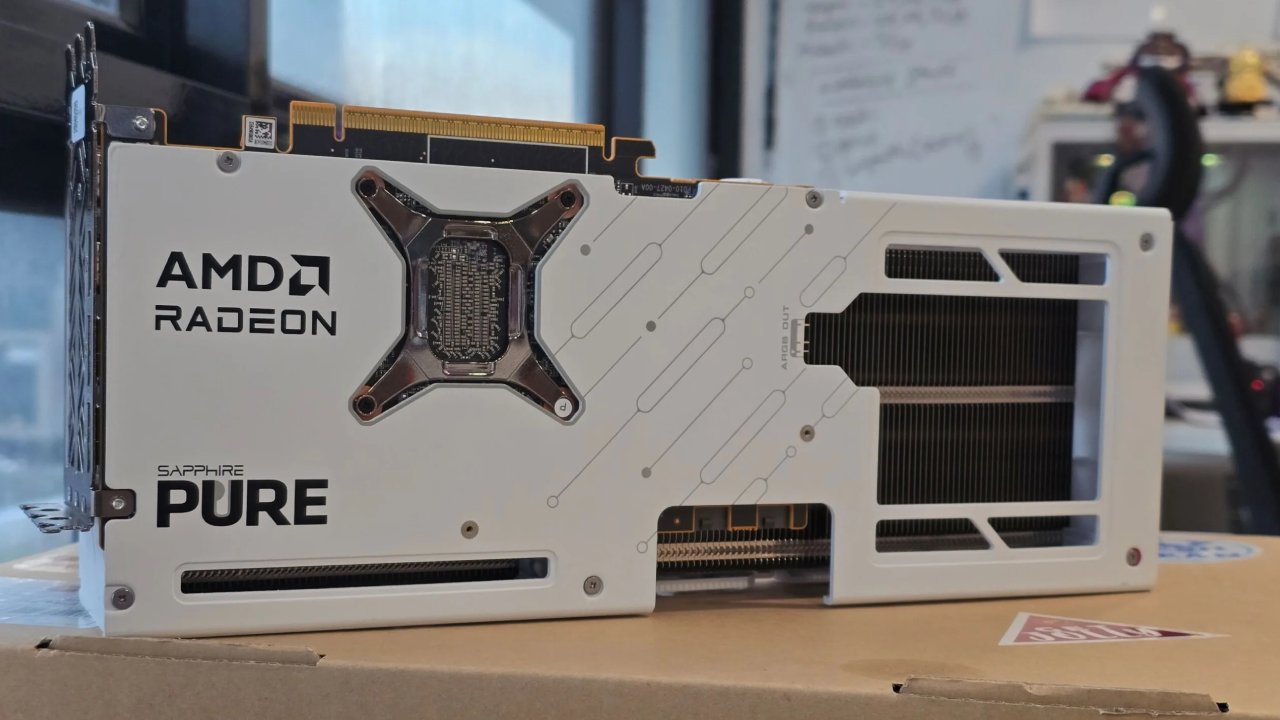
This is the RX 9070 XT. It is a gaming GPU with more than 1,500 TOPS of AI compute, as listed on its specification sheet. Most reviews barely mention that part. However, that specification changes how you look at the card. Instead of just feeling like another gaming GPU, it starts to look like a small piece of AI infrastructure.
RDNA 4 Powers the RX 9070 XT
RX 9070 XT runs on AMD's RDNA 4 architecture. The chip inside it is called Navi 48, and it is manufactured using a 4nm process. A smaller manufacturing node simply means more computing power can fit into a smaller space while operating more efficiently.
The details of the story are already known. The card has 16GB of VRAM connected via a 256-bit memory bus. The boost clock speed can reach just under 3 GHz. The average range for hardware in this performance class is 250-300W under load. The GPU originally had an MSRP of $599, but due to supply and demand, it is now closer to $700 on the street.
Gaming Performance Remains Competitive
For gaming, the short version is simple. RX 9070 XT goes head-to-head with Nvidia's RTX 5070 Ti while costing less, and it delivers a noticeable lead over the RTX 5070 at both 1440p and 4K gaming. Gaming performance, however, is not the most interesting part of this GPU. AMD claims the RX 9070 XT can deliver 1,557 TOPS.
On a specification sheet, that number doesn't mean much immediately. TOPS stands for tera operations per second. "Tera" means trillion, so 1TOPS equals 1 trillion tiny mathematical operations completed every second. This GPU claims more than 1,500 of those, which translates to roughly 1,500 trillion mathematical operations every second.
To put that into perspective, imagine every person on Earth, all 8 billion people, solving one math problem every second without stopping. Collectively, everyone would need to continue for more than 5,000 years to match what this GPU can theoretically accomplish in a single second. All of that hardware fits quietly inside your desktop PC.
What INT4 AI Processing Actually Means
The type of computation behind that number is called INT4. It simply refers to lower-precision math. Think about multiplying 6 by 7. Most people can solve it instantly. Now imagine multiplying 6,874 by 7,231. The operation is fundamentally the same, but it takes more effort because the numbers are larger and require greater precision. Computers behave in much the same way.
INT4 represents the simpler version of those calculations. Since the numbers are smaller, the processor can complete them much faster. Many AI workloads don't require maximum precision. Instead, they perform well with lower-precision calculations, enabling hardware like the RX 9070 XT to process enormous numbers of operations per second.

Real-World Performance is Lower Than the Peak Rating
We also need to be realistic about those figures. The advertised 1,557TOPS is a theoretical maximum. Think of it like a speedometer capable of reading 180mph. It doesn't mean you will actually drive at that speed all the time. Real AI workloads depend on software optimization, memory overhead, and the model itself. In practice, you may only reach a third or even half of the theoretical limit.
That doesn't make the specification meaningless. Instead, it shows the maximum capability available when software can fully utilize the hardware. Large AI models, including chatbots and image generation systems, typically run on rows of specialized GPUs inside data centers that cost more than many homes in hardware alone. Traditionally, that level of AI processing stayed behind cloud services.
You simply uploaded your data and received the results. AMD has now brought a meaningful portion of that same design philosophy into a gaming graphics card priced around $700. Dedicated low-precision AI hardware is no longer limited to enterprise environments. It is now available to consumers. That shift is what stands out the most.
Why RDNA 4 Improved AI Performance
The reason AMD could achieve this comes down to the way RDNA 4 was designed. Imagine a small office. In previous GPU generations, employees handled every task that came through the door. AI workloads were simply another responsibility mixed in with everything else. With RDNA 4, AMD effectively hired a dedicated specialist whose only responsibility is AI computation.
The dedicated AI hardware doesn't handle traditional graphics tasks. It exists solely to accelerate AI math, and it does so much more efficiently than before. That architectural change explains why AI performance increased so dramatically in a single generation. AI processing has evolved from being a secondary task into dedicated hardware.
What Dedicated AI Hardware Means for Everyday Users
For everyday users, this brings two practical advantages. The first is FSR 4. Rather than rendering every single pixel at native 4K resolution, FSR 4 renders the game internally at a lower resolution and then uses AI to reconstruct a sharper final image. Machine learning now plays a larger role in that reconstruction process. Older versions relied primarily on the GPU's general-purpose hardware.
RDNA 4 introduces dedicated AI blocks that can perform more of that work independently. That doesn't mean FSR suddenly stops working on older graphics cards. Instead, the new hardware creates additional headroom for more advanced AI models to run in real time. You can think of it as one artist quickly sketching the initial idea while another artist adds the details with greater precision.
No graphics card is perfect, and the RX 9070 XT has limitations. Ray tracing simulates realistic lighting, reflections, and shadows inside games. Although AMD significantly reduced the performance gap this generation, Nvidia still maintains an advantage in games that rely heavily on maximum ray tracing settings.
If ray tracing performance is your highest priority, Nvidia continues to lead in this price category.
Raw AI hardware is only one part of the equation. NVIDIA has spent more than a decade building CUDA, which remains the standard software platform for AI development. Most AI applications continue to prioritize Nvidia hardware. RX 9070 XT is a capable gaming graphics card, but its biggest development is not just gaming performance.
It represents one of the first mainstream consumer GPUs to include dedicated AI-precision hardware without requiring enterprise-grade pricing. If we look beyond gaming, we're beginning to see the same concepts found inside enterprise data centers appear in consumer PCs. Precision trade-offs, dedicated AI accelerators, and local AI workloads are gradually becoming part of everyday desktop hardware.
AI compute is becoming a standard feature of gaming systems rather than an expensive add-on reserved for enterprise environments. That intersection between data center design philosophies and consumer hardware is becoming increasingly visible, and the RX 9070 XT is one of the clearest examples of that transition.
Editor, NoobFeed
Latest Articles
No Data.