
XBOX Project Helix Reportedly Targets 2027 With PC-Level Hardware and 56 Teraflops
A reported 2027 launch could bring PC-level hardware and a major performance jump to Microsoft’s next-generation XBOX console.
News by Tahmid Mahi on Sep 24, 2026
XBOX Project Helix is reportedly shaping up to be a big shift in Microsoft’s console hardware strategy, with new details hinting at a powerful hybrid machine that could blur the lines between a traditional XBOX and a gaming PC. Hardware details surrounding the project are reportedly becoming clearer, including information about its GPU, clock speeds, neural rendering hardware, and potential performance.
The system has previously been associated with the name XBOX Magnus, while Sony's next-generation console has reportedly been referred to as Project Horizon. If these reports are to be believed, you may get to see Microsoft’s next XBOX debut in the 2027 holiday season.

Project Helix is set to go in a different direction from previous XBOX consoles, functioning as both a console and a PC-style gaming machine.
Instead of being limited to the usual XBOX ecosystem, the system is reportedly being designed to support PC game libraries from platforms such as Steam, Ubisoft, EA, Epic Games, and GOG, alongside much of the existing XBOX library. That would give you access to a considerably wider selection of games from a single device.
A major part of the discussion surrounding Helix has been its reported GPU performance, although teraflops alone do not provide a complete picture of how powerful a console will actually be. Teraflops measure floating-point computing operations per second, but GPU architecture, efficiency, clock speeds, and other hardware features can make direct comparisons between different generations misleading.
Current reports put Helix at around 56 teraflops, while the PlayStation 6 has been rumored to reach around 40 teraflops. Those figures need to be viewed in the context of the hardware architecture behind them rather than treated as simple performance scores.
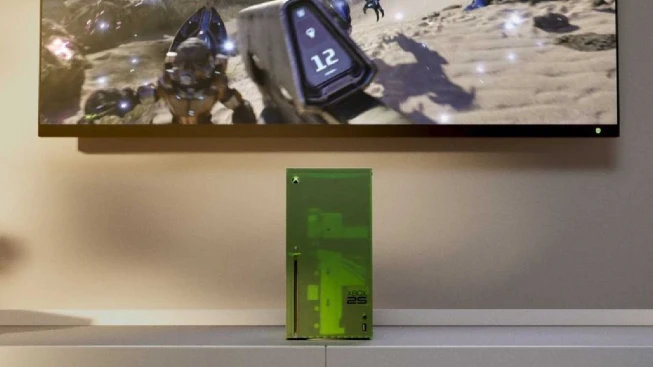
The XBOX Series X currently uses an RDNA 2 GPU and delivers around 12 teraflops of compute performance. Helix is reportedly moving to AMD's RDNA 5 architecture while also introducing dual-issue mathematics, which could significantly change how its teraflop figure should be interpreted.
Under the same approach, the 12-teraflop Series X could theoretically be considered equivalent to 24 teraflops if it had dual-issue capabilities. Because of that, the reported 56-teraflop figure does not automatically mean Helix will be several times faster than the Series X in every game.
The reported GPU configuration makes the hardware even more compelling, with Helix said to feature 68 compute units running at a minimum clock speed of around 3.2 GHz.
That would be a substantial increase over the Series X, whose GPU currently operates at around 1.85 GHz. The new architecture, paired with faster clock speeds and dual-issue capabilities, could offer a massive upgrade in graphics power. This combination could also allow developers more room to push higher resolutions, smoother frame rates, and more demanding visual effects in future games.
However, an XBOX hardware engineer reportedly explained that these changes would not result in a two-times performance increase across every game and could instead produce something closer to a 20% improvement in certain situations. The GPU is only one part of Microsoft's reported plan, as Helix is also expected to include a dedicated neural rendering chip. This could allow games to use advanced reconstruction techniques to take lower native resolutions and frame rates and produce higher-resolution output while maintaining smoother performance.
Instead of rendering every frame at native 4K, the system could use its neural processing hardware to reconstruct additional visual information. For you as a player, that could mean games that maintain higher frame rates without sacrificing as much image quality.
The reported Magnus chip is also said to measure around 408 square millimeters and provide a major increase in rasterization performance. One claim places the improvement at roughly 10 times, potentially giving the console enough graphical power to handle more advanced lighting and path-tracing techniques.
If those reported improvements translate into actual games, more demanding lighting effects could become a regular feature rather than something mostly associated with high-end PC hardware. The combination of stronger rasterization and dedicated neural processing could give developers more options when balancing visual quality and performance.
Microsoft's reported neural rendering technology could also serve a role similar to the reconstruction and upscaling systems already used on modern gaming hardware.
The information points toward an AMD proprietary solution that would compete with Nvidia's DLSS technology. Rather than simply increasing the resolution of an image, the system could use neural processing to improve details involving textures, lighting, and other visual elements. This would give developers another way to produce sharper images while keeping performance at higher frame rates.
The reported development timeline suggests that the hardware itself is already moving forward. Trusted insider Kepler L2 has reportedly said that the Magnus chip has been taped out, meaning its design has reached a completed stage and can proceed toward manufacturing.
The chip is reportedly expected to be manufactured by TSMC, with production predicted to begin around spring 2027. If that timeline holds, Microsoft would have a relatively clear path toward producing the hardware in time for a holiday 2027 launch.
The biggest uncertainty surrounding Helix remains its price, especially considering the amount of hardware reportedly being packed into the system. A large chip, RDNA 5 graphics, high clock speeds, dual-issue capabilities, and dedicated neural rendering hardware would all contribute to manufacturing costs.
Microsoft could therefore face decisions about which components and features it can reduce or remove to keep the system below the $1,000 price point that has been discussed. Getting that balance right may be key if the company wants to position Helix as a premium console without pushing too far into the high-end gaming PC space.
Microsoft might also announce Project Helix by the end of 2026, perhaps in time for the XBOX brand’s 25th anniversary in November.
A reveal at that point would give the company time to explain the hardware, software, and hybrid PC-console approach before the reported 2027 launch window. The specifications could still change as development continues, particularly while Microsoft works through manufacturing and software optimization.
If Helix follows the hardware direction currently being reported, you could end up with an XBOX that sits much closer to the high-end PC market than previous generations. Its combination of an RDNA 5 GPU, 68 compute units, a reported 3.2 GHz clock speed, dual-issue mathematics, neural rendering, and access to PC game libraries would give the system a noticeably different role in Microsoft's hardware lineup.
Rather than simply offering a more powerful version of the current XBOX, Microsoft appears to be working toward a broader platform that connects console gaming with PC gaming. That approach could also influence how future XBOX hardware is designed across different types of devices.
The Magnus technology could eventually appear beyond the main XBOX console as part of Microsoft's wider OEM plans. And that could extend beyond a single console if the chip also appears in other devices and is part of a wider hardware ecosystem.
As development continues through the end of 2026 and into 2027, we expect to learn more, especially as Microsoft starts to officially talk about the system. For now, the reported holiday 2027 target, 56-teraflop number, 3.2 GHz GPU clock, RDNA 5 architecture, and neural rendering hardware paint a clearer picture of the direction Microsoft is reportedly taking with Project Helix.
Editor, NoobFeed
Related News
No Data.