

Intel 270K Plus Performance Compared to 265K
Normalized benchmarks show minimal differences between Arrow Lake Refresh and original Arrow Lake processors.
Hardware by Godrics01 on Jun 13, 2026
Intel's Arrow Lake Refresh processors have sparked discussion about whether they represent an architectural improvement over out-of-the-box tuning. Questions have been geared more toward why newer CPUs seem faster, even though there is nothing significantly different in core count, cache, or clock speed. Normalized die-to-die clocks are used to test performance differences and provide deeper insight into where the differences actually lie.
The primary issue is how much of the performance boost Arrow Lake Refresh retains when die-to-die clocks are matched with those of standard Arrow Lake CPUs. Others have proposed silicon-level improvements in the updated chips; however, this does not appear to be supported by the evidence.
Test Configuration and Methodology
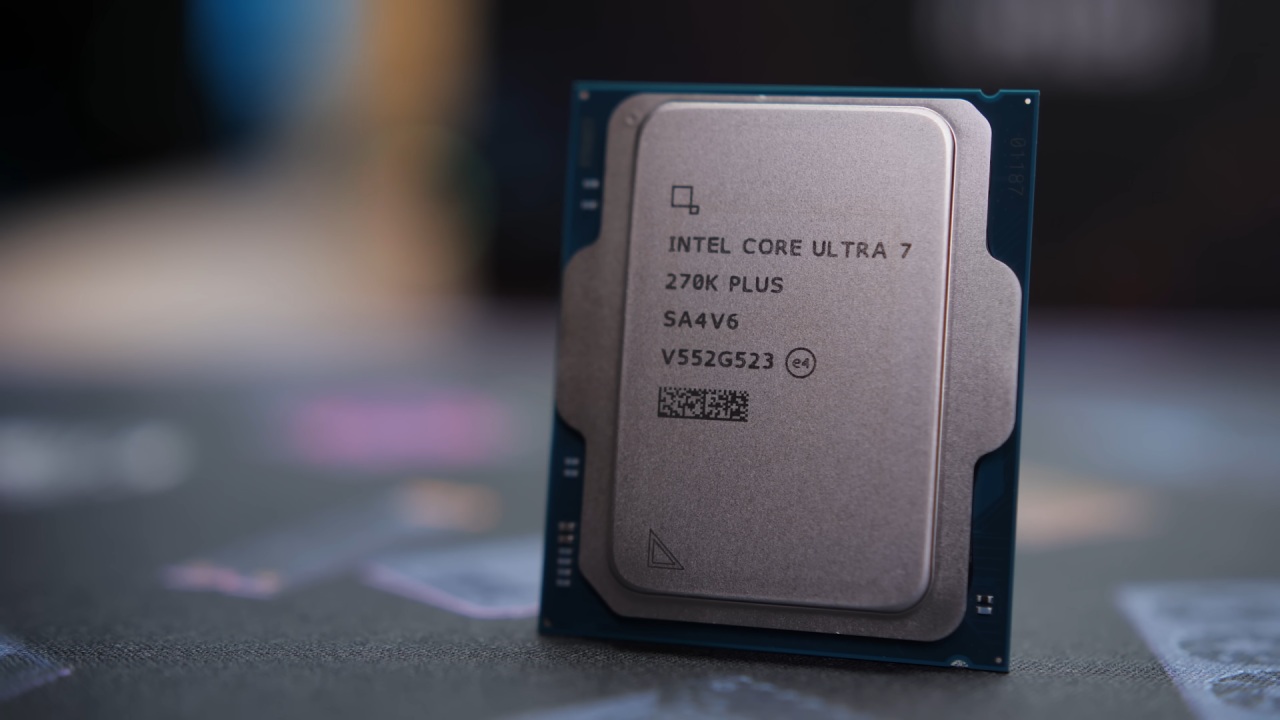
Arrow Lake Refresh processor appears to be a tweaked version of the current flagship processor, from our view. Seems to be a 285K running on different parameters, but not a completely new design. Because most Arrow Lake processors can achieve a 3 GHz die-to-die frequency, the inquiry was whether there was any secret benefit to the 270K Plus.
A second configuration, the 270K Plus was made by tuning all frequencies to a 265K. Performance cores, efficiency cores, die-to-die clocks, ring ratio, and NGU were all fixed. The test platform was a 5070 Ti graphics card with 48GB of QDIMM memory running at 8533 MT/s in Gear 2 mode. The frame-rate data was scaled to 265K, the 100% mark, with the averages and 1% lows calculated accordingly.
Results of the Game Indicate Few Differences in Architecture
The normalized 270K Plus only increased average FPS by 3.4%, with no difference in 1% low performance. There was no measurable benefit with the most important metric: 1% lows. 270K was basically the same as a 265K running at the same clock rate. Should be a 6MB difference, not an architectural one, because any small difference seems to be due to the extra 6MB of cache.
From the above results, it can be inferred that the processors have similar architecture and silicon design. No sign of silicon enhancements or significant changes internally. Rather, the updates appear to be to provide better die-to-die speeds right out of the box. Remember that when comparing to other numbers you find online, the original Arrow Lake processors were shipped with conservative settings.
Additional Overclocking Results
270K sample tested showed good silicon quality and enabled further tuning beyond the normalized configuration. At max tuning, performance improved to 107.8% of the base 265K setting, and the 1% lows now improved to 105.5%. This results in an average FPS gain of 7.8%, and a 1% low gain of 5.5%.
We don't see anything here indicating that the refresh silicon is any different, let alone significantly different, from the original silicon. The results for Cinebench R23 were also normalized to the 265K we used in this case, which scored around 35,000 points and was set to the 100% mark.
In the initial multi-core tests, the 270K Plus scored around 40,000 points. That was a mere 15% over the tuned 265K, which was lower than expected since the processor was supposed to achieve at least 44,000 points. More tuning focused on the multi-core processor's performance. We did not enable VRM multi-core overclocking; instead, we set the VRM voltages for individual cores manually.
Voltage management is important for Arrow Lake processors, as excessive VRM output can reduce efficiency. The cores can operate effectively at a lower usable voltage, reducing achievable frequencies. A tuned 270K Plus achieved ~45,000 points in Cinebench R23, as shown below. This was up 29% from the 265K. Although there was a rise, temperatures did not exceed 80°C, with readings around 78°C during testing.

SSD Bandwidth Claims Put to the Test
Some claimed that Arrow Lake Refresh solved the bandwidth limitations of the original Arrow Lake SSD lineup. The conversation focuses on the performance of Gen5 NVMe SSDs. It is worth noting that, because PCIe Gen5 connectivity is implemented differently, some users have reported throughput ceilings of around 13GB/s, rather than the 15GB/s to 16GB/s typically found in high-end Gen5 storage.
To validate these claims, these results were confirmed with the same die-to-die and cache frequencies on both the 265K and 270K. The outcomes were essentially the same for all processors. SSD showed virtually no performance difference at similar settings. The benefit of higher die-to-die frequencies may be better SSD performance, but this depends on clock speed, not a revamped architecture.
Overclocking figures with a stock Arrow Lake processor, since Z890 motherboards can do so.
The results show that a tuned 265K can achieve remarkable similarity to the 270K Plus on gaming workloads. Most of the difference is due to the increased die-to-die and cache frequencies. For value, a used 265K and Z890 motherboard might be a realistic choice. A little overclocking will bring performance close to that of the updated version.
We've been playing for a few weeks now after switching to the 270K Plus, and we can't really see much difference in our gameplay compared to the 265K. Multi-core workloads used only a tiny bit more power, while gaming used less due to improved VRM tuning. The results show that the performance benefit of the Arrow Lake Refresh processors is more of a tuning improvement than new architecture.
When frequencies are normalized, there is little difference in game performance. All the evidence suggests it will be the same silicon as the original Arrow Lake lineup. However, if you already have an Arrow Lake motherboard and processor, overclocking may deliver performance close to that of the Arrow Lake Refresh.
Editor, NoobFeed
Latest Articles
No Data.