
ASUS ROG Strix XG27AQWMG Review: 280Hz 1440p OLED Gaming Performance
Advanced OLED Technology Delivers Exceptional Motion Clarity, Deep Contrast, and Vivid HDR Performance for Competitive and Cinematic Gaming Experiences.
Hardware by Masaru Hoshino on Aug 28, 2025
The first fourth-generation W OLED gaming monitor, ASUS ROG Strix XG27AQWMG, has caught our attention lately. Despite its long name, the monitor is impressive, featuring LG's new primary RGB tandem technology that enhances brightness, color, and power efficiency.
The 27-inch 2560x1440 panel supports a maximum refresh rate of 280 Hz, adaptive sync technology, and DisplayHDR True Black 500 certification, offering a step above previous True Black 400 QD OLEDs in terms of peak brightness.
Panel Technology and Design
The fourth-generation W OLED features a four-layer blue-green-blue-red stack, replacing the previous blue-yellow-blue configuration. Color accuracy, peak brightness, and energy efficiency are all improved by ASUS's claims of a 15% higher peak brightness, a 25% wider color gamut, and a 60% longer lifespan than earlier W OLEDs.
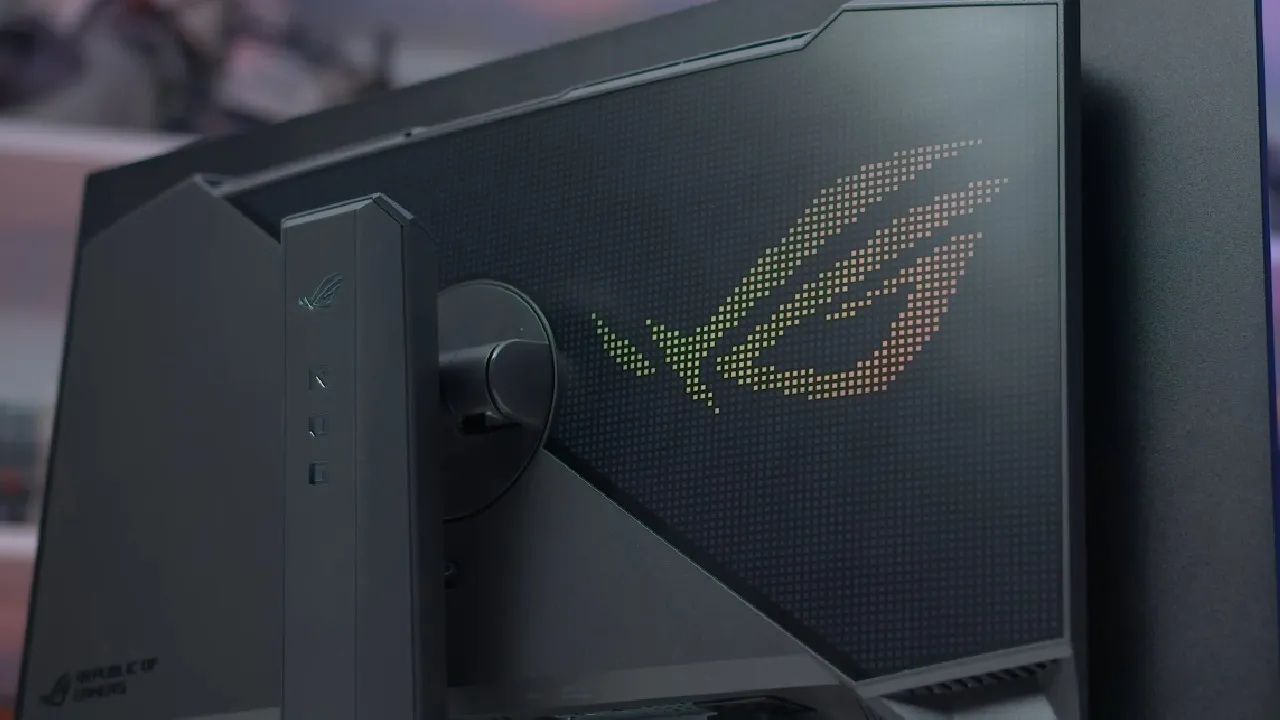
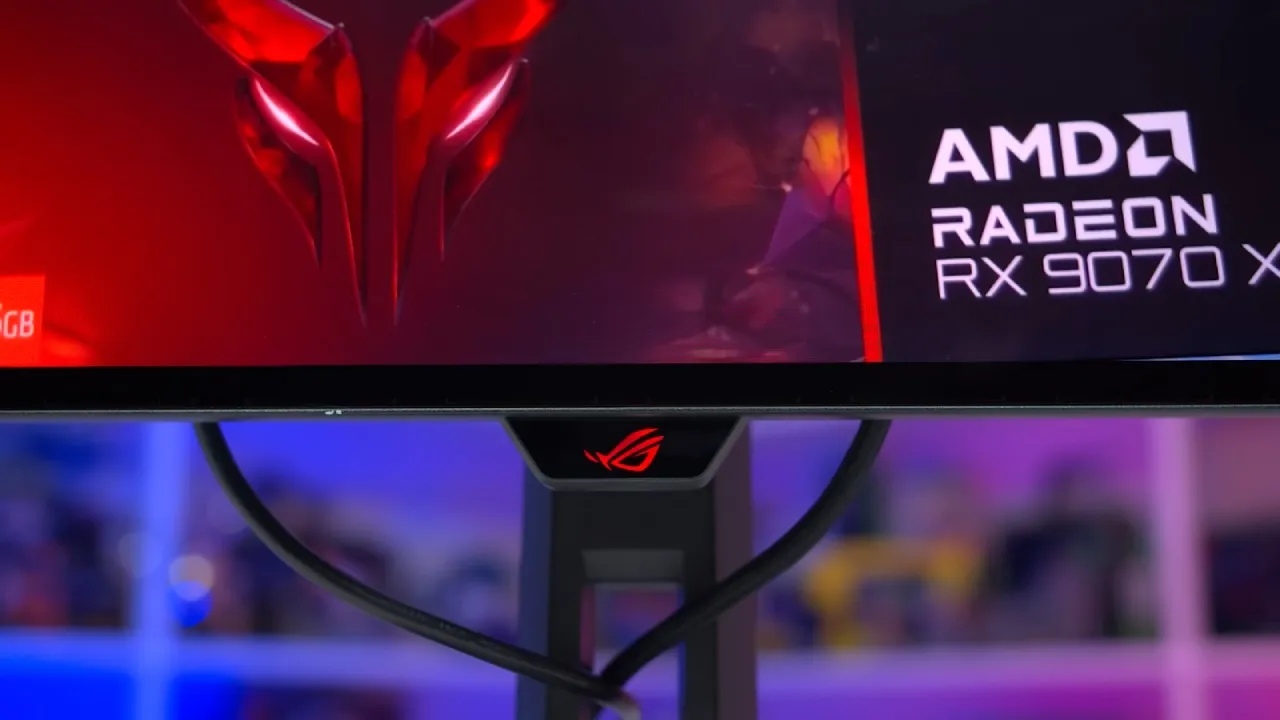
The rear features the recognizable ROG Strix design, complete with a center box and a subdued RGB logo. At the same time, the front boasts even bezels around the OLED panel. The tiny metal stand is stable and makes the most of desk space.
Connectivity and On-Screen Display
Connectivity options include a two-port USB hub, two HDMI 2.1 ports, and one DisplayPort 1.4 port with DSC support. HDMI supports up to 4K at 120 Hz, and both HDMI and DisplayPort can handle 10-bit 1440p at 280 Hz.
The directional toggle behind the ASUS logo controls the on-screen display, offering extensive options such as color adjustments, OLED care settings, and other gaming-centric features.
Text Clarity and Coating
The RGWB subpixel layout improves text clarity over previous 1440p W OLEDs, reducing horizontal shadowing and giving a sharper image. ASUS's True Black glossy coating, now with 0% haze, enhances contrast and clarity while reducing ambient reflections.
While direct reflections remain more noticeable than on matte or QD OLED panels, the finish performs exceptionally in dark or moderately lit rooms. Burn-in remains a consideration, but ASUS mitigates this with a three-year warranty and a Neo Proximity sensor that turns off the screen when not in use.
.jpg)
Motion Performance
Response times are extremely fast, averaging 0.3 milliseconds, providing motion clarity comparable to a 420 Hz LCD when gaming at 280 Hz.
The monitor also includes black frame insertion (ELMB) and OLED anti-flicker technology to minimize VRR-induced flicker.
Input latency is under 1 ms at high refresh rates, although it increases at lower refresh rates, such as 60 Hz. Power efficiency has improved, with a 28% reduction in full-white power draw compared to previous W OLED models.
Color Accuracy and HDR
Color performance has improved with 99.8% DCI-P3 coverage and 83.8% Rec. 2020 HDR coverage. Factory-calibrated SDR modes are adequate, but sRGB mode provides the most accurate results.
Full-screen white brightness now reaches 331 nits, a 26% improvement over previous models. Viewing angles remain excellent, though minor gray banding can appear in darker interfaces.
HDR performance is strong, with deep blacks and minimal blooming, while peak HDR brightness reaches 1,400 nits in small window tests. Overall color volume is up 18% from previous W OLED models.
Final Thoughts
ASUS ROG Strix XG27AQWMG sets a new standard for 1440p 280 Hz OLED gaming monitors. Its fourth-generation W OLED panel delivers notable improvements in brightness, color accuracy, efficiency, and subpixel design.
The True Black glossy coating enhances clarity and depth of black, while motion performance, calibration, and features like ELMB, anti-flicker, and the Neo Proximity sensor further elevate the user experience.
Although the MSRP of $699 may be slightly higher than expected, the monitor's performance and feature set make it a top choice, even compared to QD OLED competitors.
Also, check our other hardware articles:
- AMD Ryzen 9 9950X3D Review: Setting The Standard For 2025 Gaming CPU
- Amazon Luna 2025 Review: Is Prime Gaming's Cloud Service Your Go-To For Casual Fun?
- AMD RX 9070 XT Review: AMD's RDNA 4 Champion for 1440p Gaming
- GeForce Now Ultimate: Ditching Your Gaming PC For Cloud RTX 4080 Power?
- NVIDIA GeForce RTX 5080 Review (2025): Still A 4K Gaming Powerhouse?
- Intel Core Ultra 9 285K Review And Performance Breakdown (2025)
- AMD Ryzen 7 9800X3D Review: 3D V-Cache Goes God Mode with Stunning Gaming Performance
- Intel Core Ultra 9 285K vs AMD Ryzen 7 9800X3D: In-Depth Gaming Performance and Benchmark Comparison
- NVIDIA GeForce RTX 5080 Super Performance In Cyberpunk 2077: Path Tracing & DLSS 4.0 Tested
- RTX 5090 Performance Testing In GTA 5 – 1080p, 1440p, and 4K Max Settings Benchmark
- AMD Radeon RX 9070 XT In Cyberpunk 2077: Ray Tracing & FSR 4.0 Tested
- Intel Arc B580 Review: The $250 GPU Revolutionizing 1440p Gaming
- Intel Arc B570 Vs. B580: Value, Specs, And Real-World Gaming Performance
- Intel Arc B570 Review: Efficient Xe2 Performance At An Affordable Price
- RTX 5090 Laptop Vs. M4 Max MacBook Pro: Ultimate Raw Performance Vs. Battery Endurance
- Intel Arc b580 Vs. RTX 4060: Game Performance And Value Analysis
- RTX5090 Hell Is Us Demo 4K Ultra Benchmark: DLSS Vs. Native Performance Guide
- NVIDIA RTX 5070 Review: Mid-Range Muscle or Marketing Hype?
- Nintendo Switch 2 Review: Handheld Performance, Features & Value Breakdown
- RTX 5070 Ti Review: Performance, Thermals & Power Efficiency Tested
- Samsung Odyssey OLED G81SF Review 2025: Ultimate 32-Inch QD-OLED Gaming Monitor
- AMD RX 9070 Performance Review: Thermals, Clocks, and Real-World FPS
- AMD Ryzen 5 7600 Review: Best Budget Gaming CPU of 2025?
- AMD Radeon RX 7800 XT Review: RDNA 3 Power For Midrange Gaming
- Asus ROG RTX 5090 Astral OC Vs. Founders Edition: The 4K Gaming Benchmark
- ASUS ROG Astral RTX 5090 OC Edition Review: 32GB GDDR7 & 4K Gaming Benchmark
- Intel Core i5-13400F Gaming Performance: Still Worth It in 2025?
- ASUS GeForce RTX 5090 LC Liquid Cooled GPU Review: Unmatched Silence & Speed
- ASUS ROG Ally X Handheld Review: Double the Battery, Double the Comfort
- Lenovo Legion Go S Review: The Ultimate Steam Deck 2 Alternative
- Sapphire NITRO+ AMD Radeon RX 9070 XT Review: The Ultimate 4K Gaming GPU
- Alienware 16 Area 51 Review: The Ultimate 2025 Gaming Laptop
- Alienware Area-51 Review: Unmatched 4K, Thermal, and Acoustic Performance
- AMD Ryzen 7 7800X3D: Delivers Gaming Performance Far Beyond Expectations
- AMD Ryzen 9 7900X Review: Powering the AM5 Era with DDR5 & PCIe 5.0
- Intel Core i9‑14900K vs. AMD Ryzen 7 7800X3D: Power Profiles & Gaming Benchmarks
- Intel Core i9 14900K: Specs, Benchmarks, and Competitor Comparison
- ASRock Radeon RX 7800 XT Challenger OC Review: Best Price-to-Performance GPU of 2025
Editor, NoobFeed
Gaming Hardware Updates
No Data.