
Intel Arc Pro B50 and B70 Specifications Reveal Battle Mage Details
Intel’s Arc Pro B65 and B70 bring 32GB memory configurations aimed at professional and home AI workloads.
Hardware by Nahe Yan on Sep 05, 2026
Intel has announced its next Battlemage-based professional GPUs: the Arc Pro B50 and B70. The specifications list 20 or 32 Xe cores, 32GB of GDDR6 memory, and a 256-bit memory interface. The cards also show that Intel is continuing its GPU work while targeting workloads that can benefit from higher memory capacity.
Intel announced the Arc Pro B50 and B70 earlier this week, and the available spec sheets show what Intel is bringing to the professional GPU lineup. Both GPUs use the Xe2 microarchitecture and are built on TSMC's N5 process. B50 gets 20 Xe cores, while the B70 gets 32 Xe cores.
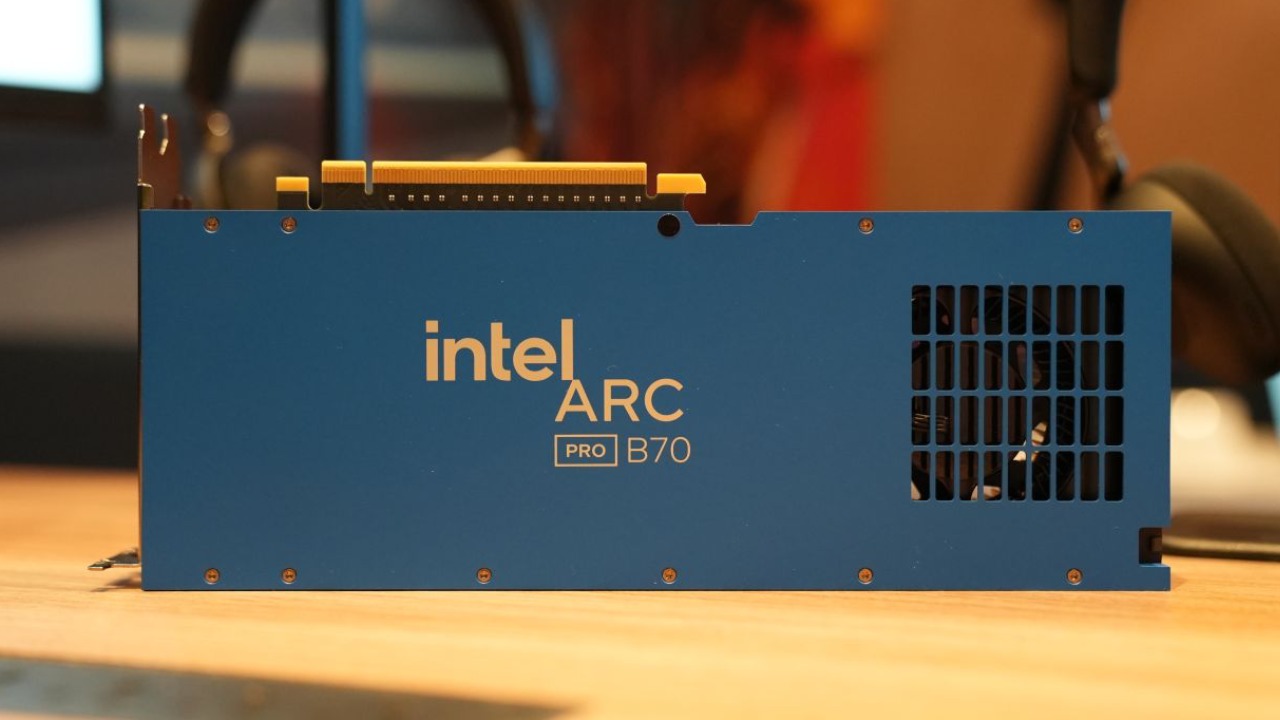
Intel Arc Pro B50 and B70 Specifications
B70 appears to be what was previously expected to arrive as the rumored B770. The bad news is that it isn't coming as a consumer card. The good part is that it is at least coming to light, which confirms it exists. If the current memory supply situation ends reasonably soon, there could still be a chance of seeing something like it someday. It also means Intel has not abandoned GPUs.
Everything Intel does that shows it is still making GPUs is encouraging because we must not have a monopoly in this space. B50 and B70 come with 20 and 32 ray-tracing units, respectively, along with 162 and 252 vector engines. The B70 also has higher clock speeds, making it the larger of the two configurations.
Both cards use PCIe Gen 5 x16 and feature 256-bit memory interfaces with 32GB of GDDR6 memory. That 32GB of memory is notable for a GPU expected to sit below $1,000. That capacity could make these cards useful for workloads where enough memory matters more than the fastest possible memory.
These GPUs could potentially end up in dual-GPU setups. It is pretty clear what Intel is trying to do here. Intel is trying to get home lab people running Arc and optimizing their AI workloads for Arc so that, in the longer term, its data center accelerators will have people familiar with how to use them. That seems pretty smart.
Memory Capacity and AI Workloads
An important distinction exists between memory capacity and memory speed in AI workloads. We covered this in more detail when looking at older data center AI accelerators. Capacity and speed are related, and the importance of each depends on the workload.
For certain AI workloads, memory speed matters a great deal. That is why high-bandwidth memory stacks sit right next to the die on some data center accelerators. From what we can remember, much of the difference comes down to training versus inference. You want the speed for training. For inference, or actually using the models, memory speed matters less.
If there isn't enough memory, performance can drop dramatically because the system starts swapping data to storage. Faster memory might make inference a little faster, but not having enough memory can cause performance to drop because the system suddenly has to swap to storage.
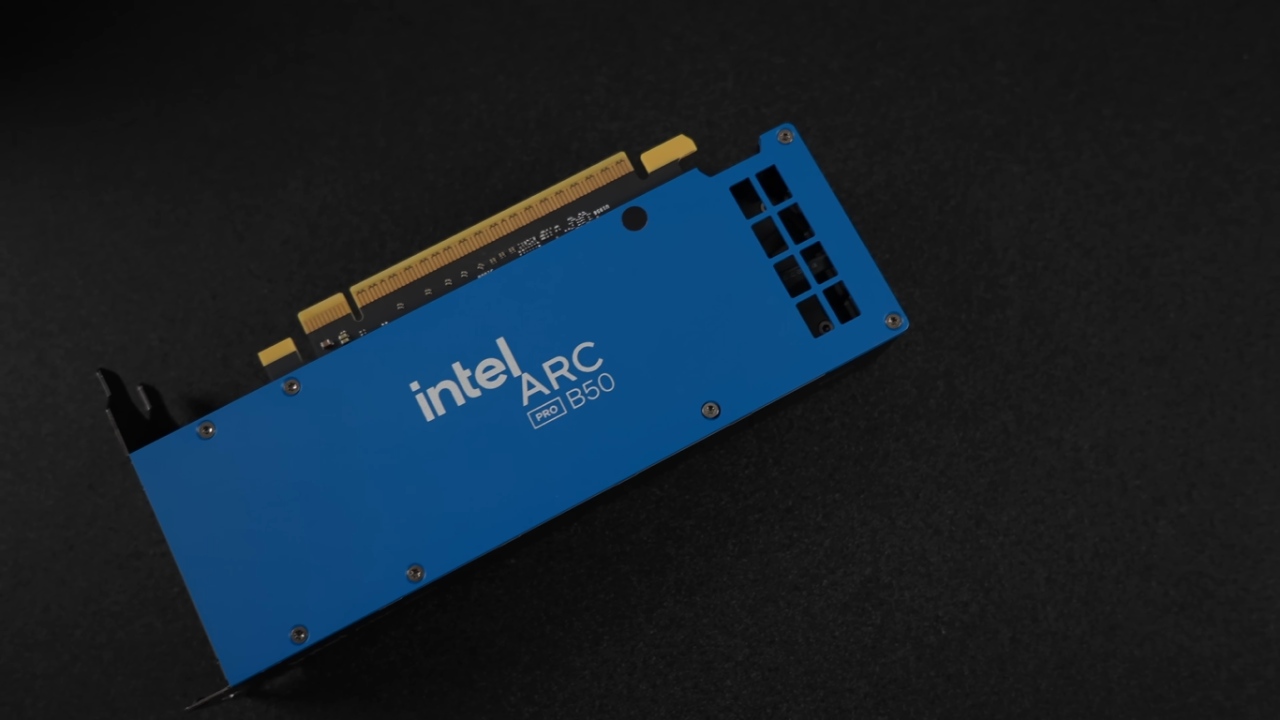
For home lab workloads, 32GB of memory can be appealing even when it's not as fast as HBM.
GDDR6 won't be the end of the world for these workloads, and the 256-bit bus will help. Intel quotes total memory bandwidth of around 608 GB/s. That is not industry-leading by any stretch of the imagination. Still, with this much memory for what people are trying to do at home, where they are not operating at an industrial scale, the capacity could be more useful.
The ability to keep larger models in memory can matter more than a small gain in inference speed. Arc Pro B50 and B70 also indicate that Intel is continuing to develop GPUs. We don't have a consumer B770 here, but the existence of a 32 Xe-core configuration shows the underlying hardware direction hasn't disappeared.
For home lab users working with AI workloads, the combination of 32GB of GDDR6, a 256-bit memory interface, and PCIe Gen 5x16 gives these professional GPUs a configuration that could fit workloads where memory capacity is a priority.
Editor, NoobFeed
Gaming Hardware Updates
No Data.