
AMD Ryzen 7 9700X vs. Intel Core i7-14700K: Gaming, Power & Win 11 Scaling
Benchmarking revealed consistent improvements in performance scaling for AMD on newer Windows versions.
Hardware by Masaru Hoshino on Aug 10, 2025
AMD made some bold claims prior to the release of Ryzen 7 9700X, regarding the gaming performance of its new Zen 5 processors, particularly Ryzen 7 9700X. One notable claim suggested the 9700X would be 6% faster than Intel's Core i7-14700K.
However, AMD later walked back this statement in a community blog post, clarifying that if 14700K is run using the Intel Extreme Performance Profile and high-speed memory (as is standard in most reviews), then 9700X is merely on par with 14700K.
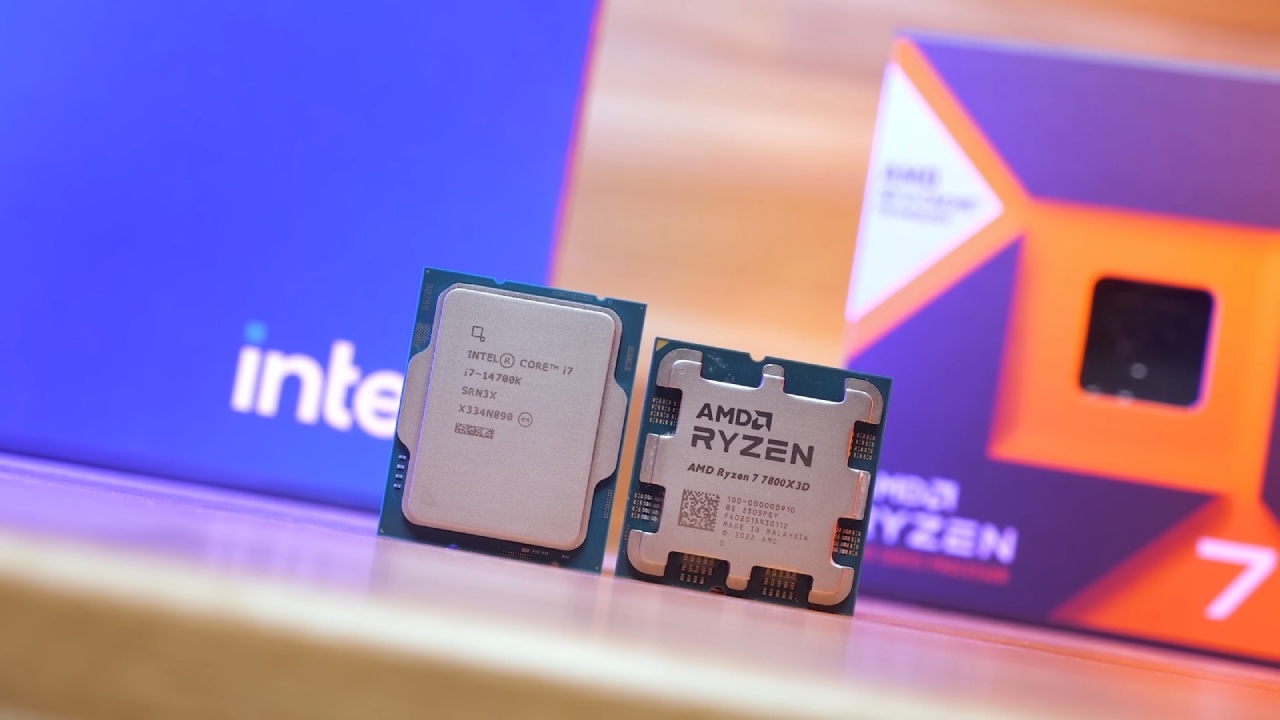
This strongly suggests that AMD's original marketing leaned on what could be considered nerfed Intel performance, likely using a 125W profile not intended for K-series parts, according to Intel.
Still, claiming equal gaming performance with 14700K is bold, considering we found 9700X to be 5% slower in our day-one review.
To verify and expand on those results, we compared the two CPUs across more than 40 games using both the current Windows 11 23H2 build (without the recent patch) and the Insider Preview 24H2 build.
Test System Specs
For testing, we used Core i7-14700K with the latest BIOS, microcode update, and Intel Extreme Profile enabled—setting PL1 and PL2 to 253W. The AMD platform was also updated to BIOS version F33b for optimal performance comparison.
Game Benchmarks
In Assetto Corsa Competizione, both CPUs offered similar performance under Windows 11 23H2, but the 14700K had 7% higher 1% lows. Under 24H2, the 9700X gained an 8% performance boost, pulling ahead.
Halo Infinite showed a 4% improvement for 9700X under 24H2, bringing it closer to 14700K.
In F1 24, 9700X edged out 14700K by 4% on 23H2 and widened the lead to 9% on 24H2.
With Call of Duty: Modern Warfare III, performance was largely unchanged across Windows versions, but 9700X still managed to be 6% faster on average.
Microsoft Flight Simulator 2020 showed a major regression on 23H2 for Ryzen, where 9700X was 13% slower. This was corrected under 24H2, bringing the CPUs to parity.
In Spider-Man Remastered, 9700X was 15% slower on 23H2, improving to 9% slower with 24H2.
A Plague Tale: Requiem saw 9700X go from 3% ahead on 23H2 to 9% ahead on 24H2.
Ghost of Tsushima showed a reversal—4% slower for 9700X on 23H2, but 2% faster on 24H2.

Cyberpunk 2077: Phantom Liberty mirrored Flight Simulator. 9700X went from 6% slower on 23H2 to matching 14700K on 24H2.
Borderlands 3 gave 9700X a 10% performance boost on 24H2, although the 1% lows were still weaker than Intel's.
In Baldur's Gate 3, 24H2 brought no change, and 9700X remained 12% slower.
Black Myth: Wukong showed parity in average frame rate under 24H2, though 14700K maintained 10% better 1% lows.
Both CPUs saw a 3% uplift in Hitman 3 under 24H2, but 14700K still held a 12% lead.
In Total War: Warhammer III, 9700X narrowed the gap from 8% to 5% using 24H2.
Returnal showed no performance difference between CPUs regardless of the Windows version.
Hogwarts Legacy delivered huge gains on 24H2. 9700X saw a 177% uplift, reducing the performance gap from 14% to 6%.
Star Wars Jedi: Survivor was notable—initially a 6% lead for 14700K on 23H2, which grew to 11% on 24H2 due to a 20% performance jump for Intel.
Dying Light 2 showed a consistent 9% lead for 14700K across both versions of Windows.
The Last of Us Part I saw the Intel CPU extend its lead from 8% to 10% under 24H2.
In Fortnite, 9700X saw a large 14% gain under 24H2, giving it a solid lead as Intel showed no improvement.
Starfield was a different story, with 14700K showing 177% better performance—clearly a win for Intel here.
Watch Dogs: Legion saw a 9% deficit for 9700X on 23H2 and is still 7% slower even after a 9% boost under 24H2.
Remnant 2 went from a 13% lag to near-parity under 24H2, similar to other titles that had issues on 23H2.

In Horizon Forbidden West, 9700X was consistently 7% slower.
The Riftbreaker showed a 13% deficit for 9700X on 23H2, which was reduced to 6% on 24H2.
9700X vs. 14700K on Windows 11 23H2
Across 42 games, 9700X was 5% slower than 14700K using Windows 11 version 23H2. In 23 titles, it lagged by 6% or more, with 13 games showing double-digit losses. Clearly, 9700X trails Intel under this Windows version.
9700X vs. 14700K on Windows 11 24H2
Even after upgrading to 24H2, 9700X remained slower—but the gap narrowed to just 3%. While AMD's marketing suggests parity, it's more of a stretch. Still, performance is close enough that many would let that claim slide, especially with cherry-picked benchmarks.
Intel Performance Scaling with 24H2
The biggest performance gains for Intel under 24H2 were seen in Homeworld 3, Gears 5, and Star Wars Jedi: Survivor. However, these were outliers. Gains were within 5% in more than 80% of the tested games, with 14700K seeing an average modest 3% increase.
AMD Performance Scaling with 24H2
The improvement in Ryzen under 24H2 was more notable, with an average increase of 7% for 9700X. Performance discrepancies in a number of titles were fixed or reversed by this patch, which favored AMD.
Power Consumption Comparison
Power testing using 23H2 revealed massive differences. In Baldur's Gate 3, the 9700X consumed 84W, while the 14700K drew 171W—104% more power for a 133% performance gain.
In The Last of Us Part I, Intel was 8% faster but used 127% more power. Cyberpunk 2077 showed a 7% performance gain for Intel at the cost of 129% more power. This highlights a key challenge for Intel's 13th and 14th-gen chips: high power draw for modest gains.

Final Thoughts: Which CPU Should You Buy?
Although 9700X and 14700K are positioned as direct competitors, we don't recommend buying either. 14700K costs at least $380, and 9700X sits around $340.
If you're chasing top-tier gaming performance, it's better to spend a little more and grab 7800X3D. However, this option is currently hard to find in stock.
If 7800X3D isn't available, the smarter move is to go with 7700X, which offers roughly the same gaming performance as 9700X but at just $270, or as low as $250 on Amazon. That's up to 26% cheaper for similar results, making it the better value by far.
9700X is a solid gaming CPU, especially given its efficiency, but its price holds it back. If it dropped to around $280, it'd be easier to recommend. As for 14700K, the high-power usage and unresolved stability concerns make it a difficult choice right now.
Check Our Other AMD articles:
- AMD Ryzen 9 9950X3D Review: Setting The Standard For 2025 Gaming CPU
- AMD Ryzen 7 9800X3D Review: 3D V-Cache Goes God Mode with Stunning Gaming Performance
- AMD RX 9070 Performance Review: Thermals, Clocks, and Real-World FPS
- AMD Ryzen 5 7600 Review: Best Budget Gaming CPU of 2025?
- AMD Radeon RX 7800 XT Review: RDNA 3 Power For Midrange Gaming
- Sapphire NITRO+ AMD Radeon RX 9070 XT Review: The Ultimate 4K Gaming GPU
- AMD Ryzen 7 7800X3D: Delivers Gaming Performance Far Beyond Expectations
- AMD Ryzen 9 7900X Review: Powering the AM5 Era with DDR5 & PCIe 5.0
- ASRock Radeon RX 7800 XT Challenger OC Review: Best Price-to-Performance GPU of 2025
- Intel Core i9‑14900K vs. AMD Ryzen 7 7800X3D: Power Profiles & Gaming Benchmarks
Editor, NoobFeed
Gaming Hardware Updates
No Data.