
Nintendo Switch 2 Job Post Hints at Docked VRR Upgrade Soon
A newly discovered Nintendo job listing suggests the company may still be working to bring Variable Refresh Rate support to Switch 2's docked mode through a future firmware update.
News by Wasbir Sadat on Jul 11, 2026
Nintendo Switch 2 owners may have a new cause to feel positive about one of the console's most desired missing features. A recently posted Nintendo job description has fueled rumors that Nintendo is working to implement Variable Refresh Rate (VRR) functionality for the console while docked.
Go Nintendo came across a new job opportunity for a display engineer with experience troubleshooting VRR-related issues at the HDMI-to-DisplayPort interface. While the job listing doesn't directly reference the Switch 2 or any forthcoming feature upgrade, it is very much in line with Nintendo Switch 2's most significant unresolved hardware limitations.
.jpg)
When Nintendo announced the Switch 2, it confirmed support for variable refresh rate, a display technology that dynamically adjusts a screen’s refresh rate to match a game’s frame rate.
This helps smooth out gaming by decreasing screen tearing and motion judder when the performance fluctuates. When VRR launched, it was only available in handheld mode. Nintendo's own FAQ before launch said this would be available even with the console docked, which was abruptly deleted just before launch, leaving many fans wondering what happened.
Nintendo has never revealed why this choice was made. Still, the recently unearthed job listing has spurred speculation that docked VRR was only delayed due to technical issues rather than completely abandoned. The listing says Nintendo is looking for an engineer with experience troubleshooting VRR connectivity issues across HDMI and DisplayPort.
This need has many fans believing that the company is trying to work around the compatibility concerns that kept the docked VRR from being released with the system. Several community members observed the historically challenging implementation of HDMI-to-DisplayPort VRR functionality. Nintendo may have deemed the various stability issues experienced even by devices like Valve’s Steam Deck (which supports VRR with compatible docks) undesirable for one of its own products.
If Nintendo is staying true to its historic focus on reliability, it would make sense for the firm to hold off introducing the functionality until it’s able to provide a uniform experience across different televisions and display sets. The job listing doesn’t suggest docked VRR is on the horizon, but it’s one of the most tangible signs to date that Nintendo is still working on the problem behind closed doors.
There are also other cases of Nintendo adding huge features far after a console’s launch.
At its debut, the original Nintendo Switch didn't support Bluetooth audio, so users had to settle for wired headphones or third-party devices. Years later, Nintendo released a firmware upgrade that eventually allowed native Bluetooth audio, vastly boosting the console’s wireless capabilities. That example has led many gamers to think that docked VRR may take a similar route.
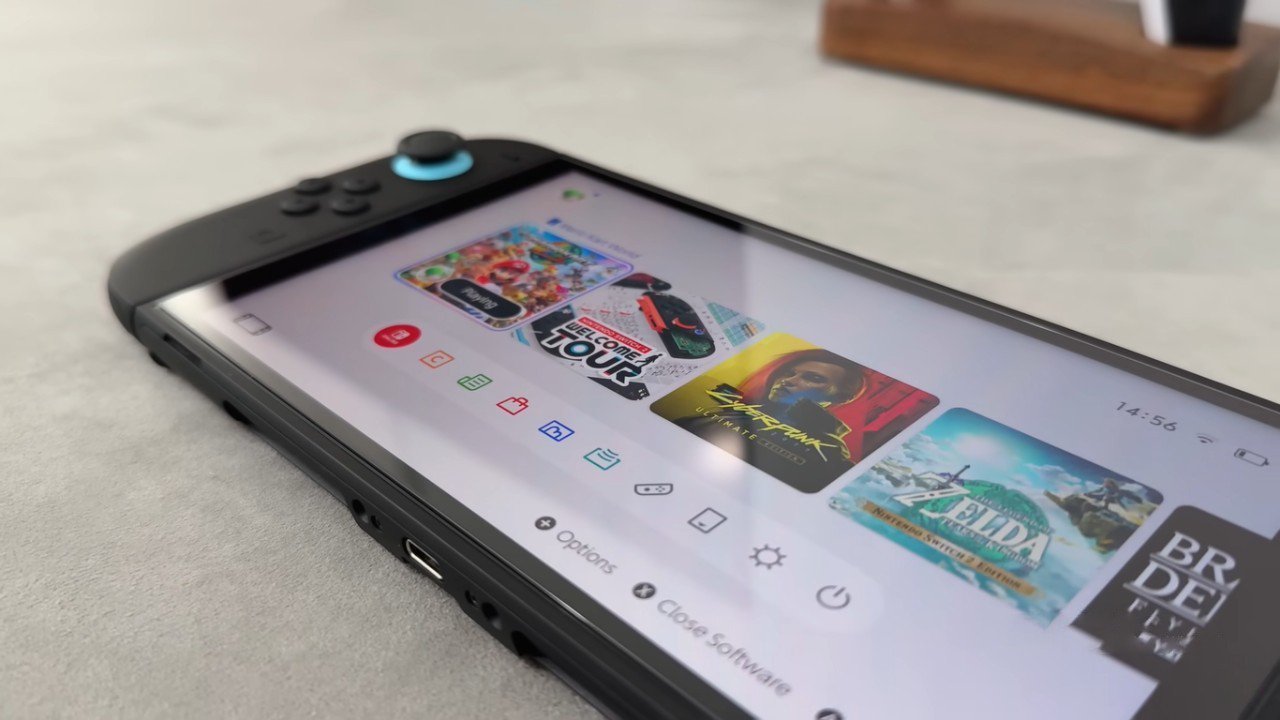
If the core technical challenges can be overcome, the functionality could be incorporated into a future system software update without requiring any hardware redesign. The inclusion of docked VRR in Nintendo's pre-launch FAQ (before it was removed) further indicates that the business had planned to offer the feature originally but concluded it wasn't ready in time for release.
Variable Refresh Rate doesn't boost a game’s frame rate, but it does make gameplay look much smoother while performance fluctuates. Traditional displays tend to run at fixed refresh rates, such as 60Hz or 120Hz. If a game suddenly drops from 60 fps to 45 fps or so, the display can cause screen tearing or noticeable stutter. The refresh rate no longer lines up with the game's output.
VRR largely fixes that issue by allowing the display to dynamically match its refresh rate to the console's framerate in real time. When performance dips, the display compensates in real time, leading to smoother animation and fewer annoying visual artifacts.
This Upgrade can be especially useful in graphically intensive games, where the frame rate will naturally vary as you run around large environments or play through hectic sections.
Docked VRR is poised to help titles that push the Switch 2’s hardware the hardest, especially for players who are sensitive to frame-pacing anomalies and screen tearing. VRR wouldn’t be a silver bullet for overall performance, but it’s a major quality-of-life improvement that makes existing games seem noticeably smoother during demanding moments.
Nintendo has not made any formal declaration about docked VRR support at this time. But the timing and technical specifics of the company’s recent engineering job posting strongly suggest the functionality remains under active investigation. Until Nintendo releases confirmation, users should consider the finding an encouraging sign rather than solid proof. Still, it’s one of the clearest signs yet that docked VRR may eventually arrive via a future firmware update.
Contributor, NoobFeed
Related News
No Data.