
Tides of Tomorrow Review
PlayStation 5
DigixArt delivers an ambitious post-apocalyptic adventure where your decisions don’t stop with you, creating one of the most unusual choice-driven experiences in years.
Reviewed by Maisie Scott on Apr 23, 2026
DigixArt has spent the last few years building a reputation for narrative games that treat player agency as more than a branching checklist, and that history matters when looking at Tides of Tomorrow. The studio’s earlier success with Road 96 showed a clear interest in fragmented storytelling, layered consequences, and player-driven momentum rather than traditional adventure game rigidity.
That same philosophy forms the backbone of Tides of Tomorrow, though this project takes those ideas much further and in far stranger directions. Rather than simply iterating on established formulas, Tides of Tomorrow arrives as a game trying to challenge the structure of choice-driven storytelling itself.
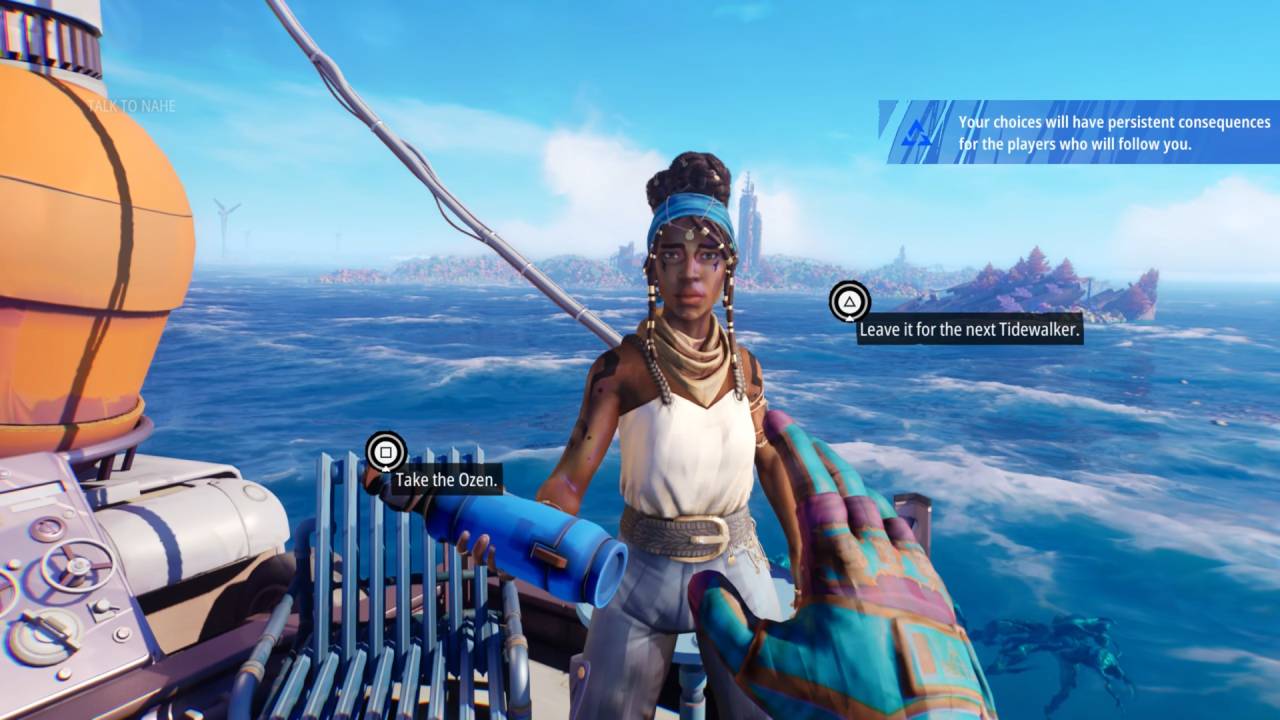
In a genre where “your choices matter” has become a common selling point, DigixArt approaches that promise from a different angle by making your decisions part of a larger shared system. It is not simply about what happens because of what you choose, but also about what happens because of what somebody else chose before you arrived.
That central idea gives Tides of Tomorrow a distinctive quality. It also reflects a developer willing to experiment at a time when many narrative games lean heavily on familiar frameworks. Even before the world, story, or mechanics fully reveal themselves, the game carries the sense that it is attempting something riskier than most of its peers.
That ambition starts showing almost immediately.
Tides of Tomorrow opens beneath rising water in a drowned future, introducing its unusual setting and defining system. Before truly beginning your journey, you select another player to follow, inheriting traces of their decisions, consequences, and world state. This adventure is not framed as a gimmick layered over a conventional adventure. It is fundamental to the game's functioning.
Through what the game calls its Story Link, or inheritance system, other players’ actions can alter your experience in meaningful ways. A prior player may have earned your trust through a settlement, leaving you feeling welcome rather than challenged. They may have consumed scarce resources, forcing you into tougher decisions. They may have angered entire factions and left you walking into consequences that were never originally yours.
That structure creates a form of shared storytelling that feels genuinely unusual. Importantly, the mechanic is not as chaotic or opaque as it may sound. Tides of Tomorrow does a strong job communicating inherited consequences through visual traces, contextual clues, and systems that let you understand how earlier decisions shaped your circumstances.
Rather than feeling random, it often feels like stepping into an evolving narrative midstream and contributing your part before handing it onward.
The effect is often very strong. Even when inherited choices don't completely change your path, they do change things in small ways that keep the idea alive. Sometimes that shows up in big ways, like when relationships change or chances are missed.
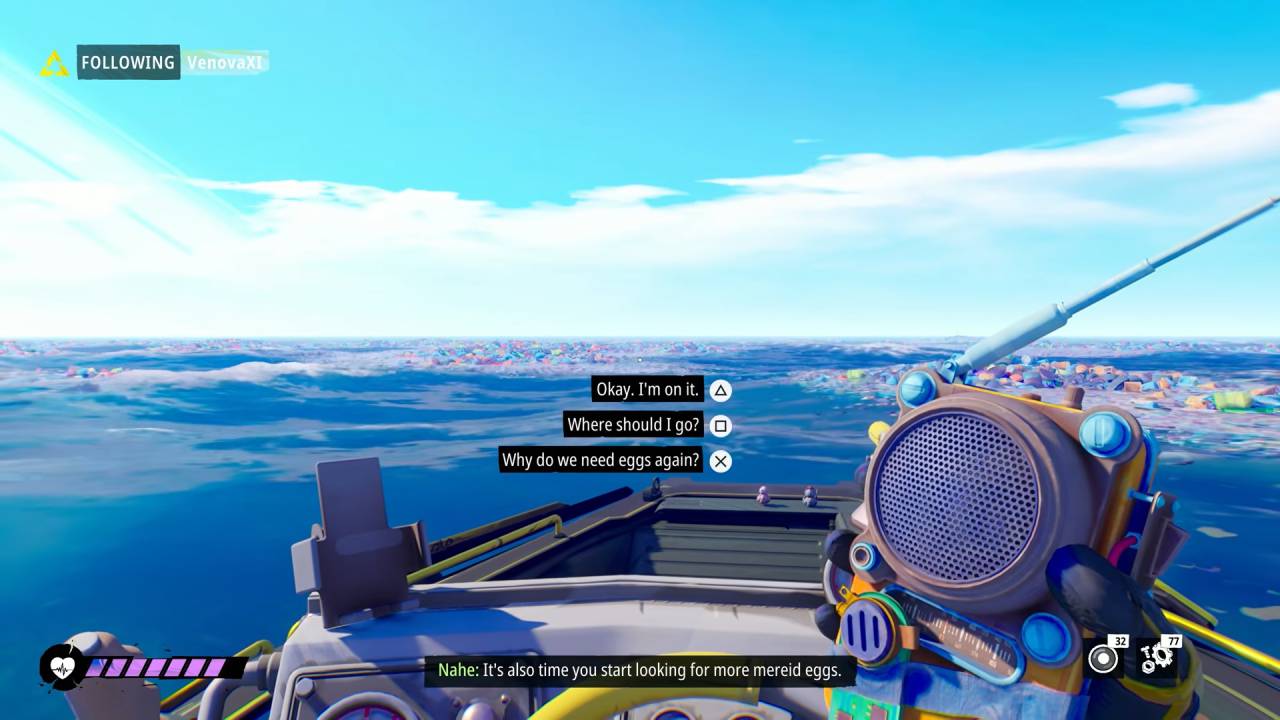
Sometimes it shows up in smaller, almost invisible ways, like when resources are available, when the way people talk to each other changes, or when moral choices have more weight because another player might get the results.
The game's setting does a great job of supporting these ideas. Tides of Tomorrow is set in a world where the environment has collapsed, and most of civilization has been submerged. Only a few small communities survive on floating settlements, salvaged platforms, and makeshift island societies.
Plastic waste has become part of the ecosystem and, through the disease plastia, part of humanity itself. Rather than leaning into familiar mutant apocalypse tropes, the game builds a world where contamination manifests through slow bodily transformation into synthetic material, an idea both strange and unsettling.
That moral tension gives the narrative much of its identity. The story consistently asks what responsibility looks like in a collapse, not only toward the people around you but also toward strangers who may follow. It is one of the few games where the idea of inheritance is woven so directly into both mechanics and theme.
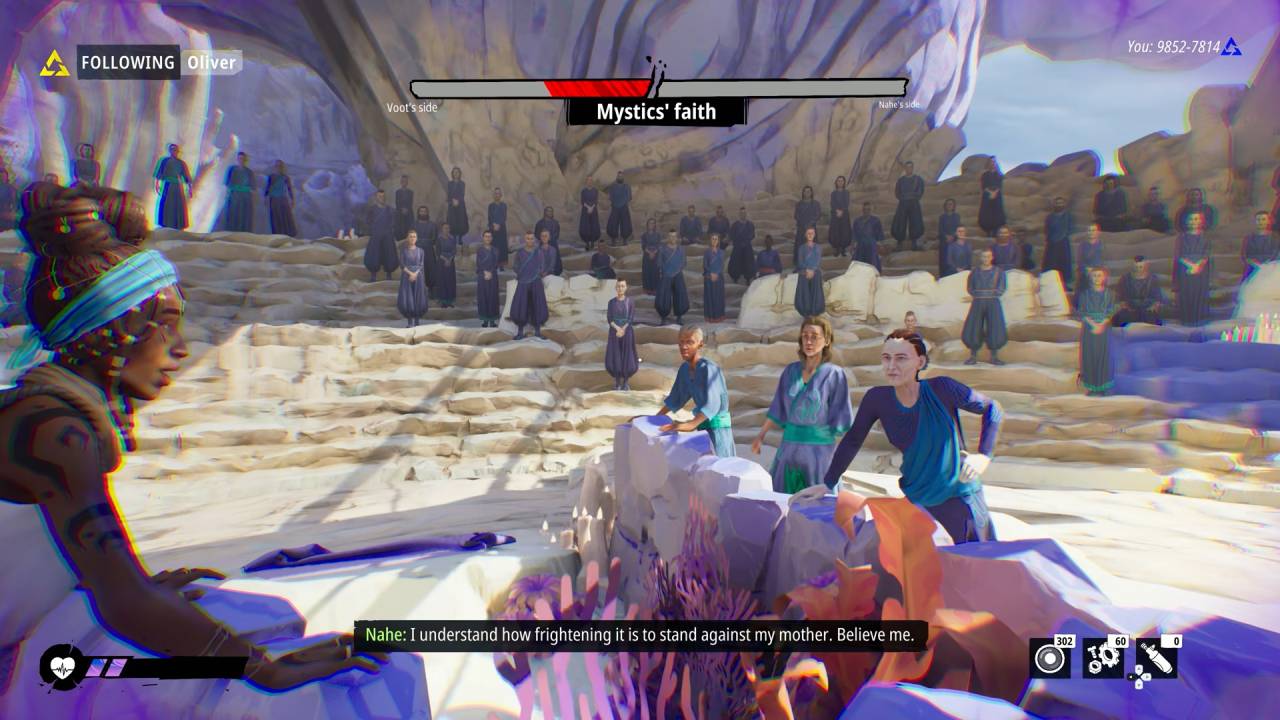
The supporting cast and factions help sustain that premise, even if characterization can be uneven. Some friends and enemies make a big impression through their beliefs and conflicts, especially when they have to do with faith, the environment, and control of resources. The game has themes that deserve more than what some characters get.
That can sometimes cause a disconnect, especially in a game that asks players to care about the choices they make that affect those relationships.
There are also times when the writing doesn't quite support the scale of its choices. Some choices carry real emotional weight, while others seem too easy to forget or fit into the larger story. It doesn't ruin the experience, but it can make the game's sense of consequence less strong at times.
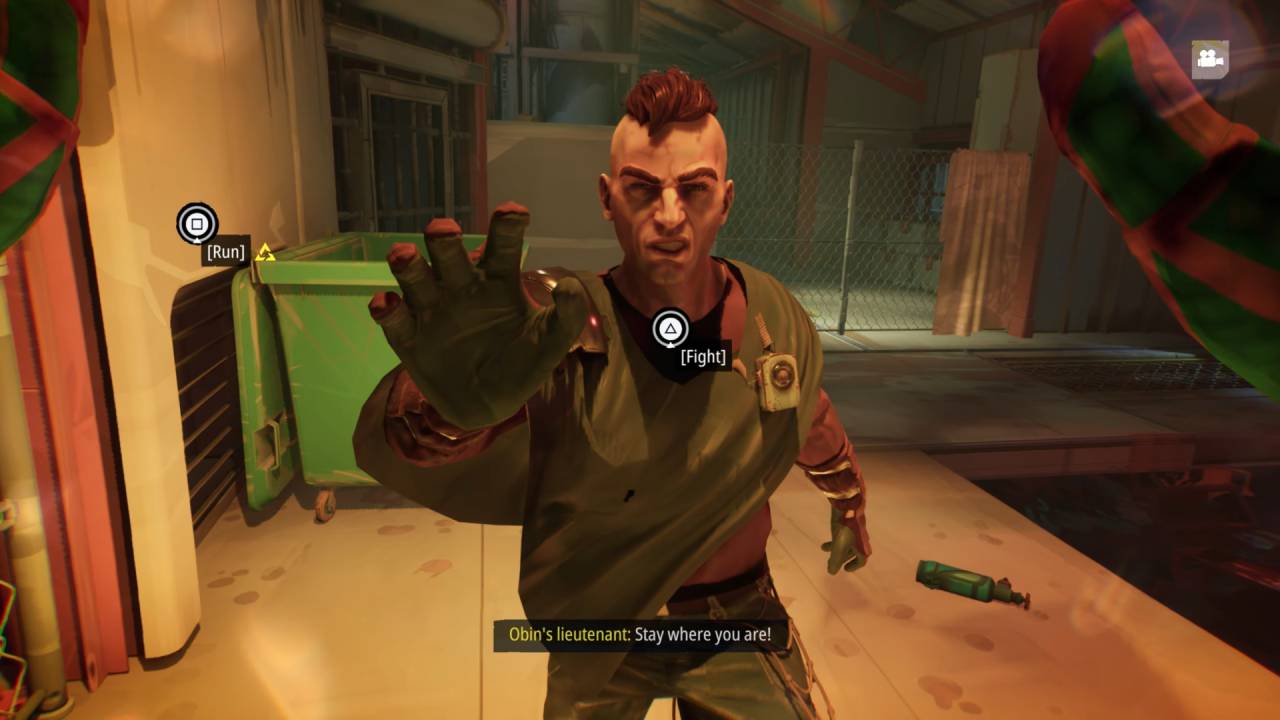
Still, even with those inconsistencies, the larger storytelling experiment remains engaging because the central shared-choice concept keeps adding tension to even ordinary interactions. Decisions rarely feel isolated.
Outside its narrative systems, Tides of Tomorrow folds in more traditional gameplay than many may expect from a choice-driven adventure. Traveling by boat is a big part of progress because it works as both a way to get around and a mechanical layer. You go from one island to another, look for optional places, pick up scrap, and sometimes fight with light naval ships.
These fights are pretty easy, just dodging and shooting back, but they break up the action nicely.
Boat racing is also in the game, and sometimes you can even race against the recorded traces of players you follow. These moments can feel unexpectedly playful in a game that deals with serious subjects, but they add variety and keep the experience from getting too repetitive.
On-foot exploration includes light stealth, platforming, scavenging, and environmental interaction. You sneak through guarded areas, search settlements for supplies, climb through layered spaces, and occasionally repair or leave behind environmental advantages for later players. That last mechanic quietly reinforces the game’s collaborative identity in elegant ways.
None of these systems is especially deep, and that becomes one of the game’s recurring trade-offs. They function well enough to support the broader experience, but they rarely evolve into standout mechanics in their own right. Stealth remains straightforward. Platforming is largely serviceable.
Exploration often feels more atmospheric than systemically rich.
Whether that feels limiting will depend on what you want from the game. For some, these systems will feel appropriately lightweight, supporting the story. For others, they may seem underdeveloped, especially when the world feels rich enough to support deeper optional content.
Progression largely avoids conventional RPG structure, and that choice suits the game. There is no traditional XP grind driving advancement. Instead, progression emerges through resource management, moral alignment, relationships, and branching outcomes. Scrap acts as currency, Ozen serves as both a survival mechanic and a narrative pressure point, and your repeated choices gradually shape personal traits that influence outcomes.
That design keeps progression tied to roleplaying rather than numerical escalation. It also makes the game’s multiple endings feel connected to accumulated behavior rather than checklist completion, which fits the experience far better than a traditional leveling model would have.
World-building remains one of the strongest reasons to stay invested.
The floating communities feel like they are shaped by different beliefs, not just like interchangeable quest hubs. Factions show different ways of dealing with collapse, like authoritarianism, spirituality, survivalism, or community. The ideological texture makes the setting feel like it has real conflict.
Tides of Tomorrow also looks different from most other post-apocalyptic games. Instead of using familiar colors like ash and rust, it uses bright, sometimes strange colors against polluted waters and fake decay. It can be visually chaotic at times, but it rarely feels generic. The flooded world has a strong identity.
Sound design supports that atmosphere well. The soundtrack shifts between ambient, electronic, and regionally flavored music, helping settlements feel culturally distinct. Environmental audio does a great deal of immersion work. Voice acting is less consistent. Some performances work well, while others can feel stiff during moments demanding emotional precision. In a game with a lot of talking, it's easy to see when people don't do well.
The game doesn't always show how your choices affect the story after it's over, which is one area where it feels a little unfinished. Given how heavily the entire experience relies on consequences and inherited outcomes, stronger post-game breakdowns or more robust decision-tracking would have added valuable closure.

It feels like a missed opportunity in a game so invested in looking at the chain of cause and effect.
Even so, Tides of Tomorrow leaves an impression because it attempts something few narrative games dare attempt. Its ambition matters. Even where some systems feel thinner than they could be, the shared storytelling structure consistently gives the game an identity that carries beyond individual mechanics.
At its price point, Tides of Tomorrow feels worthwhile for players interested in narrative games willing to push structure in unusual directions. It won't appeal to everyone, especially those who want more traditional adventure pacing or deeper action systems. But for players who like to try out new ways of telling stories, it has ideas that are refreshingly different.
Tides of Tomorrow may not completely change the genre, but it does add a lot to what choice-driven games can look like. In a field where consequences are often fake, it offers a version of consequence that really feels shared. That alone makes it one of the more compelling narrative experiments in recent memory.
Editor, NoobFeed
Verdict
Tides of Tomorrow occasionally stumbles in execution, but its shared-choice storytelling, striking setting, and willingness to experiment make it a compelling and inventive narrative adventure well worth experiencing.
80
Related News
No Data.