
Kingston Fury Renegade G5 Review: A Powerful Gen 5 SSD With Consistent Performance
Structured breakdown of thermal characteristics and cooling requirements necessary for maintaining consistent high-speed Gen5 SSD operation
Hardware by Tanvir Kabbo on Dec 20, 2025
Kingston's first Gen 5 SSD, the Fury Renegade G5, enters a market where its older Gen 4 products, like the KC3000 and the original Fury Renegade, have always performed well at a fair price. The major question here is whether the newest G5 model can keep that balance of value and performance.
Design and Specifications
The drive is available in 1TB, 2TB, 4TB, and 8TB capacities. It is sold without a proper heatsink, with only a sticker serving as a heat spreader. Cooling is still recommended for this drive.
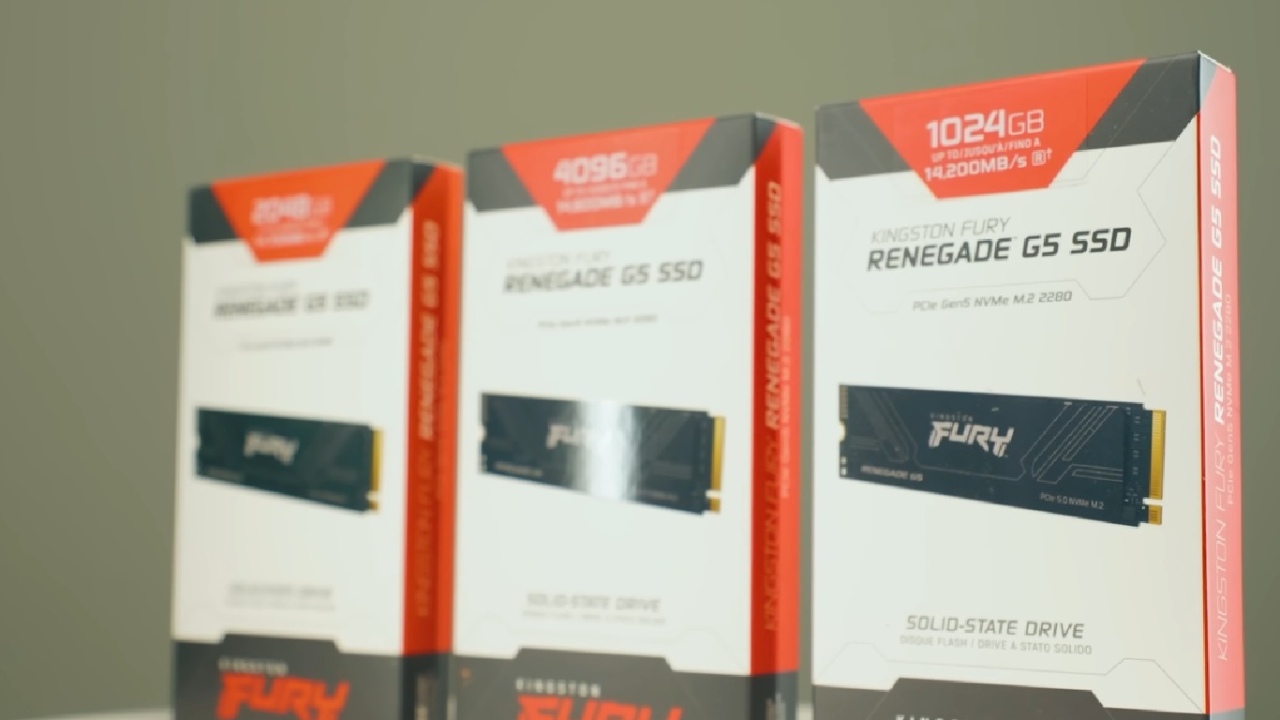
Kingston clearly states that the 1TB to 4TB models are single-sided, while the 8TB model is double-sided. The Silicon Motion SM2508 controller is specifically mentioned as well as the presence of DRAM cache.
Memory-wise, Kingston only notes that it uses 3D TLC NAND. Still, the tested unit uses Kioxia BICS8 NAND, similar to the Corsair MP700 Pro XT SSD and the WD SN8100. Performance is listed with "up to" numbers, so you shouldn't assign too much weight to those.
The endurance rating is 1,000TB of total writes per 1TB capacity, which is well above the typical 600–700 range. This doesn't guarantee the G5 will last 50% longer than other drives, but these numbers matter when claiming a warranty. If you write a large amount of data daily, this could be a benefit for you.
PCMark10 Quick Benchmark
The PCMark10 fast benchmark is a suite of tests that mimic common PC activities, such as opening documents, viewing pictures, and loading games. Even though these jobs don't need a high-end Gen 5 SSD, performance is still important. The G5 averaged 982 MB/s here.
This puts it near the top with drives like the 9100 Pro and the T705, and it is far better than its Gen 4 predecessor. It comes after the SN8100, which has the same controller, and the MP700 Pro XT, which has a newer Phison controller.
PCMark10 Full Suite
The full PCMark10 suite simulates more demanding workloads and is ideal if you plan to use the drive as your main disk or for heavier applications.
In this test, the Fury Renegade G5 moves up a few spots to third place, ahead of the T710 and 9100 Pro and just behind the SN8100. The MP700 Pro XT sits further ahead. Latency results are consistent with expectations, placing the G5 near the top.
Consistency Test
The consistency test puts the drive through a long, heavy workload that most people would never have to deal with. However, it still shows how the drive performs under sustained stress. The Fury Renegade G5 averaged about 1,000 MB/s, which is a lot better than the MP700 Pro XT, which drops off significantly in this case.
The G5 also beats the SN8100, putting it in a good spot. If you care most about how well a drive performs under heavy loads, though, E26-based drives or the Samsung 9100 Pro are still superior options.
.jpg)
3DMark Storage Benchmark
3DMark Storage pretends to do things that are relevant to gaming, like loading games, installing them, recording gameplay, and rearranging game folders. This benchmark is quite crucial if you want to use the SSD mostly for gaming.
Kingston G5 comes in fourth position. It is a little below the top three, but it is still ahead of drives like the P51 Platinum, T75, and 9100 Pro. The G5 stays in fourth place when you look at the most crucial gaming tasks, including loading, installing, and upgrading games.
Sequential Read and Write Performance
Sequential performance doesn't represent real-world use as well as other benchmarks, but it is still useful in certain scenarios. Many Gen 5 SSDs push the limits of the interface, placing the top drives very close together in both read and write speeds.
Fury Renegade G5 manages to take the number-one spot in sequential writes and performs well in sequential reads. It exceeds Sony's read-speed requirement for PlayStation 5, but since the PlayStation doesn't support Gen5 speeds, buying a Gen5 SSD for it makes little sense. You're much better off choosing a mainstream Gen4 DRAM-based SSD.
Thermals and Cooling
The SM2508 controller is more efficient than earlier Gen5 controllers, but it can still get hot and throttle under heavy load. You'll want to use a heatsink—either the one on your motherboard or a simple third-party option. Any basic model for a few dollars will work fine.
.jpg)
Pricing
Pricing for Gen 5 SSDs remains complicated. These drives are still expensive overall, and the Fury Renegade G5 is relatively new, keeping prices higher than ideal. It will take time for costs to stabilize. In the US, the 2TB G5 is priced higher than the SN8100 or Samsung 9100 Pro, making it hard to justify the extra cost. The 4TB model sits in an even tougher spot.
However, the 8TB models are more interesting. Many drives don't offer this capacity, and the 8TB Fury Renegade G5 is currently one of the most affordable 8TB Gen5 drives available. Still, you should ask yourself whether you need an 8TB Gen5 SSD when a Gen4 option like the SN850X is significantly cheaper. For most people, a Gen4 drive is more than enough.
Final Thoughts
Whether the Fury Renegade G5 makes sense depends entirely on pricing in your region at the time you buy it. SSD prices fluctuate often, so you should always check current listings before purchasing any storage. Any drive can be worth buying if the price is right.
If the G5 is cheaper than its competition, it's absolutely worth considering. It's not the fastest Gen 5 SSD out there, but it does well on all tests and is a strong, well-rounded high-end Gen 5 drive. If you can find it at a fair price, it's worth your time.
Also, check our other articles below:
- Intel Core Ultra 9 285K Review And Performance Breakdown (2025)
- Intel Core Ultra 9 285K vs AMD Ryzen 7 9800X3D: In-Depth Gaming Performance and Benchmark Comparison
- Intel Core i5-13400F Gaming Performance: Still Worth It in 2025?
- Intel Core i9‑14900K vs. AMD Ryzen 7 7800X3D: Power Profiles & Gaming Benchmarks
- Intel Core i9 14900K: Specs, Benchmarks, and Competitor Comparison
- Intel Core Ultra 5 245K Review: Gaming, Productivity & Power Efficiency Tested
- Intel Core Ultra 9 285 K's iGPU Gaming: In-Depth Benchmarks & Analysis
- Intel vs. AMD Gaming Laptop: Performance, Thermals & Battery Life Compared
- AMD Ryzen 7 9800X3D vs.7800X3D vs. Intel Core Ultra 7 265K: Gaming, Thermals & Price Analysis
Senior Editor, NoobFeed
Gaming Hardware Updates
No Data.