
RTX Spark Runs Alan Wake II, a Full City in Unreal Engine, and an AI Agent That Codes Itself
RTX Spark ran Alan Wake 2 with full ray tracing while showcasing an early build of DLSS 4.5 ray reconstruction.
Games by Naheyan Tahmin on Jul 12, 2026
NVIDIA recently held a series of live demos based on its new RTX Spark platform, which ran on a Microsoft Surface Laptop Ultra. These gave people an early look at how well the chip performs in gaming, content creation, and AI-driven development. The demos showed three use cases, each highlighting a different aspect of what RTX Spark can do.
The first demo showed Alan Wake II running with ray tracing enabled on RTX Spark, illustrating that the platform handles demanding gaming workloads alongside its AI and content creation capabilities. RTX Spark supports Nvidia's full suite of rendering technologies, including ray tracing, DLSS Super Resolution, and frame generation.
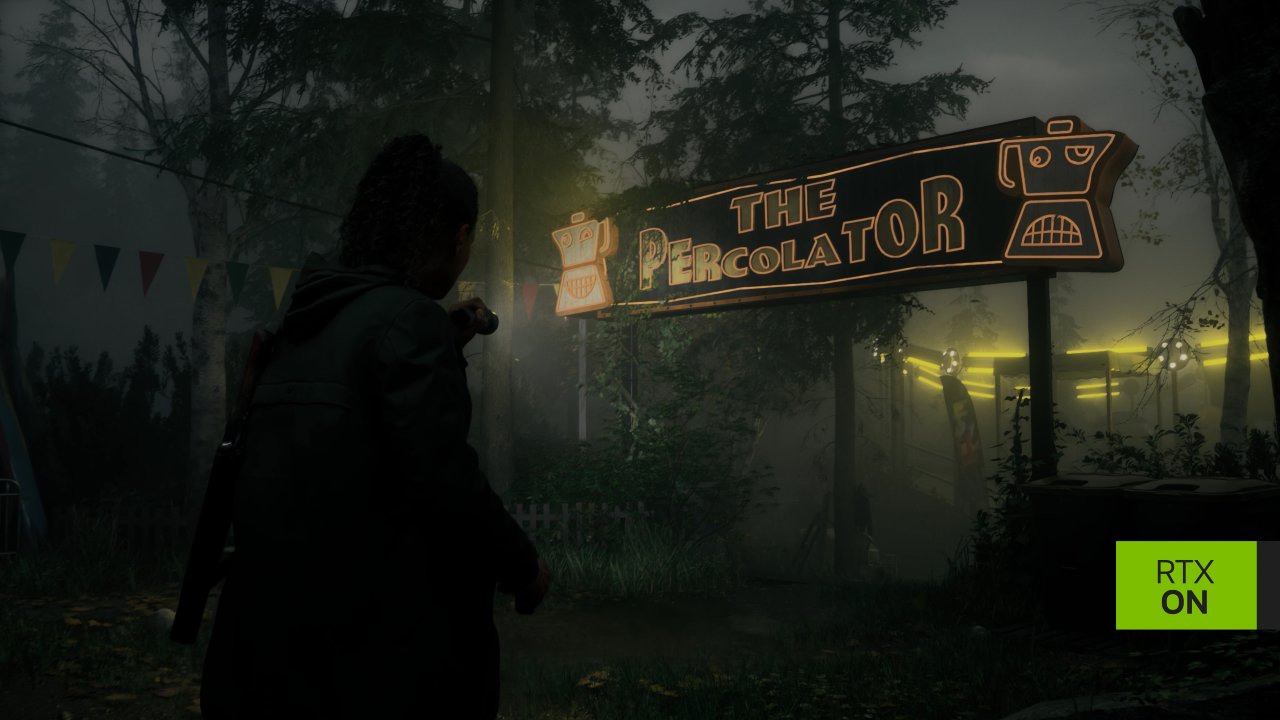
RTX Spark Runs Alan Wake 2 With Updated Ray Reconstruction
The demo specifically highlighted a difference between ray reconstruction models: an older model tends to interpret certain visual static, such as flickering on in-game television screens, as ray tracing noise and suppresses it once the camera stops moving.
The newer DLSS 4.5 ray reconstruction model, which is on track to arrive more broadly in August, preserves that static instead, restoring the original artistic intent and associated lighting effects.
Notably, DLSS 4.5 ray reconstruction was already running on RTX Spark hardware at this early stage of testing. A second demo, built in Unreal Engine, focused on RTX Spark's 128GB of unified memory and its implications for game development workflows.
Game developers typically work within smaller, unlit sections of a level at a time, since limited video memory prevents loading an entire game world at once.
AI Coding Agent Demo Shows Autonomous Bug Fixing
With 128GB of unified memory available, developers can instead work within a fully real-time lit environment without being confined to isolated sections. The demo loaded an entire city environment into memory simultaneously, using roughly 80GB of that available memory, effectively combining RTX 50-class GPU performance with a much larger memory pool than typically available on comparable hardware.
The final demonstration focused on RTX WorkWatch, a platform built specifically for running local AI coding agents. Using a custom setup with the Qwen3.6 35B-parameter model, the demo showed how a local AI agent can handle repetitive development and troubleshooting tasks that would otherwise slow down a developer's workflow.
Running the 35-billion-parameter model consumed close to 60GB of memory, leaving meaningful headroom.
The example used a real, currently maintained web application for a badminton club reservation system that had a bug causing available court slots to not display correctly, even though the system reported availability.
Using natural-language voice input, enabled by running speech-to-text and text-to-speech models locally alongside the coding model, the agent was asked to investigate issues that had emerged overnight.
The agent quickly pulled relevant information from recent code changes using connected tools and MCP servers, identified a change related to the reported issue, and was then asked to investigate and fix the specific issue directly.
The agent entered a triage phase, analyzing the full codebase and recent changes before identifying the root cause and applying a patch. Taken together, these three demonstrations show RTX Spark positioned across gaming, large-scale content creation, and local AI-driven software development.
The consistent thread across all three is the platform's large unified memory pool, which supports demanding ray-traced games, fully lit large-scale game environments, and large local language models running simultaneously alongside supporting AI tools, all on a single laptop-class device.
Editor, NoobFeed
Latest Articles
No Data.